
Is Extra Reach Worth Giving Up Some Forgiveness?
Learn when added reach, leverage and handle room outweigh the need for lateral forgiveness and quick repositioning—and which specs to compare.
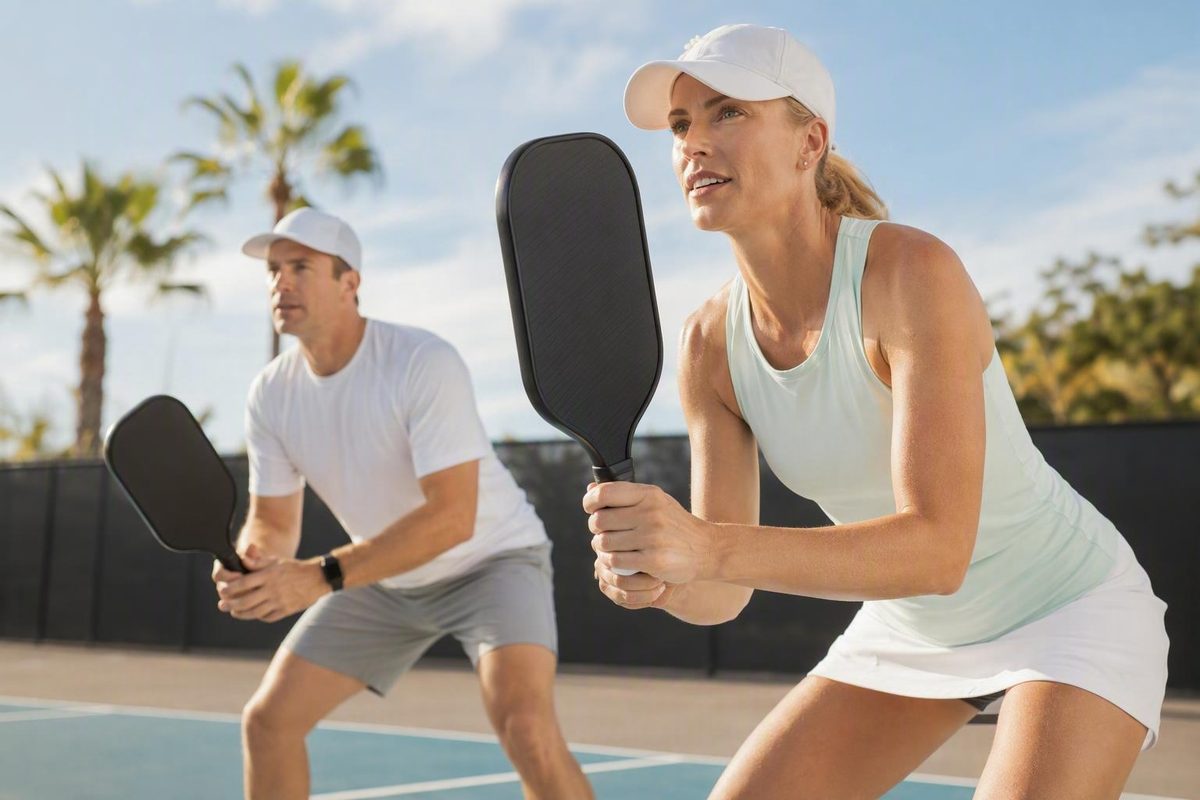
Elongated pickleball paddles are worth testing if you prioritize reach, leverage, singles coverage, or enough handle room for a two-handed backhand. If quick hands, stable mishits, resets, and side-to-side forgiveness matter more, begin with a hybrid or widebody. These are tendencies, not guarantees: construction, balance, swing weight, twist weight, and technique can matter more than silhouette.
The quick answer: who should choose an elongated paddle?
The question is not whether elongated paddles are universally better. It is whether their likely advantages solve a problem in your game without creating a larger one.
Put an elongated paddle on your demo list if you want more singles coverage, prefer full baseline swings, tend to contact the ball higher on the face, or need space for a second hand. Start with a hybrid or widebody if you prioritize rapid kitchen exchanges, stable resets, or forgiveness when contact drifts toward either side of the face. A hybrid is the middle-ground option, not a consolation choice.
| Your priority or situation | Shape to test first | Why |
|---|---|---|
| Singles coverage | Elongated | Prioritizes reach and leverage |
| Baseline drives and serves | Elongated or hybrid | Suits longer swings while retaining some width |
| Two-handed backhands | Elongated or hybrid | May provide more handle room |
| Fast doubles exchanges | Hybrid or widebody | Usually favors quicker repositioning |
| Off-center contact | Widebody or hybrid | More lateral area can improve mishit tolerance |
| Uncertain first-time buyer | Hybrid or widebody | Provides a forgiving comparison baseline |
Commercial shape guides generally associate elongated paddles with reach and leverage, widebodies with lateral forgiveness and maneuverability, and hybrids with a balance of the two. Actual dimensions and weight distribution can override those category-level tendencies.
Do not buy solely because a product page says “elongated.” A well-balanced elongated paddle may feel quicker than expected, while a head-heavy hybrid may feel slower. A narrow paddle with sufficient twist resistance can also remain comparatively stable on mishits.
What counts as an elongated pickleball paddle?
There is no separate official definition of an elongated shape, and brands do not use shape labels consistently. Compare listed length and width instead of relying on terms such as elongated, longbody, blade, hybrid, or standard.
Common commercial reference dimensions are:
| Shape | Approximate length | Approximate width |
|---|---|---|
| Elongated | 16.5–17 in. | 7–7.5 in. |
| Hybrid | 16.25 in. | 7.75 in. |
| Widebody | 16 in. | 8 in. |
These are shopping conventions rather than regulatory categories. A paddle between those reference points might be called elongated by one brand and hybrid by another. One commercial guide uses approximately 16.5 by 7.5 inches for elongated, 16.25 by 7.75 inches for hybrid, and 16 by 8 inches for widebody while noting that the terminology is not standardized (Wowlly’s paddle-shape guide).
The basic geometry explains why elongated paddles are narrower. Under USA Pickleball’s January 2025 Equipment Standards Manual, overall paddle length cannot exceed 17 inches, while combined length and width cannot exceed 24 inches. Those measurements include the edge guard and butt cap (USA Pickleball Equipment Standards Manual).
For a paddle at the maximum length:
- Maximum length: 17 inches
- Maximum combined dimensions: 24 inches
- Remaining allowable width: 24 − 17 = 7 inches
A 17-inch paddle can therefore be no wider than 7 inches under that combined-dimension rule. Within the permitted envelope, additional length consumes available width.
Elongated vs. hybrid vs. widebody: the practical tradeoffs
Shape helps identify which paddles to test, but it cannot predict the performance of a particular model.
| Trait | Elongated | Hybrid | Widebody |
|---|---|---|---|
| Reach | Usually greatest | Moderate | Usually least |
| Lateral hitting area | Usually narrowest | Middle ground | Usually widest |
| Likely sweet-spot location | Higher and narrower | More central | Broader side to side |
| Off-center forgiveness | Often lower laterally | Moderate | Often highest |
| Hand speed | Can feel slower | Moderate to quick | Often quickest |
| Handle space | Often more; not guaranteed | Varies | Often less; not guaranteed |
| Common uses | Singles, drives, serves, overheads | All-court play, mixed priorities | Fast doubles, resets, counters |
What elongated paddles tend to add
A longer profile can provide extra reach on defensive balls, overheads, volleys, and singles coverage. It may also provide useful leverage on serves and drives. Players who consistently contact the upper center of the face may find the higher contact area natural.
That reach supplements positioning; it does not replace footwork. If you regularly arrive late or reach instead of moving, a longer paddle may occasionally disguise the problem without solving it.
What elongated paddles tend to give up
A narrower face offers less side-to-side hitting area. Players whose contact moves toward the edges may see less consistent results on blocks, resets, and rushed volleys. A higher, narrower sweet-spot area also places more value on repeatable contact.
Some elongated paddles feel slower to reposition because more mass sits farther from the hand. That increases rotational resistance, but it is not true of every model. Reviewers therefore compare measurements such as swing weight and twist weight rather than inferring handling from shape alone (Matt’s Pickleball elongated-paddle review hub).
Where hybrid and widebody paddles fit
A hybrid retains some reach while recovering some width. It is a sensible choice for mixed singles and doubles play or for anyone who finds a full elongated shape demanding.
A widebody generally favors lateral forgiveness and quick handling. That can help with counters, blocks, and resets, although construction and mass distribution still determine how an exact model responds.
“Elongated” describes geometry, not a standardized performance category. Elongated paddles can be designed for control, all-court play, or power.
Match the shape to your game, not your skill label
Elongated paddles are not reserved for advanced players, and beginners do not automatically need widebodies. Start with what happens during your points.
-
Which format do you play most? - Mostly singles: include an elongated paddle. - Mostly doubles: begin with a hybrid or widebody unless reach or handle room is a clear priority. - A mix: begin with a hybrid and compare it with an elongated model.
-
Where do you contact the ball? - Consistently near the upper center: an elongated shape may suit your pattern. - Frequently toward either side edge: prioritize width and twist resistance. - Unsure: inspect your contact marks after play and compare shapes.
-
What do you need more of? - Defensive reach or leverage: elongated. - Faster reactions and easier repositioning: hybrid or widebody. - A balance of both: hybrid.
-
How do you hit your backhand? - Two hands: check handle length, grip circumference, taper, and usable grip room. - One hand: choose according to overall handling and contact pattern.
Singles and baseline-oriented play
Singles requires one player to cover the court. Defensive reaches, serves, returns, drives, passing shots, and overheads can therefore make an elongated shape worth considering. Baseline-oriented players may also prefer how a longer profile works with a full swing.
The tradeoff appears when contact moves laterally across the face. Added theoretical coverage is not helpful if the narrower shape produces more edge contacts.
Doubles and kitchen exchanges
Doubles often puts greater emphasis on counters, resets, blocks, and rapid paddle recovery. A hybrid or widebody is therefore a practical starting point.
An elongated paddle can still suit doubles if reach, upper-face contact, or handle room matters more to you than maximum width. Format should guide the comparison, not dictate the result.
Tennis converts and two-handed backhands
Some tennis converts find a longer profile familiar, especially if they use longer swings or a two-handed backhand. Familiarity is a reason to test the shape, not proof that it will fit.
Do not assume every elongated paddle has a long handle. Overall length can be divided differently between the handle and face. A longer handle may accommodate two hands, but it can also leave less usable face length within the paddle’s fixed total dimensions.
If you are a newer player without an established preference, start a demo with a hybrid or widebody and compare it directly with one elongated option. That creates a clearer baseline than testing several unfamiliar elongated models.
The specifications that matter after shape
Once you have chosen a shape family, compare exact models in this order:
- Exact length and width
- Handle length
- Usable face area
- Grip size
- Static weight
- Swing weight
- Twist weight
- Balance
- Core thickness
- Face material
- Construction
- Price
- Current approval status
Swing weight describes how resistant a paddle feels to being rotated through a swing. Two paddles with the same static weight can accelerate and reposition differently if one carries more mass toward the tip. Swing weight can affect acceleration, hand speed, and how demanding a paddle feels over a session.
Twist weight describes resistance to rotation when the ball strikes away from the centerline. Greater twist resistance can help the face remain steadier on off-center contact. A narrow elongated paddle can therefore be comparatively stable when its construction and mass distribution support sufficient twist resistance.
Balance connects those measurements. A head-heavier paddle may supply the momentum a baseline player wants but feel slower during kitchen exchanges. A more handle-biased model may reposition faster. Static weight alone does not reveal either behavior.
Handle length also requires context. More grip room can help a two-handed backhand, but a longer handle may reduce usable face length. Compare the actual handle and face dimensions rather than assuming the longest paddle provides both the longest grip and the largest hitting surface.
Retail catalogs show how much variation exists within the category. In one inventory snapshot, JustPaddles reported 187 elongated results, including 167 listings with handles of at least 5.5 inches and 163 carbon-fiber matches; middleweight listings predominated (JustPaddles elongated catalog). Those filters overlap, are retailer-specific, and change with inventory. They illustrate assortment, not market share, quality, or player suitability.
Face material, core thickness, and labels such as “power” or “control” cannot establish performance on their own. Compare measurements and on-court behavior between relevant models. Price should come near the end: first find the dimensions and handling that fit, then compare value among paddles that meet those needs.
Use this multi-session paddle demo scorecard
When possible, compare one elongated paddle directly with a hybrid or widebody over multiple sessions. This is not a controlled experiment; the goal is to identify repeatable differences that affect your play.
Use the same type of ball and comparable court conditions where practical. Do not decide from one unusually good or bad game.
Rate each item from 1 to 5 and add a short note about contact and outcome.
| Test | Rating | What to notice |
|---|---|---|
| Serves | /5 | Depth, repeatability, contact location |
| Drives | /5 | Timing, trajectory, consistency |
| Dinks | /5 | Control while reaching or moving laterally |
| Resets | /5 | Stability and depth control |
| Punch volleys | /5 | Acceleration and clean contact |
| Counters | /5 | Reaction speed and recovery |
| Overheads | /5 | Reach, timing, face control |
| Defensive reaches | /5 | Whether added length changes outcomes |
| Two-handed backhands | /5 | Grip room and freedom of movement |
| Off-center hits | /5 | Twisting and ball response |
Also check:
- Kitchen reaction speed: Can you move from forehand to backhand without feeling late?
- Twisting on mishits: Does the face turn noticeably on contact near either edge?
- Tip and edge consistency: Are upper-face contacts useful and predictable?
- Grip comfort: Is there sufficient handle room without awkward hand placement?
- Late-session handling: Does your timing or acceleration deteriorate?
Keep the elongated shape only if its practical benefit in reach, leverage, or handle room outweighs any decline in forgiveness, hand speed, or consistency. If the result is close, a hybrid may offer the more flexible compromise.
Check tournament legality before you buy or compete
Under USA Pickleball’s January 2025 Equipment Standards Manual, a paddle may be no more than 17 inches long, and its combined length and width may not exceed 24 inches, including the edge guard and butt cap. Satisfying those measurements alone does not make a paddle eligible for sanctioned competition (USA Pickleball Equipment Standards Manual).
Use this three-step check:
- Identify the exact brand and model. Include the model name, version, and relevant variant.
- Search that exact model in the official USA Pickleball Approved Paddle List.
- Confirm that it is currently listed as Pass shortly before the event.
The official database has included approved models explicitly described as elongated, demonstrating that elongated geometry itself is not prohibited. Approval establishes compliance for sanctioned competition; it does not establish quality, durability, value, or suitability for your game.
Approval can change because certified production paddles must remain consistent with approved samples and compliant throughout their useful life. Decertification can make a paddle ineligible for sanctioned competition without prohibiting recreational use.
Equipment standards can also be revised. Treat the January 2025 manual as the governing document cited here, then check USA Pickleball’s official equipment site for a newer manual, rule update, or approval-status change before competing.
Does USA Pickleball limit paddle weight or thickness?
The January 2025 manual states no separate restriction on paddle weight or thickness. The completed paddle must still satisfy all other applicable requirements. The same manual identifies specified categories of potentially permitted alterations—including qualifying grip changes, edge-guard tape, and weighted tape—provided the altered paddle remains compliant with the applicable dimension, placement, and surface rules.
Can I add grip tape, edge tape, or weight to an approved paddle?
Potentially, but approval of the underlying model does not automatically validate your modification. Confirm two separate things before sanctioned play: that the exact model is currently listed as Pass and that your particular alteration complies with the current rules for materials, placement, dimensions, and the hitting surface.
Ultimately, choose an elongated paddle only when its added reach, leverage, or handle room is more valuable to you than maximum lateral forgiveness and quick repositioning. Compare exact specifications, test it against a hybrid or widebody in real play, and verify the exact model’s status when sanctioned competition matters.