
How to Adjust Your Paddle Angle in Pickleball
Learn how open, neutral and closed paddle angles affect ball flight, what to use on dinks, drops and volleys, and a simple partner drill.
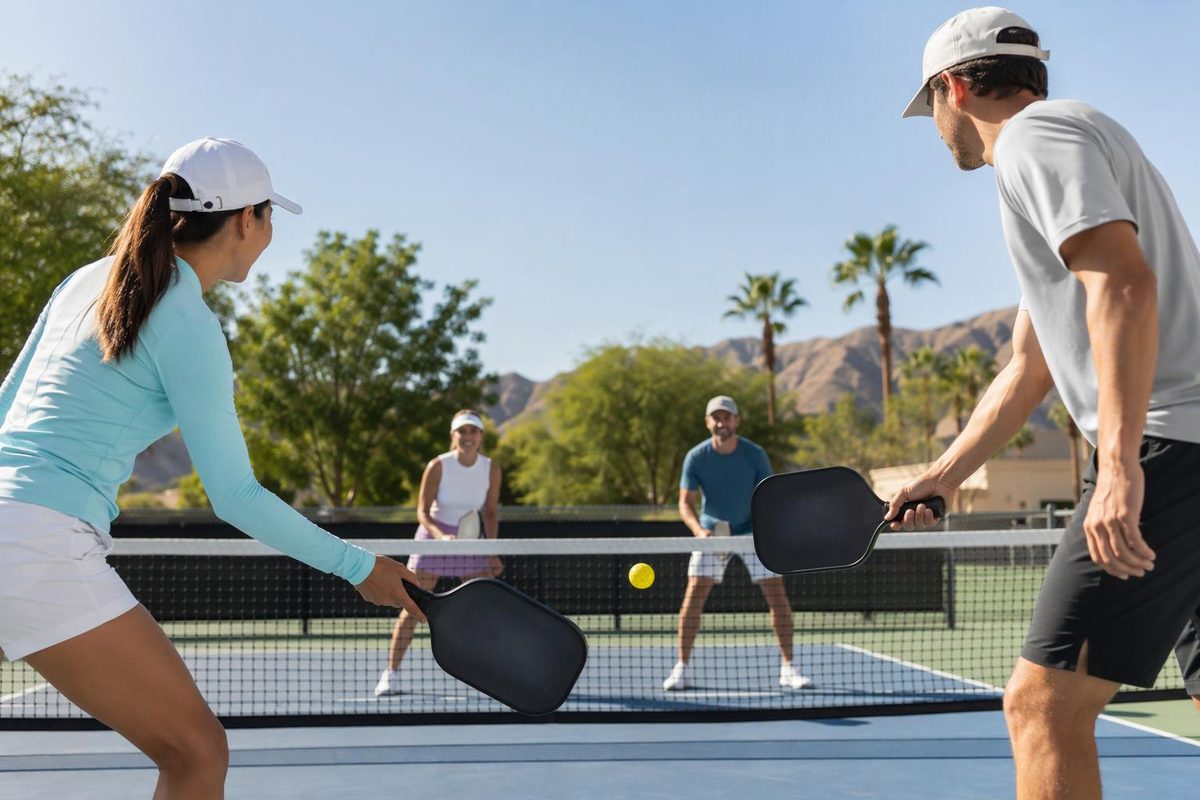
Paddle angle is the tilt of the hitting face when it meets the ball. Opening the face helps lift the ball; closing it tends to send the ball lower. The useful angle depends on your contact height and the shot you want—not simply whether you are hitting a forehand or backhand.
What open, neutral and closed mean
Imagine holding the paddle face vertically, like a wall facing the net:
- Neutral: The hitting face is vertical, pointing neither upward nor downward.
- Open: Tilt the top edge back toward you. The hitting face points partly upward.
- Closed: Tilt the top edge toward the net. The hitting face points partly downward.
These describe the face, not whether the paddle tip points up or down. You can lower the paddle head to reach a low ball while keeping its face open.
With otherwise similar contact, a more open face tends to launch the ball higher; a more closed face tends to launch it lower. Coach Sarah Ansboury teaches this distinction and recommends a slightly open face for low contacts rather than trying to lift them with a wrist flick. See her paddle-face lesson.
Angle is not the whole shot. Swing speed, swing path, incoming ball and spin also affect the result. Treat these positions as starting points, not fixed settings for every ball. Coach Dave’s shot lab uses a teaching model to illustrate how face angle, pace and contact height work together.
Adjust the face to the contact height
For a shot over the net, a ball contacted below net height must first travel upward. Closing the face to “hit down” on a low ball works against that requirement. Bend your knees, make room for contact in front, and use a little opening rather than a last-second scoop. Ansboury’s low-ball guidance applies to both forehands and backhands.
Use these practical starting points:
| Shot | Face-angle starting point | What to watch |
|---|---|---|
| Soft dink from a low bounce | Slightly open, with a gentle lifting motion | Clear the net and land in the opponent’s Kitchen without floating a high ball to their paddle. |
| Basic drop from farther back | Open enough to produce an arc | Combine smooth lift with enough forward motion to reach the target—not an abrupt wrist scoop. |
| Compact volley near net height | Near neutral, adjusted slightly for the incoming ball | Send it forward without tipping the face upward into a pop-up. |
| High attacking volley | More closed when contact gives you a clear downward path over the net | Aim into the court, not steeply into the net. |
For volleys, Engage’s guidance emphasizes compact swings and attacking when the ball is high enough.
For a drop’s full swing and target, see how to hit a drop shot. Here, the key distinction is that a low soft shot needs lift, while a genuinely high attack can use a downward trajectory.
A drive does not mean “close the face as much as possible.” A low drive still needs net clearance. For topspin, the upward brushing motion through contact matters; merely turning the face down is not a substitute. Jordan Briones emphasizes starting below the ball and keeping the wrist fairly stable in his topspin lesson.
Make one adjustment at a time
For repeated net misses on similar low feeds, try opening the face a little. For repeated high floaters, try slightly less opening—but also check whether you are swinging too hard or flicking your wrist. Do not change all three at once.
Keep contact comfortably in front. USA Pickleball recommends bent knees, short backswings and contact ahead of the body as basic mechanics. Its beginner guidance gives you a useful checkpoint before blaming every miss on angle.
Partner drill: find your usable angle
Stand opposite a partner near the Kitchen lines. Have them gently feed similar low, bouncing balls to your forehand.
- Hit five soft shots with a slightly open face.
- Hit five with a little less opening, keeping the swing length and effort similar.
- Compare net clearance and landing depth. Choose the setting that clears safely and lands softly in the Kitchen.
- Repeat on the backhand.
Then ask for a few gentle, higher feeds to volley—hit before the bounce—while you stay outside the Kitchen. Notice how much less lift those contacts need.
Checkpoint: You can change the ball’s height with a small, deliberate face adjustment—not an emergency wrist flip.