
Learn the Pickleball Drop Shot: Soft Touch from Farther Back
Learn what a pickleball drop shot is, how it differs from a dink, and how to practice a controlled arc into the Kitchen from farther back.
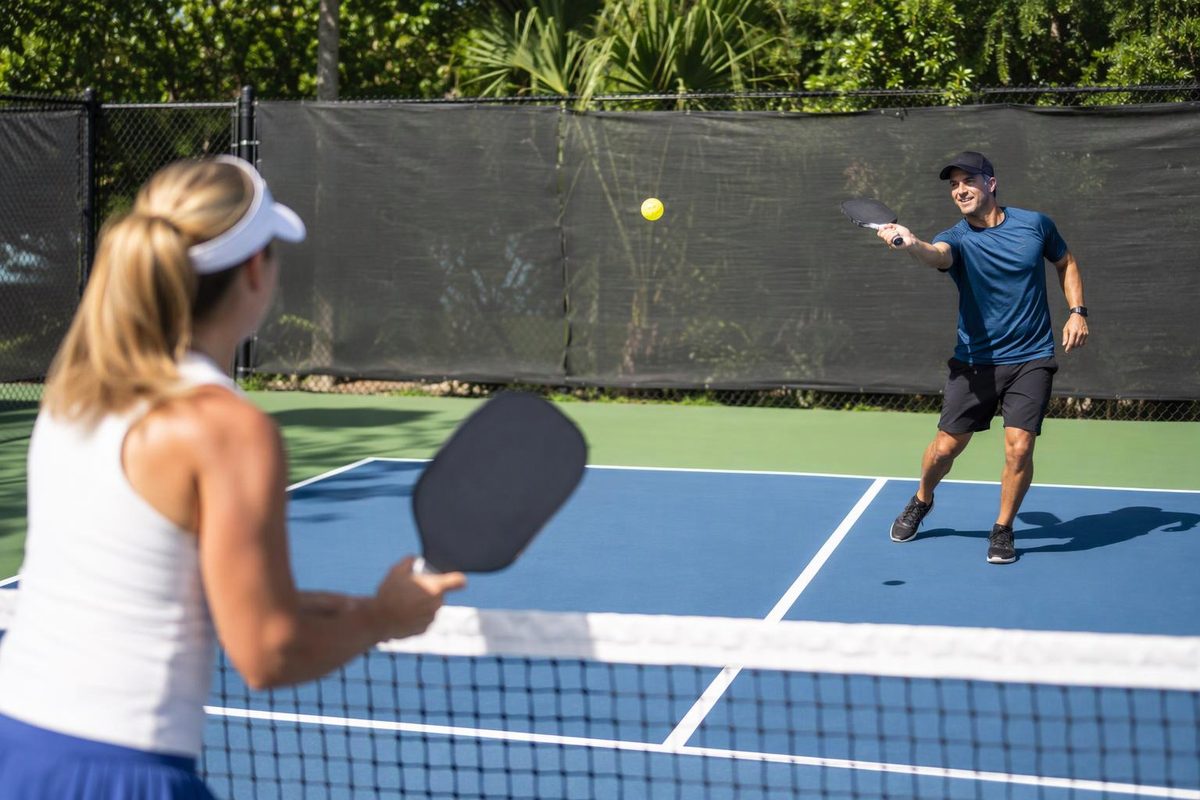
A drop shot is a soft, controlled shot hit from farther back in the court, intended to land in your opponent’s Kitchen—the non-volley zone beside the net. Instead of driving the ball hard, you give it an arc and a soft landing. In doubles, its main job is to make an aggressive reply harder and give your team time to move toward the Kitchen line. Drop-shot explanation
A drop does not create a special bounce requirement. Under USA Pickleball rules, once the serve and return have each bounced, an opponent may volley your drop if they can do so legally. The Kitchen rule restricts the volleying player’s contact with the zone, not the ball’s flight above it. A player may also enter the Kitchen to return a bounced ball. 2026 USA Pickleball rules, Sections 10 and 11
Drop, dink and third-shot drop
These terms describe related shots, but they are not interchangeable:
- Drop: A soft shot into the opponent’s Kitchen from farther back, such as the baseline or middle of the court.
- Dink: A short-range soft shot played near the Kitchen line, intended to bounce in the opponent’s Kitchen. The target is similar; the distance is shorter. Drop versus dink
- Third-shot drop: A drop hit immediately after the serve and return. “Third” identifies its place in the rally, not a different stroke. USA Pickleball’s third-shot explanation
You can use a drop later in the rally, too. For deciding between a drop and a drive after the return, see third-shot selection.
How to hit a basic drop
Start with a bounced ball and a simple stroke. Leave spin and sharp angles for later.
- Move into a balanced position. Bend your knees and make room to contact the ball in front of your body rather than reaching behind yourself.
- Keep the backswing short. Set the paddle in front of you instead of winding up as though you were hitting a drive.
- Relax your grip. USA Pickleball suggests roughly three out of ten for grip pressure. Treat that as a light-touch cue, not a precise measurement. USA Pickleball’s mechanics guidance
- Lift smoothly toward the target. Slightly open the paddle face—tilt it upward—and swing from low to high. Keep your wrist steady rather than flicking it at contact. Finish with a controlled follow-through toward the Kitchen. Stroke guidance
Think arc and land, not “barely scrape over the net.” Give yourself clearance while controlling the distance. When an opponent is at the Kitchen line, look for a reply they must lift rather than one they can hit down hard.
After the shot, advance only as the reply allows. Set your feet just before the opponent hits so you are ready for the next ball. USA Pickleball’s movement guidance
Practice the distance, then add movement
Have a partner stand outside the opposite Kitchen line and gently feed balls that bounce in front of you. Start around midcourt and drop each feed into a broad Kitchen target, away from the sidelines.
Try ten balls. Record how many land in the Kitchen and whether you finish balanced. Once the stroke feels repeatable, step farther back and try another set. Keep the same relaxed, compact action while adjusting the swing enough to cover the extra distance.
Finally, let your partner return each drop and practice moving forward, then stopping just before their contact. Your checkpoint is not merely a Kitchen bounce: it is a controlled shot followed by readiness for the next ball. If opponents keep attacking the result, use the separate guide to drops getting volleyed.