
Semi-Western Grip in Pickleball: Hand Placement and Uses
Find the semi-Western grip for either hand, learn when it helps forehand topspin, and practice switching back for kitchen defense.
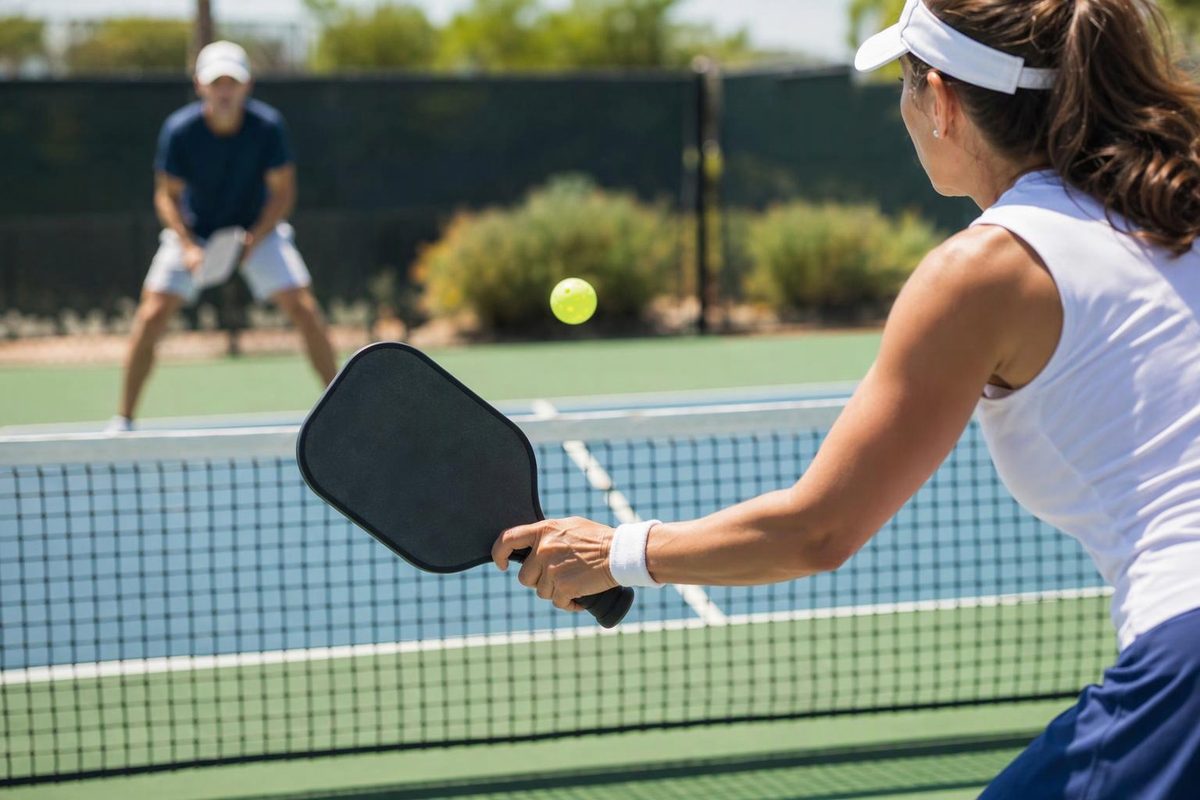
The semi-Western grip is a forehand-biased grip: your hand sits farther underneath the handle than with an Eastern grip, but not as far as with a full Western grip. It can help you hit topspin forehand drives and rolls. For recreational doubles, treat it as a grip for selected shots—not a replacement for your neutral kitchen grip. ProXR’s grip guide describes that same situational use.
How to place your hand
A bevel is one of the eight flat surfaces around an octagonal handle. Use this fixed numbering system for either hand:
- Hold the paddle with its face vertical, as though its edge could slice downward.
- Look at the handle’s butt end, with the paddle head pointing away from you. The top flat surface is bevel 1.
- Count clockwise around the handle: the right-side flat is bevel 3, the bottom-right diagonal is bevel 4, and the bottom flat is bevel 5.
- Right-handed: place your index finger’s base knuckle—the knuckle where the finger joins the hand—and your palm’s heel pad on bevel 4.
- Left-handed: mirror that placement onto the bottom-left diagonal, bevel 6 under this same clockwise numbering.
These are the tennis-derived bevel conventions used to name the grip. Some guides count counterclockwise for left-handers and therefore call their mirrored position “bevel 4”; the physical location is the same. UTR Sports explains the numbering and knuckle-and-heel placement.
Already know your Eastern forehand grip? Move your hand one bevel farther toward the underside of the handle. If your knuckle reaches the bottom flat, you have gone into full Western.
Wrap your fingers comfortably without forcing your wrist into a twist. Compared with Eastern, the paddle face will tend to close more—tilt downward—when you keep the same forearm position. That changes the swing you need; the grip alone does not create topspin.
Where it helps—and where it costs you
Try it on a forehand groundstroke—a shot after the bounce—when you have time to prepare. Start the paddle below the ball, meet the ball in front of you, and swing forward and upward. You still need enough forward motion to send the ball through the court; brushing almost straight up is not the goal. PickleballMAX’s forehand lesson recommends Eastern or semi-Western for drives and explains the low-to-high swing and forward contact point.
The advantage is a hand position suited to a closed-face, low-to-high forehand. The main tradeoff is the backhand: a semi-Western hold can make a conventional one-handed backhand awkward. ProXR describes it as useful for rolling forehands and baseline shots, but not a full-time kitchen choice. See its semi-Western guidance.
Return to a neutral grip before you need to defend. A forehand drive may be followed immediately by a low block or backhand volley. PrimeTime Pickleball recommends moving toward Continental while advancing for drops, resets and kitchen exchanges, where a more open face is useful. Loosen your hitting hand and use your other hand near the paddle throat to help turn the handle. Its grip-switching lesson explains that action.
If your dinks and blocks are still inconsistent, develop your Continental hold first rather than adding another grip to every rally.
A partner drill: drive, then reset the grip
Setup: Stand near your baseline. Have a partner feed easy, bouncing balls to your forehand. Choose a large target safely inside the opposite baseline.
Action: Hit five controlled forehands with Eastern, then five with semi-Western at similar effort. Before each shot, check your base knuckle. After each semi-Western drive, return to Continental and your ready position.
Checkpoints:
- Does the ball clear the net and land in your target without extra wrist manipulation?
- If it repeatedly hits the net, check whether the face points too far downward or you kept a flat swing despite closing it. Start below the ball and work forward and upward.
- Can you restore your neutral grip before the next feed?
Finally, ask your partner to alternate an easy, bouncing forehand feed with a gentle, bouncing backhand feed. Use semi-Western for the forehand and return to Continental for the backhand. If switching leaves you late or uncomfortable, use your familiar grip in games while you practice the change separately.