
Move One Bevel, Then Adjust Your Forehand
Transition from semi-Western to Eastern with clear hand-placement cues, forehand adjustments, miss checks and a simple partner practice progression.
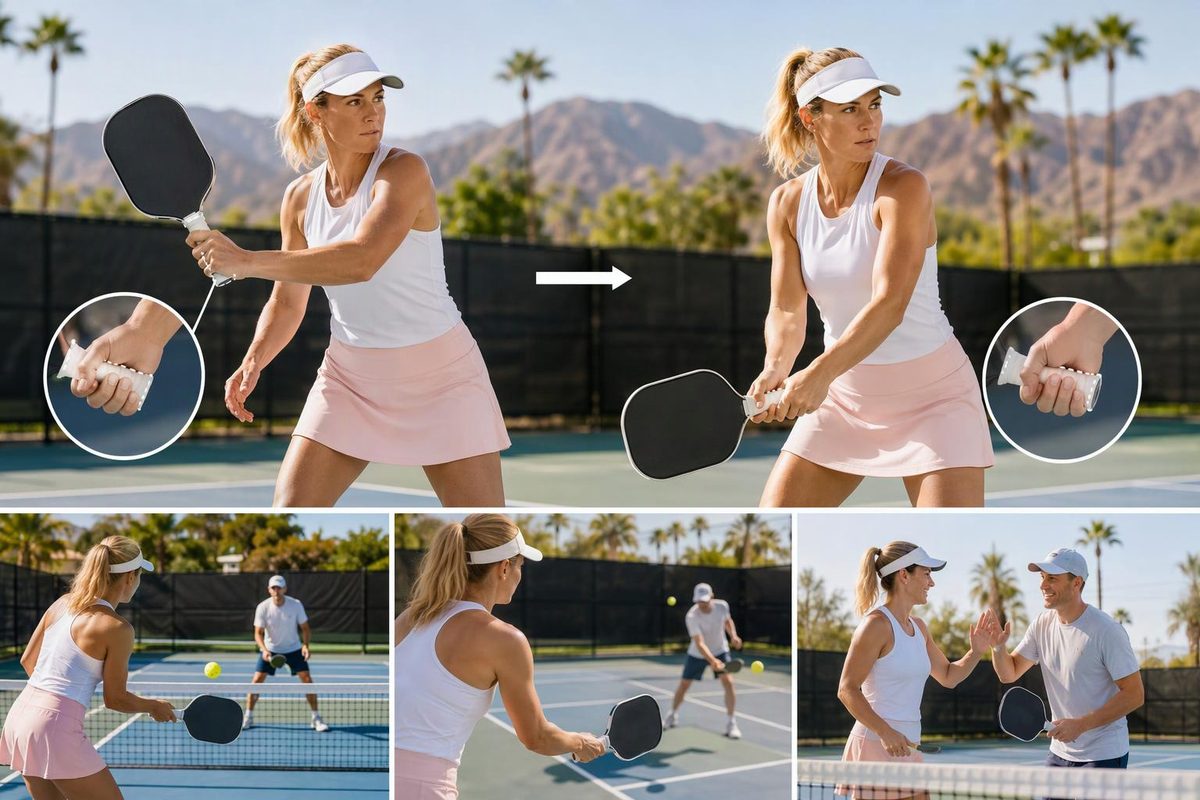
To move from a semi-Western grip to an Eastern forehand grip, move your hand one bevel away from the underside of the handle. Then recalibrate your forehand at easy pace. With the same forearm and wrist position, Eastern leaves the face less closed—less tilted toward the court—so copying your old swing unchanged may send the ball higher than intended. Pickleball Union’s grip guide explains how forehand grip rotation changes the paddle’s starting angle.
You do not have to abandon a working semi-Western drive to improve your drops and backhand volleys. You can keep it for prepared forehands and learn a neutral Continental grip for softer shots and defense. ProXR’s grip comparison describes that situational approach. If you want a less extreme forehand hold, use the progression below.
Move the hand, not just the wrist
Use this fixed numbering convention: hold the paddle with its faces vertical, look from the butt cap toward the paddle head, and number the handle’s eight flat surfaces clockwise, starting with the top surface as bevel 1.
| Hitting hand | Semi-Western | Eastern forehand |
|---|---|---|
| Right | Bottom-right diagonal, bevel 4 | Broad right-side panel, bevel 3 |
| Left | Bottom-left diagonal, bevel 6 | Broad left-side panel, bevel 7 |
These are the tennis-derived grip landmarks; UTR Sports’ grip guide gives the right-handed positions and reverses the counting direction for left-handers. Here, the numbering stays fixed for both hands. Grip names vary across pickleball guides, so use the hand landmarks rather than the name alone.
Support the paddle with your other hand, loosen your hitting hand, and turn the handle until the base knuckle of your index finger, where it joins your palm, rests on the Eastern panel. Let your palm move with it and wrap your fingers comfortably. Do not keep the old hand placement and twist your wrist to imitate the new face angle.
For a fuller placement check, see how to find the Eastern grip.
Adjust the forehand before adding speed
Start with easy, bouncing forehands around waist height. Keep your paddle and target unchanged so you can concentrate on the new hand position.
Keep the forward-and-upward swing. Eastern can still produce topspin. Start the paddle below the intended contact point and travel forward and upward through the back of the ball—not over its top. TopspinPro’s forehand lesson explains that action and recommends contact in front of the body.
Recheck the face at contact. Pause a shadow swing where you expect to meet the ball. Start with the face near vertical or slightly closed, rather than pointing toward the sky or sharply down at the court. Eastern is less closed than semi-Western, not a deliberately open-face stroke. If you previously opened the face to compensate for your former grip, check whether you are still doing it.
Find comfortable spacing. Meet the ball in front with room for your arm to swing. Do not force your old contact position if it now requires a wrist twist. Use small footwork adjustments rather than a last-second hand correction.
Change one thing at a time:
- Repeatedly high or long: check whether the face is too open before changing swing speed.
- Repeatedly into the net: check for an excessively closed face and whether the paddle starts below the ball.
- Crowded or late contact: slow the feed and adjust your distance from the bounce.
These are checks, not proof that every miss comes from the grip. The paddle-angle guide explains the face positions.
A short practice progression
Have a partner feed gentle, bouncing forehands from across the net. Stand near your baseline and choose a generous target inside the opposite service box.
- Locate: Make five slow Eastern shadow swings. Check the knuckle before each one.
- Calibrate: Hit ten easy Eastern forehands. Count target balls, net misses and long misses. Between feeds, check that your hand has not drifted underneath the handle.
- Adjust: Repeat ten balls using one cue from the miss pattern. Keep the intended pace steady.
- Add variety: Once the face and placement are repeatable, introduce modestly lower and higher feeds, then a little more pace.
Your checkpoint is not the hardest successful drive. It is whether you can locate Eastern without searching, clear the net, and control depth without repeated wrist corrections. If the grip change still distracts you from tracking the ball, keep practicing it on predictable feeds before using it in games.