
Pickleball Rally: What It Is and How to Keep It Going
Learn when a pickleball rally starts and ends, how winning differs from scoring, and simple doubles habits and a partner drill to keep play going.
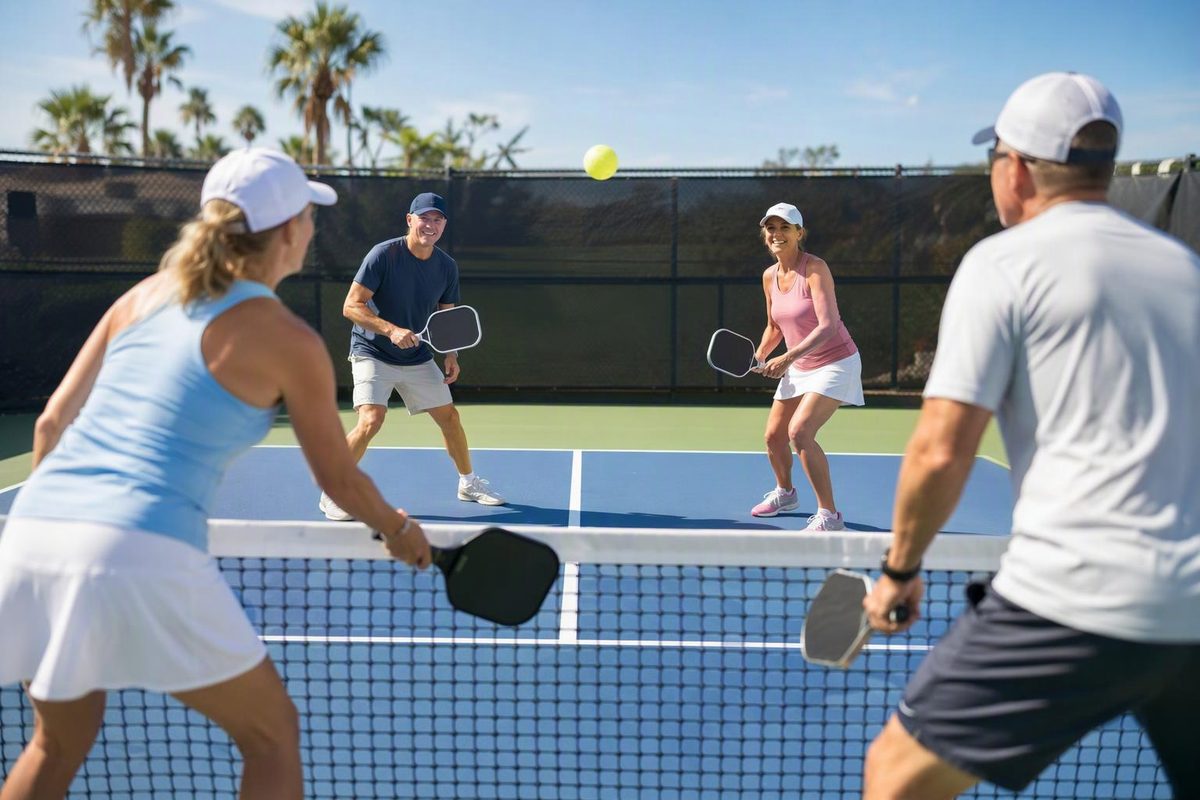
A pickleball rally is the continuous play that starts when the serve is hit and ends when the ball becomes dead, meaning it is no longer in play. It includes the serve—not just the shots exchanged afterward. Even a serve that lands out ends a rally; a rally does not need to last several shots. This follows the definitions in the 2026 USA Pickleball Official Rulebook, Section 2.
Winning a rally and scoring a point are not always the same thing.
How a rally unfolds
The opening shots have a required order:
- Serve: The server sends the ball diagonally into the opposite service court, clearing the Kitchen and its boundary line.
- Return: The receiver lets the serve bounce before hitting it back.
- Third shot: The serving team lets the return bounce before hitting its next shot.
- Continuing play: Either team may now hit after a bounce or volley—hit the ball before it bounces—subject to the Kitchen rule.
The two required bounces are one on each side, not two bounces on the same side. Those requirements apply at the start of every rally, not after every shot. See Sections 7.E and 10.A of the official rulebook, or the plain-English two-bounce rule guide.
The Kitchen, officially the non-volley zone, is not a keep-out area. You may step into it to hit a ball that has bounced. During a volley or its momentum, neither you nor anything touching you may contact the Kitchen, including its boundary line. That momentum restriction applies even after the ball becomes dead. After contacting the Kitchen, both feet must touch the playing surface completely outside it before you volley again. These restrictions come from Sections 3.A.4.c and 11 of the rulebook.
What ends the rally—and who gets a point?
Common rally-ending faults include:
- Hitting a ball that first lands out of bounds.
- Hitting into the net so the ball falls back onto your side.
- Failing to return the ball before its second bounce in standard play.
- Volleying the serve or return before its required bounce.
- Committing a Kitchen volley violation.
A ball clipping the top of the net does not automatically end the rally. If it crosses and otherwise meets the placement rules, keep playing—even on a serve. A valid hinder call, such as an interfering stray ball, stops play and requires a replay rather than awarding a rally winner. Rulebook Sections 7.E, 9, 10, 11 and 13.A cover these situations.
Under standard side-out scoring, only the serving team scores when it wins a rally. If the receiving team wins, it gets no point. In doubles, the serve passes to the serving team’s second server or, if the second server was serving, to the receiving team—a side out. The team serving first in a game starts with its second server, so losing that opening service turn causes a side out.
Under the provisionally approved rally-scoring option in the 2026 rulebook, the rally winner scores a point. For that separate format, see rally scoring in pickleball. Rulebook Sections 1, 5.B and 14.A establish the distinction and serving sequence.
How to keep a doubles rally going
Start with space for the required bounce. Both serving players should stay back for the return. The receiver starts behind the baseline; their partner can start near the Kitchen line. After returning, the receiver works forward.
Move, then get balanced. As you advance, settle into a ready stance just before the opponent hits. Stay coordinated with your partner rather than having one player rush ahead and leave a large gap. These habits follow USA Pickleball’s positioning guidance.
Give low balls a controlled reply. Near the Kitchen, use a dink—a soft shot played after a bounce that lands in the opponent’s Kitchen—instead of trying to blast every ball. Make contact in front with a short backswing and gentle lifting motion, as described in USA Pickleball’s dink guidance.
Practice: build a ten-shot exchange
With one partner, stand opposite each other just behind the Kitchen lines. Start with a gentle feed rather than a serve; this is a cooperative drill, not a scored game.
- Let each ball bounce, then dink it back toward a generous target near your partner.
- Count each paddle contact after the feed. Aim for ten consecutive returns together.
- Reset the count after a miss. If ten is too difficult, start with four.
Checkpoint: Can both players meet the ball in front and recover their balance before the next shot? If someone repeatedly stretches or lunges, use an easier target before adding pace or sharper angles.