
Can You Play Pickleball on a Tennis Court? Setup and Line Guide
Yes—with permission, pickleball lines and the right net setup. Learn what to measure, which tennis lines to ignore and how to prepare for play.
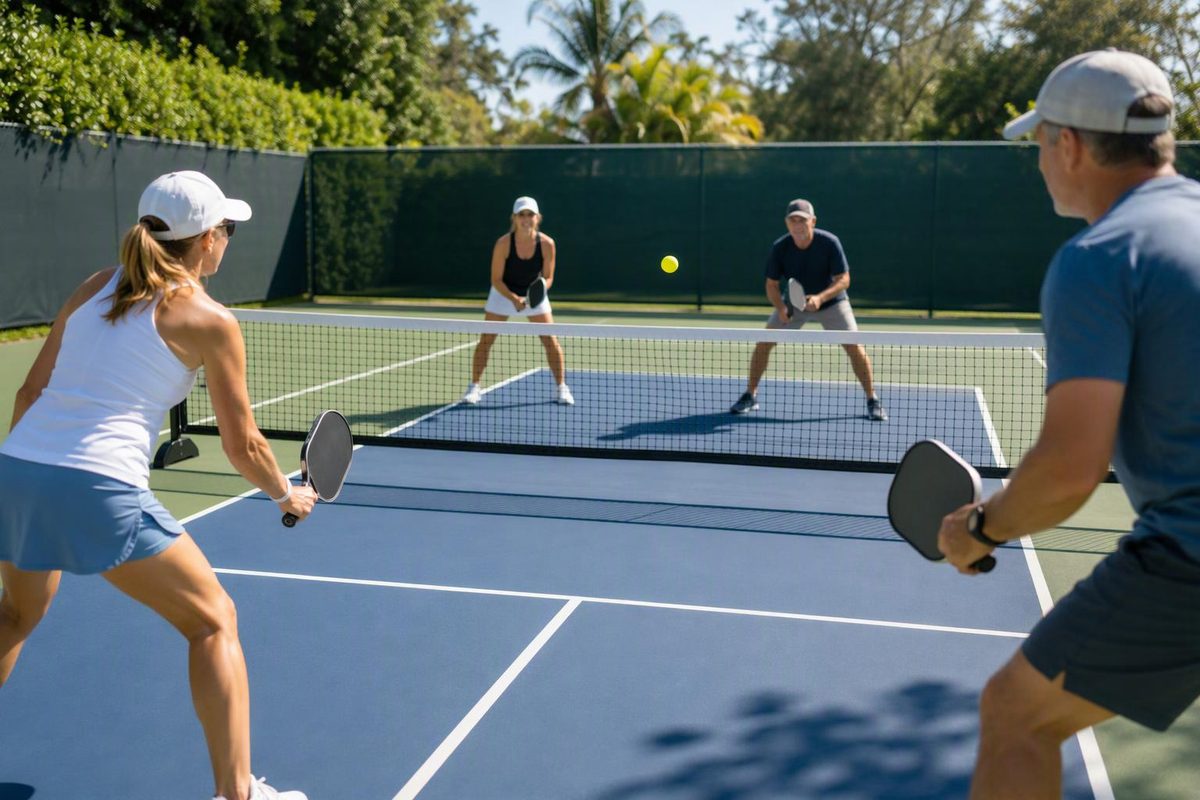
Yes—you can play pickleball on a tennis court if the facility allows it and you set up pickleball-sized boundaries and a suitable net. A hard-surface tennis court can serve both sports; the existing tennis lines do not automatically become pickleball lines.
For a straightforward temporary setup, use a portable pickleball net and removable markings approved by the court owner. Check the facility’s reservation and shared-use rules. If the court already has pickleball lines, confirm which color to use before starting.
Can you use the tennis net?
You can rally over an unchanged tennis net for informal practice, but that is not a regulation pickleball setup. A tennis net is 36 inches high at the center; pickleball’s specified heights are 34 inches at the center and 36 inches where the net crosses the outer edges of the pickleball sidelines, with a quarter-inch tolerance at both locations. Those measurements come from the 2026 ITF Rules of Tennis and 2026 USA Pickleball Official Rulebook, Section 3.
If the owner permits lowering the tennis net, measure both the center and the new pickleball sidelines. Pulling the center down to 34 inches does not by itself establish the correct sideline heights or net-post spacing. Treat a mismatched setup as a casual adaptation, not a regulation court.
A portable pickleball net avoids modifying the tennis net. Place it within an approved layout, with enough space behind both baselines—not where the permanent tennis net becomes an obstacle immediately behind a player.
Which lines do you need?
Pickleball uses a 20-by-44-foot court for both singles and doubles. By comparison, a full-size tennis court is 78 feet long and either 27 feet wide for singles or 36 feet wide for doubles. You cannot simply use the tennis singles sidelines and service boxes. See the governing bodies’ pickleball specifications and tennis specifications.
To mark one pickleball court:
- Lay out a 20-by-44-foot rectangle. Measure to the outside edges of the perimeter lines and check that the corners are square.
- Locate the net halfway along the length: 22 feet from each baseline.
- Mark the Kitchen—the non-volley zone—on each side. Its boundary line runs across the court 7 feet from the net. Measure to the edge farthest from the net.
- Add each centerline from the Kitchen line to the baseline, dividing the service area into right and left boxes.
Standard pickleball lines should be 2 inches wide, all the same color and clearly contrasting with the surface. These measurements follow USA Pickleball’s court rules. For service-box dimensions and a fuller layout explanation, see pickleball court dimensions.
Before adding anything, ask the operator which marking product is allowed. Do not assume any removable tape is safe for every surface. USA Pickleball’s court-lining guidance specifically warns against duct tape because removal can damage the surface. Leave painting to the owner or an authorized contractor.
How many pickleball courts fit?
USA Pickleball’s layout guidance shows two pickleball courts on one tennis court and notes that four are possible—but four leave minimal space between courts. The usable area around the tennis court determines whether a layout has adequate clearance.
Do not judge a layout by the painted rectangles alone. The 2026 rulebook specifies a minimum total playing surface of 30 by 60 feet per court, including surrounding space; it recommends 34 by 64 feet for new construction and tournament play. Check fences, permanent net posts, gates and neighboring players against that space requirement.
Before your first game
Walk the boundaries together and point out the pickleball baseline, sidelines and Kitchen line. Agree that unrelated tennis markings are ignored for line calls.
Then try a short dink rally: stand just behind the new Kitchen lines and gently send the ball into the opposite Kitchen, letting each shot bounce. Checkpoint: both players recognize the correct Kitchen boundary and can move without crossing loose tape or encountering an obstacle. Fix loose markings before playing.
When you start a game, the tennis setting does not change pickleball’s two-bounce rule: the receiver must let the serve bounce, and the serving team must let the return bounce before hitting it. That requirement appears in the 2026 pickleball rulebook. Use your first-game guide for the serving sequence and score calls.