
One Bounce Per Side: Pickleball’s Opening Sequence Made Simple
The receiver lets the serve bounce, then the serving side lets the return bounce; after that, either side may volley or play a groundstroke.
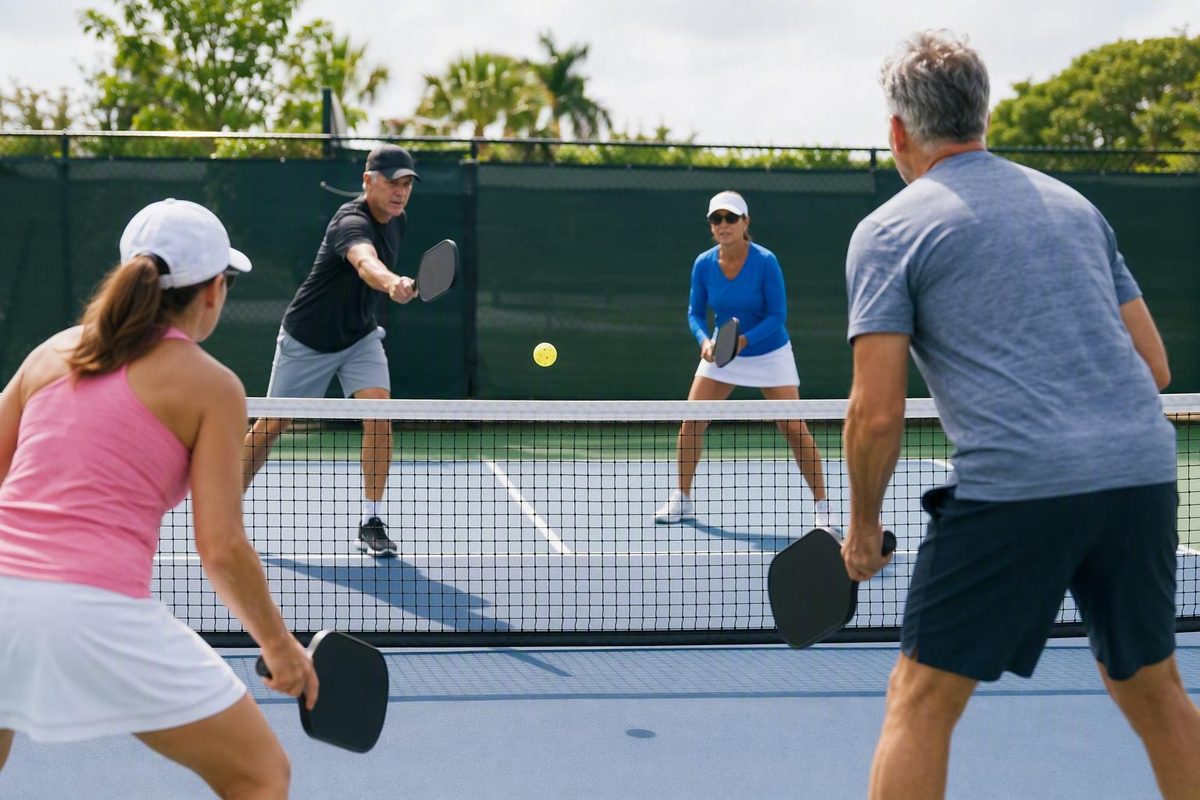
The rule commonly called the double-bounce rule in pickleball requires the serve to bounce on the receiving side and the return to bounce on the serving side before either side may volley. Its official name is the Two-Bounce Rule. The simplest memory cue is: one required bounce per side, not two on one side.
The rule in one sentence
The receiver must let the serve bounce, and the serving side must let the return bounce; after that, either side may volley or play another groundstroke.
The USA Pickleball rules summary calls this opening requirement the Two-Bounce Rule. Players often call it the “double-bounce rule,” but that wording can cause confusion because a double bounce also describes the ball bouncing twice on the same side.
The requirement belongs to each side, not to each individual player. In doubles, both partners do not need a personal bounce before they can volley. The receiving side allows the first required bounce, and the serving side allows the second.
Serve, bounce, return, bounce: the complete sequence
When a rally legally progresses to the third shot, the opening sequence is:
- Team A serves.
- The ball bounces in Team B’s court.
- Team B returns the ball.
- The return bounces in Team A’s court.
- Team A plays the third shot.
The receiver cannot volley the serve. Likewise, neither player on the serving side can volley the return before it bounces.
Once the second required bounce occurs, the opening restriction is complete. Either side may then volley the ball out of the air or let it bounce and play a groundstroke. Volleying becomes permitted, not required.
The rally begins when the serve is struck, not after the two required bounces. The Two-Bounce Rule governs the opening serve-and-return sequence, resets at the start of each new rally, and applies in both singles and doubles.
A rally can end before reaching the third shot. For example, a serve or return that lands out ends the rally without completing the entire five-step progression.
Two-Bounce Rule versus a double-bounce fault
These terms sound similar but describe opposite situations.
| Concept | Where the bounces occur | Result |
|---|---|---|
| Two-Bounce Rule | One required bounce on each side during the opening sequence | Legal and mandatory |
| Double bounce | Two bounces on the same side before a standing player returns the ball | Normally a fault |
The concise distinction is:
- The required two bounces cause a fault if they do not occur.
- A same-side double bounce causes a fault if it does occur.
Under the ordinary rule for a standing player, the ball must be returned before its second bounce on that side. The opening rule does not give either side permission to wait for two bounces; it requires one bounce on each side. This distinction is explained in a comparison of the Two-Bounce Rule and a same-side double bounce.
Legal and illegal rally examples
Legal opening: Team A serves. The ball bounces in Team B’s court. Team B returns it. The return bounces in Team A’s court. Team A then hits a third-shot drive or drop. Both required bounces occurred.
Early-volley fault by the receiver: Team B strikes Team A’s serve out of the air. Because the serve did not bounce before being returned, the receiving side committed a fault.
Early-volley fault by the serving side: Team B lets the serve bounce and returns it, but a Team A player takes that return out of the air. The serving side failed to allow its required bounce.
Same-side double-bounce fault: During an ordinary rally, a standing player reaches the ball only after it has bounced twice on that player’s side. That is a different fault from failing to complete the opening Two-Bounce Rule.
Under the 2026 USA Pickleball Official Rulebook, a fault results in a dead ball and loss of the rally. Do not automatically announce “point,” “side out,” or “loss of serve,” however. The scoring consequence depends on the scoring format, which side committed the fault, and which side was serving.
What the rule changes about court positioning
The Two-Bounce Rule gives the serving team a practical reason to begin near the baseline. Because the return must bounce before the serving side plays the third shot, moving forward too soon can leave a player backing up or trying to handle a deep return at their feet.
The server’s partner should be especially careful. A soft, floating return may look like an easy volley, but it still must bounce. Starting too far forward can invite an instinctive overhead or punch volley before the required bounce.
The obligation applies to the serving side, so either partner may play the third shot after the return bounces. It does not have to be the original server.
Staying near the baseline is practical positioning, not an additional rule. Players may stand elsewhere if they choose; they simply cannot strike the return before its required bounce.
The kitchen still matters after both bounces
Completing the Two-Bounce Rule makes volleying available, but it does not override the non-volley-zone restrictions.
For example, a player may allow the serve and return to bounce and then volley the next ball. That volley satisfies the opening sequence, but it can still be illegal if the player violates the kitchen rule.
Treat these as two separate questions:
- Did the serve and return complete their required bounces?
- Was the later volley legal in relation to the non-volley zone?
Passing the first test does not guarantee that the volley passes the second.
Adaptive and wheelchair play
Applicable official rules provide additional-bounce allowances for eligible wheelchair players and certain players with disabilities. Not every adaptive player receives the same modification.
Under the supported wheelchair provision, a player using a wheelchair may return the ball before its third bounce rather than before its second. Official guidance also sets conditions for where the permitted bounces may land. Players and event organizers should consult the current applicable rules for the complete eligibility, bounce-placement, and competition provisions.
Frequently asked questions
Does the Two-Bounce Rule apply in singles as well as doubles?
Yes. In both singles and doubles, the serve must bounce before the receiving side returns it, and that return must bounce before the serving side plays the third shot.
Does every player have to let the ball bounce once?
No. Each side must allow one required bounce; each individual player does not. In doubles, one partner may return the serve, and either opposing partner may play the third shot after the return bounces.
Does the Two-Bounce Rule continue for the whole rally?
No. It applies only to the opening serve-and-return sequence and resets with every new rally. Once the serve bounces and the return bounces, normal rally options begin: players may volley or use groundstrokes, while the kitchen still governs volleys.
The court-ready cue is simple: serve bounces, return bounces, then play on—one required bounce per side, not two on one side. If someone strikes either opening ball too early, call the fault, but determine the scoring consequence from the format and serving status rather than assuming every fault has the same result.