
Before You Play a Quiet Ball, Make These Three Checks
They are not generally required for ordinary play; venue permission, Quiet Category recognition and tournament approval are separate checks.
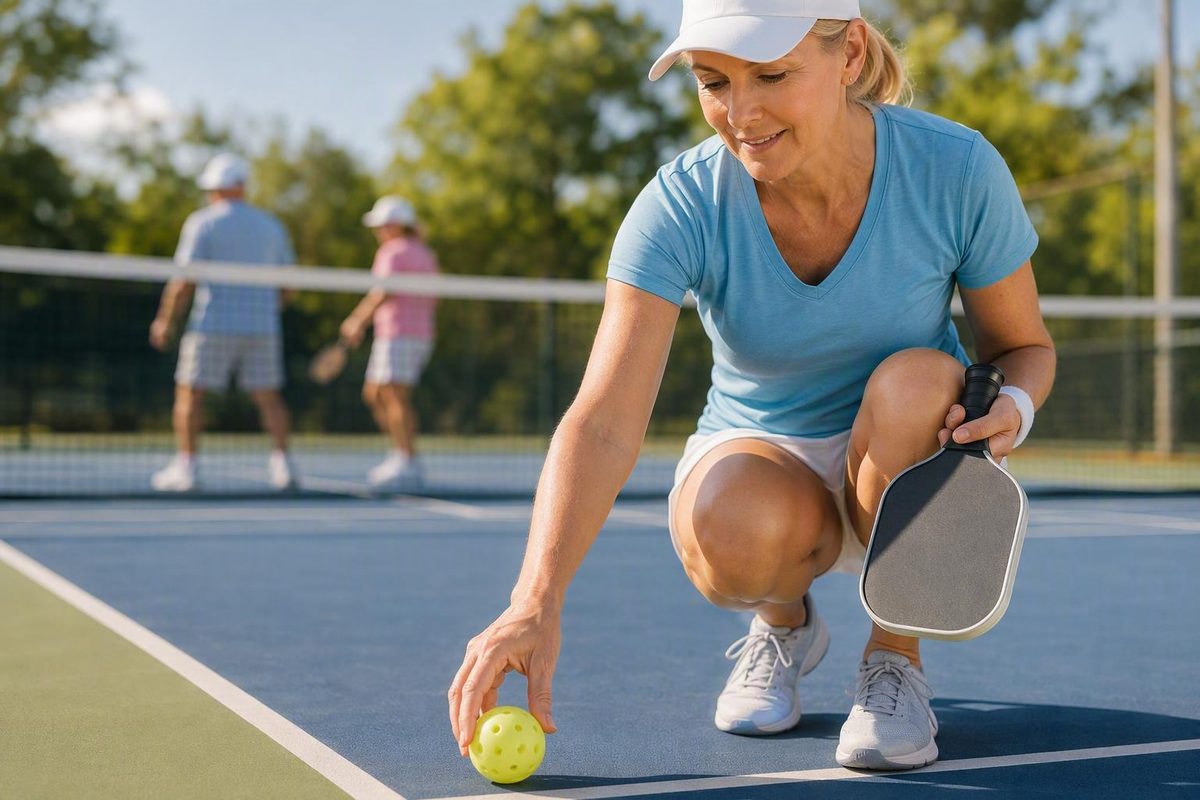
Quiet pickleball balls are not generally required for ordinary play by the cited USA Pickleball materials. USA Pickleball describes its Quiet Category as a noise-reduction program for recreational play, with a general target of approximately 50% or less of the acoustic footprint of equipment commonly used in community parks—not as a universal playing rule (USA Pickleball’s Quiet Category announcement).
Before playing, make three separate checks:
- What does the venue or event permit?
- Does the exact ball appear in USA Pickleball’s Quiet Category, if recognized noise reduction matters?
- Is the exact ball currently approved for sanctioned competition, if applicable?
One designation does not guarantee either of the others.
The short answer: the court or event decides what you may use
That can produce very different quiet pickleball ball rules from one court to another.
Mashpee, Massachusetts, was reported to have required reduced-noise balls on town courts and warned that violations could lead to suspension or revocation of court privileges. Centennial, Colorado, takes a different approach. Its ordinance regulates matters such as court location, operating hours, permitting, and property-line noise, but the city says the ordinance does not regulate paddle or ball types (City of Centennial’s pickleball regulations FAQ).
For your next game, the practical rule is straightforward: read the posted court policy and current event instructions. Those directions control your immediate equipment choice.
Do not assume a ball is permitted merely because its packaging says “quiet,” “foam,” “soft,” or “low noise.” Those are not substitutes for a named local list or an event’s equipment requirements. If a facility permits only particular models, its current list controls access to that facility.
Three labels that are not interchangeable
“Quiet ball” is often used loosely. For compliance purposes, separate these three designations:
| Designation | What it establishes | What it does not establish | Where to verify |
|---|---|---|---|
| Venue-approved ball | The ball is permitted under a particular municipality, HOA, facility, league, or event policy | Quiet Category recognition or sanctioned-tournament eligibility | Current signs, written policy, or organizer |
| USA Pickleball Quiet Category ball | The model is recognized under a lower-noise recreational-equipment program | Acceptance at a particular venue or eligibility for sanctioned competition | Live Quiet Category list |
| USA Pickleball Approved Ball | The exact model is listed for sanctioned play when checked | Compliance with a local quiet-ball requirement | Live Approved Balls database |
The distinction matters because the Quiet Category was developed for noise-reduced recreational equipment. USA Pickleball has also described specification flexibility for products intended solely for non-sanctioned use. Quiet Category recognition therefore should not be treated as competition approval.
The reverse is also true: a ball’s appearance in the Approved Balls database does not prove that it satisfies a municipality’s reduced-noise policy. A local rule may name specific products, refer to the Quiet Category, or use its own standard.
Check the Quiet Category list and Approved Balls database separately. Match the brand and complete model name rather than relying on an old package logo, retailer description, article, or general claim about the product.
Which balls appear in the Quiet Category?
As accessed September 15, 2026, USA Pickleball’s live Quiet Category list named the following six balls and supplied acoustic figures for only two of them (USA Pickleball Quiet Category equipment list):
| Brand | Exact model | Published sound figure |
|---|---|---|
| Accel Digital Sports | DigiPro 3.0 | Not supplied |
| Accel Digital Sports | DigiPro 3.1 FastPlay | Not supplied |
| Gamma | Librarian Foam | Not supplied |
| Selkirk | Q1 Quiet Ball | Not supplied |
| Onix | Fuse | 83.3 dBA |
| Monarch | Outdoor | 81.6 dBA |
The two published values do not establish a complete loudness ranking. The available evidence does not explain the test method, measurement distance, paddle pairing, impact conditions, meter settings, or testing environment. Without sufficiently comparable conditions, you cannot conclude that one model will always sound quieter than another on your court.
The category’s broader acoustic target is also not a fixed decibel reduction. It should be understood as a program-level target rather than a promise that every listed product will produce the same result in every setting.
The table is a dated snapshot, not a permanent buying list. Products may be added, removed, renamed, or have their status changed.
Before buying: Recheck the live Quiet Category list. A restricted venue may maintain its own approved list, and Quiet Category recognition does not itself establish sanctioned-tournament eligibility.
Mashpee shows why the written local rule matters
Mashpee’s reported rollout is a useful warning against relying on a single headline, product name, or implementation date. The available news reports conflict, and each captures the policy at a different point:
-
July 22, 2026: Cape News reported that Mashpee planned an August 1, 2026 effective date and would require the Vortexball EVO or an “equivalent low-noise alternative.” The report said compliance would be strictly enforced and that violations could lead to suspension or revocation of court privileges (Cape News report on Mashpee’s announced requirement).
-
July 31, 2026: CBS News Boston identified a NETX 3D-printed noise-reducing ball and reported that the deadline had moved from August 1 to August 13, 2026. It listed the manufacturer’s price as $99 for three balls, with a 20% discount for Mashpee residents. That is approximately $33 per ball before the discount, not $50. Player Paul Key described the ball as playing “like a sponge” and said it had to be hit “twice as hard” to obtain normal pace (CBS News Boston report on the changed deadline).
-
August 19, 2026: Boston.com, republishing Boston Globe reporting, described an initial Vortexball EVO Gen 2 requirement priced at $149 for a three-pack, followed by an expanded list of 10 reduced-noise balls after player opposition. The article reported prices of approximately $3 to $30 per ball and said only two of the 10 qualified for sanctioned tournament play. It did not identify every permitted model or the two competition-approved balls (Boston.com report on Mashpee’s expanded choices).
These accounts do not establish one definitive current model, list, or effective date. The differences may reflect policy revisions during the rollout, reporting differences, or both.
Players at Mashpee town courts should therefore consult current court signage or the recreation department’s current approved list. An older article may accurately describe an earlier stage of the policy while still being unsuitable for deciding what is allowed today.
Vague wording deserves the same caution. If a policy permits an “equivalent low-noise alternative” but does not define equivalence, ask the facility which exact models qualify before arriving. Do not assume that similar construction, a retailer’s “quiet” label, or Quiet Category recognition automatically satisfies that wording.
Expect possible playability and price tradeoffs—but separate evidence from opinion
Some Mashpee players and instructors reported concerns about pace, feel, and teaching with the required equipment. Those reactions matter when deciding what to buy, but they are not controlled performance findings.
In particular, Paul Key’s sponge comparison and claim about hitting harder were one player’s assessment of the NETX ball identified in the July 31 report. They should not be presented as measured facts or generalized to every quiet pickleball.
Foam and other noise-reducing constructions can feel different from familiar perforated plastic balls. However, the available reporting does not provide controlled, like-for-like comparisons across the current Quiet Category products for:
- Bounce
- Speed
- Flight
- Durability
- Weather response
- Player effort
A category label alone cannot tell you how a ball will perform in your climate, on your court surface, or with your usual paddle. When possible, test the exact permitted model before purchasing a large quantity.
The Mashpee prices in the timeline are also historical news-report examples, not current or directly comparable retail offers. They refer to different products, package sizes, sellers, and possible discounts. Before purchasing, compare the full model name, pack size, per-ball cost, seller, resident or club discount, shipping, and current approval status.
Price alone can be misleading. A cheaper ball is not useful if the venue rejects it, while a locally accepted ball may still be unsuitable for a sanctioned tournament. Start with compliance, then compare cost and playability among the models that remain eligible.
A pre-play compliance checklist
Use this five-step check before leaving home:
-
Identify the venue and type of play. Determine whether you are attending casual open play, an HOA session, a league, a lesson, or a sanctioned tournament. Different rules may apply even at the same facility.
-
Read the current local policy. Check court signs, reservation terms, facility rules, league messages, and event instructions. Give current written directions priority over packaging and old news coverage.
-
Confirm the exact model. Match the brand and full model name. Do not rely on broad descriptions such as “quiet,” “indoor,” “foam,” “soft,” or “low noise.”
-
Check the Quiet Category list when relevant. Do this when the policy specifically refers to USA Pickleball’s Quiet Category or when you want equipment currently recognized under that noise-reduction program.
-
Check Approved Ball status separately for sanctioned competition. Search the exact model rather than inferring eligibility from its Quiet Category status.
Scenario 1: Casual municipal-court play. The town posts a named approved-ball list. Choose from that current local list, even if another ball appears in the Quiet Category. National Quiet Category recognition does not override the town’s access policy.
Scenario 2: A sanctioned tournament. Your ball is marketed as quiet and appears in the Quiet Category. You must still verify the exact model in the Approved Balls database. Quiet recognition alone does not establish eligibility for sanctioned play.
If a league or facility permits an “equivalent low-noise alternative,” ask the organizer what models or evidence it accepts. A written response can help avoid confusion if the rule is enforced on site.
Quieter paddles, paddle covers, screens, barriers, scheduling, and facility design may supplement a ball policy. They do not override a required-ball list or an event’s equipment rules.
The safest rule is to make all three checks: verify what the venue permits, check Quiet Category recognition when noise reduction matters, and separately confirm Approved Ball status for sanctioned competition. If those sources point in different directions, follow the current venue or event instruction for access and obtain clarification before play.
Can a quiet pickleball lose its approval or certification status?
Yes. Equipment status can change, and USA Pickleball recommends consulting its current equipment records because certification updates are posted regularly. Verify the exact model close to the date of play in the USA Pickleball Approved Equipment database rather than assuming that an earlier listing remains valid.
Quiet Category recognition and Approved Ball status are separate. Depending on the venue and type of play, you may need to check one list or both.
Does a lower published dBA number always prove that one ball is quieter?
No. A lower dBA value supports a comparison only when the measurements were made under sufficiently comparable conditions.
For that reason, the two figures in the Quiet Category table should not be treated as proof of how those balls will rank in every playing environment. They are published figures from the live listing, but the supplied evidence does not include the complete test conditions needed for a universal comparison.