
Hit a Pickleball Overhead Smash With Control
Learn when an overhead smash is legal, how to move and make contact, where to aim in doubles, and a simple partner drill for control.
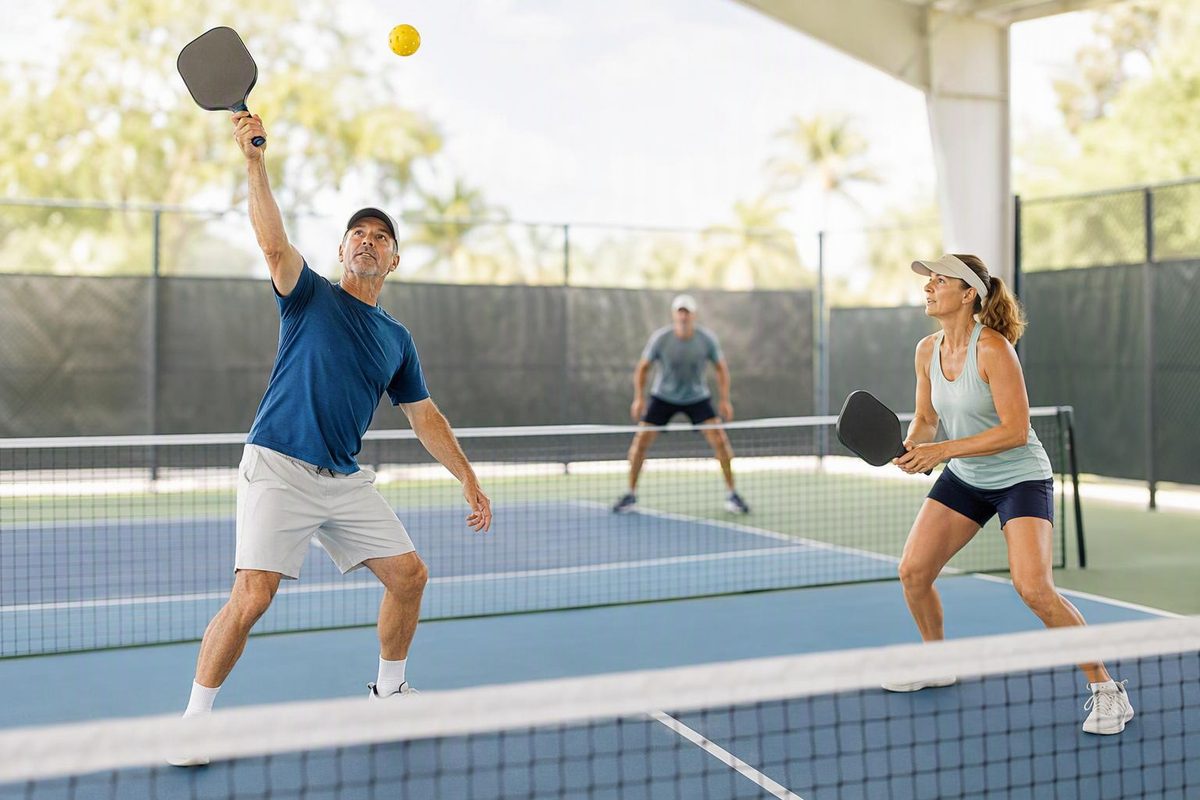
You may volley an overhead smash from outside the Kitchen—but you must not touch the Kitchen or its lines during the volley or because of its momentum. This includes contact by your paddle or anything you are wearing or carrying. Being carried into the Kitchen afterward is a fault even if your shot has already ended the rally. If the ball bounces first, the Kitchen’s volley restriction does not apply. These are the USA Pickleball rules summarized for 2026.
The pickleball overhead smash is an attacking shot struck above your head and directed down into the opposing court, often in response to a short lob. The useful goal is not maximum force: it is a balanced hit into a target you can reliably reach.
Choose the right ball
Attack when you have time to get into position and contact the ball high and slightly in front of your body. If you are reaching behind your head or falling backward, do not force the smash.
A deep lob may need to bounce. Turn and move toward its landing area rather than continuing to backpedal while facing the net. Once you reach it, a controlled soft shot into the opposing Kitchen can help you and your partner recover your position. PrimeTime Pickleball’s lob-retrieval guidance recommends this option when the lob cannot be taken overhead.
Also remember the opening-rally restriction: you cannot smash the serve or serve return out of the air. Each side must first allow its required bounce. See the two-bounce rule explained.
How to hit the overhead smash
1. Turn before you retreat
As the ball rises, turn sideways with your non-paddle shoulder toward the net. For a right-hander, the right foot moves back; reverse that for a left-hander. Move from this turned position instead of running backward with your chest facing the net.
Jordan Briones’s overhead footwork lesson emphasizes this early turn, both for balance and to avoid the risk of falling while backpedaling.
Checkpoint: You have turned before taking several retreating steps.
2. Track the ball and make room
Raise your non-paddle hand toward the ball as a tracking aid, and bring your paddle up into an overhead hitting position. Adjust your feet so the ball will be in front of you at contact—not behind your head.
3. Reach high and swing through
Use a smooth, throwing-style motion through the shoulder, reaching up to contact the ball high and slightly in front. Direct it down into the court, then allow a natural follow-through rather than trying to jab it downward with your wrist alone. This follows PrimeTime Pickleball’s smash technique guidance.
Start at moderate pace. If you cannot finish balanced without touching the Kitchen, reduce the swing or choose a less aggressive reply.
4. Recover for another shot
Bring the paddle back in front and watch the opponents’ reply. Do not assume the smash is a winner. Your partner should stay ready rather than watch the shot; call “mine” early when a lob falls between you.
Where to aim in doubles
Start with a generous target through the middle or into open court, leaving room inside the lines. When opponents are deep, a shorter angle may be available, but it demands more placement control. PrimeTime’s shot-selection guidance describes both deep overheads and shorter angled options—and notes that more than one overhead may be needed to finish a point.
A simple partner drill
Setup: Start a step behind the Kitchen line. Choose a broad landing target on one side of the opposite court. Your partner feeds gentle lobs from near the opposite baseline, on the other side of the centerline and away from that target.
Action: Hit five easy overheads at moderate pace. Reset between feeds. On the next five, have your partner vary the depth slightly: smash only when you can get balanced with contact in front; let deeper balls bounce and play a controlled return. Do not chase a feed you cannot reach safely.
Checkpoint: Count an attempt as successful only when you choose the appropriate shot, land it in court, and finish balanced without a Kitchen fault. Switch roles after ten feeds. Add pace only after those three checks become repeatable.