
Build a Legal, Repeatable Pickleball Serve From the Baseline
Start with a simple drop serve, check your feet and target, and learn volley serve rules, score calls, and the required bounce before your next shot.
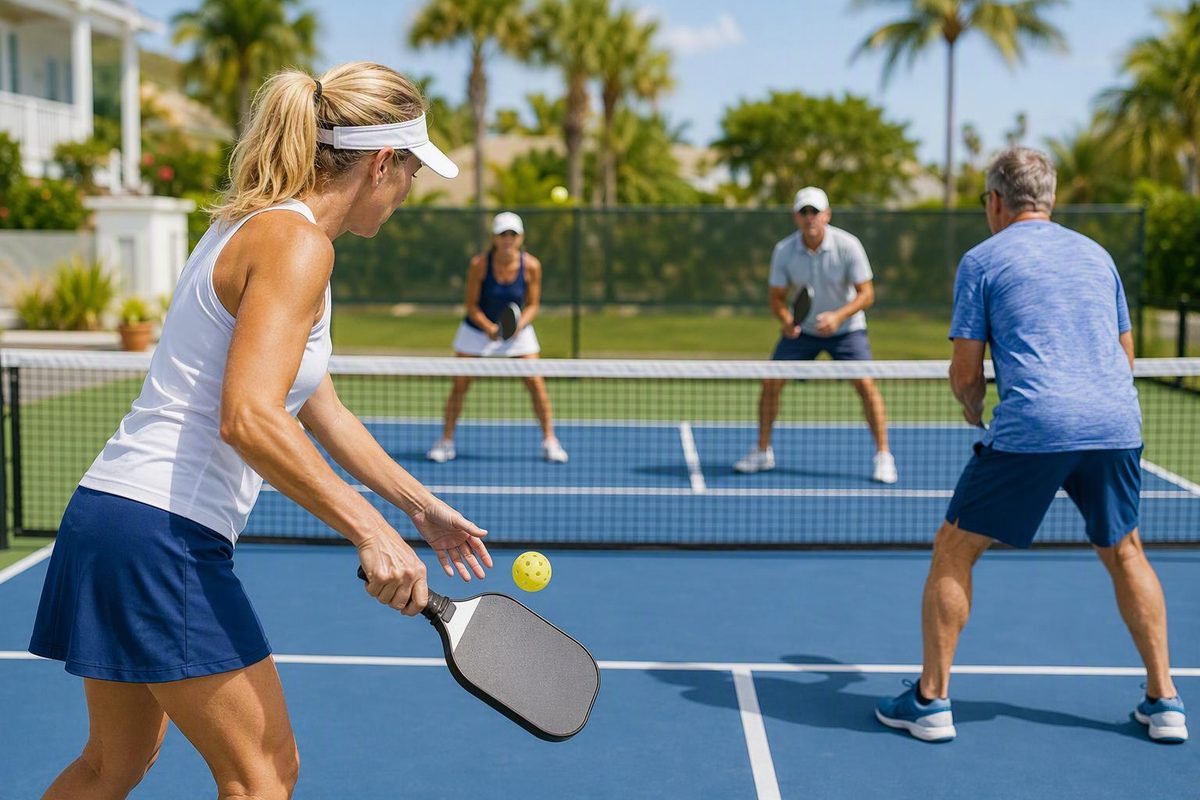
To serve in pickleball, stand behind the baseline and hit the ball diagonally into the opposite service court, beyond the Kitchen. You can strike it before it bounces—a volley serve—or drop it, let it bounce and then strike it—a drop serve. Start with the drop serve if you want fewer motion rules to manage: it removes the volley serve’s three contact requirements, but not the rules for your feet, release or target.
Choose your serve type, foot position and landing spot to check placement and see the motion rules that still apply.
Serve Placement Check
Placement Checks Pass
Your selected feet and landing meet the placement rules. This does not confirm that the whole serve is legal.
For a drop serve, check the release and bounce: release without propelling the ball and strike after it bounces. The volley contact requirements do not apply.
Foot Rules for Both Types
- At least one foot touches the ground in the serving area at contact.
- Neither foot touches the baseline or the court inside it.
- Neither foot touches ground outside the imaginary centerline and sideline extensions.
Motion Rules
- Drop: release from an unaided height without propelling the ball; hit after the bounce.
- Volley: at contact, swing upward, keep the paddle head no higher than the highest part of the wrist joint, and the ball no higher than the waist.
Release Rules and Next-Ball Reminder
For either type, release using only one hand or only the paddle. Keep the release visible to the receiver. Do not deliberately add spin before striking; paddle-generated spin at contact is allowed.
The receiver must let the serve bounce. Your team must let the return bounce before hitting it.
Source: 2026 USA Pickleball rulebook, Sections 3, 7, 8 and 10.A; standard play.
The rules below follow the 2026 USA Pickleball rulebook for standard play with traditional side-out scoring. The technique instructions are practice cues, not extra requirements for a legal serve.
Set Your Feet Behind the Baseline
At the moment your paddle hits the ball, at least one foot must touch the ground in the correct serving area. Neither foot may touch the baseline or the court inside it. Neither foot may touch the ground outside the imaginary extensions of the centerline and sideline on your serving side.
Think of the centerline and sideline continuing backward beyond the court. Those extensions define the serving area behind your half of the baseline. Standing behind the baseline alone is not enough if your foot is also outside that area when you make contact.
For your first attempts, leave a comfortable gap behind the baseline. Set your stance before releasing the ball rather than trying to fix your feet during the swing. You can shift your weight without stepping onto the line.
The key checkpoint is paddle contact, not where you started or where you finished. A stance that begins legally does not protect you from a foot fault if your movement takes you onto the baseline before you strike the ball. Keep the motion small enough that you can repeat it without watching your feet.
Aim Diagonally Beyond the Kitchen Line
Your serve must land in the opposite service court, diagonally across the net. It cannot land in the Kitchen—the non-volley zone beside the net—or on its boundary line. The Kitchen line is out on a serve.
The correct service court’s baseline, sideline and centerline are in. This creates a distinction worth learning before you practice: touching a boundary line is not always a fault. The Kitchen line is the exception for the serve.
| Where the Serve Lands | Ruling |
|---|---|
| Inside the diagonal service court | In |
| On its baseline, sideline or centerline | In |
| In the Kitchen or on the Kitchen line | Fault |
| Outside the diagonal service court | Fault |
A serve that clips the net and still lands legally remains in play; it is not automatically replayed. Judge the landing rather than stopping because you heard the ball touch the net. These foot, landing and net-contact rules come from USA Pickleball rules, Sections 3, 7 and 8.
For learning, aim at the middle of the diagonal service court. That gives you room for an imperfect shot without asking you to steer the ball toward a line. A legal, repeatable serve is a better first goal than one that barely clears the Kitchen or barely catches the baseline.
Learn the Drop Serve in Five Steps
The drop serve separates the release from the hit: you let gravity bring the ball to the court, then strike it after the bounce. Use this sequence to build a motion you can repeat.
- Set a balanced stance. Put your non-paddle-side foot slightly forward, with both feet behind the baseline. Soften your knees and leave enough room to swing without stepping onto the line.
- Choose a generous target. Look at the middle of the diagonal service court. Decide on that target before you release the ball so you are not changing your aim halfway through the swing.
- Release the ball. Hold it in your non-paddle hand at a comfortable, unaided height and open your hand. Do not propel it downward, upward or sideways. Let gravity do the work.
- Let it bounce, then swing. Use a smooth forehand swing from low to high. Give the ball clearance over the net rather than trying to skim it. Keep the action controlled enough to finish in balance.
- Finish ready. Let the paddle continue naturally toward your target, then bring it back to a ready position. Stay prepared for the return instead of treating the serve as the end of the movement.
If the bounce leaves you reaching awkwardly, work on where you release the ball before adding more swing speed. Keep the release in a place where you can watch the bounce and make a comfortable stroke. Chasing an inconsistent drop makes the hitting motion harder to repeat.
A smooth low-to-high swing is a teaching cue, not a separate drop-serve rule. You do not have to prove that your paddle was below your wrist or that contact was below your waist when using a legal drop serve.
Keep the Release Legal for Either Serve
For either serve type, release the ball using only one hand or only the paddle. Keep the release visible to the receiver, and do not deliberately manipulate the ball to add spin before striking it. Paddle-generated spin at contact is allowed.
For the drop serve, release from a comfortable, unaided height without propelling the ball in any direction. Opening your hand and allowing the ball to fall is different from throwing it down to manufacture a stronger bounce.
The volley serve’s upward-arc, paddle-height and waist-height requirements do not apply to the drop serve. The foot and placement rules still do. A bounced ball does not make a serve legal if you step on the baseline or hit into the Kitchen. See USA Pickleball rules, Sections 7.B–7.D.
Keep the release and swing simple while learning. Coach Sarah Ansboury’s serving progression emphasizes a smooth motion with minimal extra footwork. That is a useful approach when your immediate goal is consistency rather than pace. Ansboury’s serve progression
Use All Three Contact Checks for a Volley Serve
A volley serve strikes the released ball before it bounces. At contact, all three conditions must be clear:
- The paddle is moving in an upward arc.
- The highest point of the paddle head is no higher than the highest part of your wrist joint.
- The ball is no higher than your waist.
For a beginner-friendly forehand, make contact comfortably below your waist with the paddle head below your wrist. Leave a visible margin rather than building a motion that depends on contact being exactly at the legal limit.
Do not judge legality by where your follow-through finishes. Your paddle can finish higher than its contact position; the three checks concern the moment you strike the ball. Similarly, starting with the paddle low does not establish that it was moving upward at contact.
If you cannot tell whether your motion meets these conditions, return to the drop serve while you work on the volley motion separately. The drop serve lets you practice placement without managing those three requirements. The volley conditions are set out in USA Pickleball rules, Section 7.C.
Call the Whole Score Before Serving
Wait until players are ready, call the entire score, then hit the serve within ten seconds. Avoid beginning your hitting motion while you are still working out which numbers to call. A settled routine makes the score call and release easier to keep separate. USA Pickleball rules, Section 6
The score call differs between doubles and singles. In both formats, say your side’s score first. In standard doubles, add the server number; in singles, there is no third number.
Doubles Uses Three Numbers and Two Server Turns
In standard doubles, call your team’s score, their score, your server number. The opening call is “zero–zero–two,” and the opening server starts on the right.
When your team wins a point, the same server switches serving sides. When server one loses a rally, the serve passes to their partner, server two. When server two loses a rally, it passes to the opponents.
The opening service turn is the exception: it has only server two. Losing that opening rally sends the serve straight to the opponents, rather than to the opening server’s partner. This is why the game begins with “zero–zero–two,” not “zero–zero–one.” USA Pickleball rules, Sections 5–6
The server number is not a tennis-style second attempt. Each server gets only one serve attempt, unless a replay is called. Calling “two” identifies the server’s place in the team’s service turn; it does not grant another try after a missed serve. USA Pickleball rules summary
Singles Uses Your Score to Choose the Side
In singles, call two numbers: your score, then theirs. Serve from the right when your score is even, including zero, and from the left when it is odd.
Use the server’s score to choose the side, not the receiver’s score or the total of both scores. Once you know your score and serving side, aim diagonally into the opposite service court as usual. USA Pickleball rules, Sections 5–6
Diagnose the Miss Before Changing the Swing
Practice with a broad middle target first. When a serve misses, name the miss before making an adjustment. “Bad serve” gives you little to work with; “net,” “long,” “wide” or “Kitchen” identifies what happened.
| Miss | Practice Adjustment |
|---|---|
| Net | Try a smoother swing with more clearance. |
| Long | Reduce pace while keeping the same target. |
| Wide | Reset your aim toward the court’s middle. |
| Kitchen | Work on landing farther beyond the Kitchen line. |
These are starting adjustments, not guarantees about what caused the miss. Change one part of the motion, then see whether the landing improves. Changing your stance, release and swing together makes it difficult to identify which change helped.
Separate motion problems from rule problems. More power will not fix a foot fault, and a different target will not fix a propelled drop. If the ball lands in but the serve is illegal, correct the rule violation before measuring consistency.
Practice the Serve and the Required Next Bounce
Hit ten serves from each side at your broad middle target. Count legal serves and record misses as net, long, wide or Kitchen. Repeat at a controlled pace; add depth only after you can keep the ball in reliably.
Keep the routine consistent: settle your feet, choose the target, make the release and finish balanced. If you are practicing both serve types, distinguish which motion you are using so you can apply the correct contact rules.
Then add a partner returning your serves. Stay near the baseline and let the return bounce before hitting it. That bounce is required for your team, just as the receiver must let your serve bounce. Serving does not give you permission to volley the receiver’s return. USA Pickleball rules, Section 10.A
Your checkpoint is a legal serve, a balanced finish and an unhurried shot after the return’s bounce—not a rush toward the net. See the two-bounce rule explained for the next part of the rally, or use these serving consistency tips once the basic motion feels repeatable.