
Find the Racket or Paddle Game That Fits How You Want to Play
Padel, pickleball, badminton and eight more are broken down by court, equipment, bounce, setting and the tennis features each preserves.
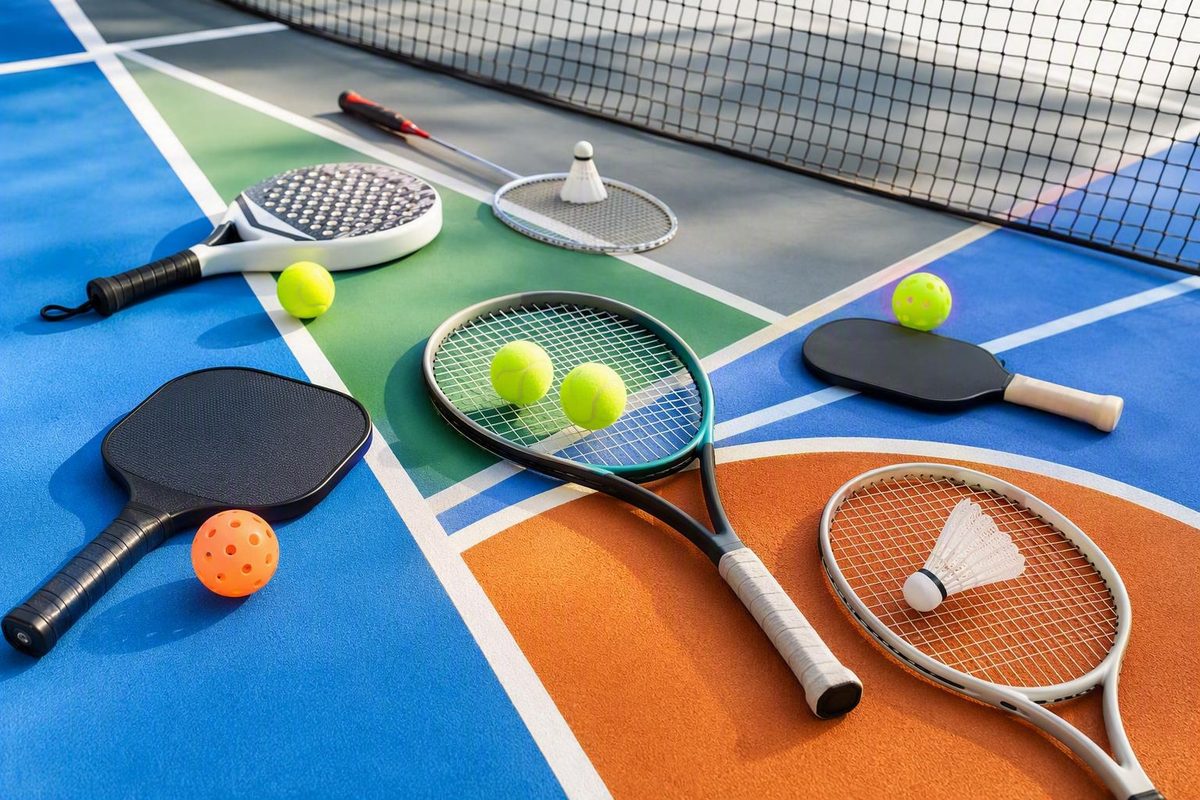
Tennis belongs to a broad family of racket and paddle sports. Some alternatives preserve the familiar experience of sending a ball across a central net. Others introduce playable walls, move the game onto a table, substitute a shuttlecock for a bouncing ball, or shift play to sand.
The recurring options are padel, pickleball, badminton, soft tennis, touchtennis, beach tennis, table tennis, racquetball, platform tennis, squash, and some forms of Basque pelota. Each preserves a different part of tennis, so a preference-based comparison is more useful than a universal ranking.
Editorial note: This guide was reviewed in September 2026 using the comparative materials cited in the text. Those materials are secondary or commercial sources rather than official rulebooks. Exact rules, equipment standards, and court requirements may vary by governing body, competition, discipline, or venue, so confirm current requirements with the organization running your session.
A quick guide to the main sports like tennis
A racket sport can be defined broadly as a game in which players use a racket or paddle to strike a ball or shuttlecock. A racket normally has a handled frame, an open hoop, and stretched strings. A paddle or bat has a solid face, although that face may be perforated or textured, as explained in this overview of racket and paddle sports.
Sharing that category does not make every game mechanically similar. Padel preserves a divided court and volleys but adds walls that remain in play. Squash uses a strung racket and bouncing ball but removes the central net. Badminton retains the net and racket while replacing bounce-based rallies with airborne shuttle exchanges. Table tennis compresses the contest onto a table.
A useful comparison should therefore consider several dimensions:
- Court layout: Is the playing area open, enclosed, compact, table-based, or on sand?
- Net or wall use: Do opponents hit across a net, toward a wall, or within an environment using both?
- Projectile: Does the game use a felt, rubber, plastic, foam, or low-compression ball—or a shuttlecock?
- Striking equipment: Is the implement a strung racket, solid paddle, perforated paddle, or table-tennis bat?
- Bounce pattern: Must the projectile bounce, may it bounce, or is it normally returned through the air?
- Stroke pattern: Are groundstrokes, volleys, overheads, wall rebounds, dinks, or compact reaction strokes central?
- Movement: Does play emphasize open-court coverage, enclosed-court positioning, sand movement, or short-range reactions?
- Setting: Is the sport associated with indoor courts, outdoor courts, beaches, tables, or specialist facilities?
- Social format: Are singles and doubles both available, or is one format more closely associated with the sport?
These criteria explain why there is no defensible universal answer to “Which alternative is closest to tennis?” A player focused on a tennis-like ball and scoring structure may prefer padel. Someone looking for a compact paddle game may investigate pickleball. A player attracted to overhead exchanges may choose badminton, while another may prefer the wall-based geometry of squash or racquetball.
No numerical similarity score is used here because the evidence does not provide a validated way to weight these features. Treating a central net as twice as important as the type of projectile, for example, would be an editorial choice rather than an objective measurement.
At-a-glance comparison of 11 tennis alternatives
The table compares the defining structure of each game. “Typical setting” identifies the environment most closely associated with the sport in the supplied comparison materials, not every possible venue or local format.
| Sport | Racket or paddle | Ball or shuttle | Net or wall | Typical setting | Defining difference from tennis |
|---|---|---|---|---|---|
| Padel | Solid perforated paddle | Tennis-like ball | Central net and playable enclosing walls | Specialist enclosed court; typically doubles | Wall rebounds remain live and change positioning |
| Pickleball | Solid paddle | Perforated plastic ball | Central net and non-volley zone | Compact indoor or outdoor court; singles or doubles | Underhand service and the kitchen alter net play |
| Badminton | Lightweight strung racket | Shuttlecock | High central net | Divided indoor or outdoor court | Rallies are aerial rather than organized around a bouncing ball |
| Soft tennis | Strung racket with lighter equipment | Soft rubber ball | Central net | Tennis-style court | Uses a softer ball than conventional tennis |
| Touchtennis | Shorter strung racket | Foam ball | Central net | Small court | Scales down the court, racket, and ball |
| Beach tennis | Solid paddle | Low-compression tennis-like ball | High central net | Sand court | Uses no-bounce aerial exchanges on sand |
| Table tennis | Solid bat or paddle | Lightweight ball | Small net across a table | Indoor table | Spin, placement, and reactions operate over a table |
| Racquetball | Strung racket | Rubber ball | Walls; no central net | Enclosed indoor court | Opponents return the ball through shared wall space |
| Platform tennis | Solid paddle | Depressurized ball | Net and playable wire screens | Specialist outdoor court | Perimeter screens participate in play |
| Squash | Strung racket | Small rubber ball | Walls; no central net | Enclosed indoor court | Players share the floor and direct shots toward the front wall |
| Basque pelota | Varies by discipline | Varies by discipline | Wall or net, depending on the form | Specialist court | It is a family of disciplines, not one standardized game |
These descriptions are summarized from a broad comparison of 11 sports like tennis. Basque pelota requires particular caution because the name covers multiple disciplines. Equipment, court design, and rules must be checked for the form being offered rather than inferred from the umbrella term.
Names that sound similar also need to be separated. Padel, paddle tennis, and platform tennis are not interchangeable labels. Padel uses an enclosed court with playable walls. Platform tennis uses solid paddles, a depressurized ball, and wire screens. The supplied evidence does not support a complete treatment of every game known as paddle tennis.
Padel, soft tennis, and touchtennis: alternatives that retain recognizable tennis features
Padel, soft tennis, and touchtennis are worth examining when the aim is to preserve a recognizable tennis structure. They are not an objective “top three.” Each retains familiar elements while changing the boundaries, ball, equipment, or scale.
Padel: tennis structure with playable walls
Padel preserves a divided court, tennis-like ball, volleys, and broadly tennis-like scoring. Tennis players will recognize the need to send the ball into the opposing half, coordinate with a partner, and choose between defensive and attacking positions.
The differences are fundamental. Padel uses a solid perforated paddle rather than a strung racket, begins points with an underhand serve, and is typically played as doubles on an enclosed court. The supplied comparison gives the court dimensions as 10 by 20 meters and identifies the walls as active parts of the game (padel comparison).
The walls change the rally structure. A ball that rebounds legally from the enclosure may remain playable, so players must account for both the initial bounce and the subsequent rebound. Positioning cannot be based solely on open-court tennis expectations.
Tennis experience may still provide a useful starting point for tracking the ball, volleying, placement, and coordinated partner movement. Transfer is only partial, however. Treating the enclosure as an out-of-play boundary would miss one of padel’s defining features.
Soft tennis: a softer-ball relative
Soft tennis originated in Japan and uses a softer rubber ball and lighter equipment.
The available evidence supports only a narrow comparison. The different ball and equipment mean players should expect the game to feel different from conventional tennis, but the supplied materials do not justify detailed claims about technique, difficulty, safety, or physical demand.
Soft tennis may be relevant to someone who wants a visibly tennis-related game rather than a wall sport or solid-paddle format. Local access is not established here, so prospective players should check whether nearby clubs provide suitable courts, balls, and organized sessions.
Touchtennis: tennis at a reduced scale
Touchtennis takes a scaled-down approach by using foam balls, shorter rackets, and a smaller court.
The smaller equipment and playing area distinguish it from conventional tennis without replacing the open, net-divided format. That may make touchtennis worth investigating for readers who want a compact game that retains obvious tennis equipment patterns.
It should not automatically be described as the closest alternative or the easiest entry point. Those judgments would depend on how a player defines similarity, personal experience, and whether a suitable local venue exists.
Together, these three sports show why “tennis-like” has several meanings. Padel retains a familiar ball-and-net structure but adds solid paddles and playable walls. Soft tennis changes the ball and equipment. Touchtennis reduces the scale while preserving an overtly tennis-derived format.
How pickleball changes the tennis formula
Pickleball and tennis share a clear foundation: opponents exchange a projectile across a net, and both singles and doubles are possible. Placement, volleys, anticipation, and partner coordination can therefore feel conceptually familiar.
Pickleball is not simply tennis on a smaller surface. Its paddle, ball, service method, court dimensions, scoring conventions, and non-volley zone create a distinct game.
Equipment and court structure
Tennis uses a strung racket and felt-covered ball. Pickleball uses a solid paddle and a lightweight perforated plastic ball. That equipment difference means tennis stroke production should not be assumed to transfer unchanged.
A pickleball court has a 20-by-44-foot footprint, and the net is 34 inches high at the center. The court also includes a non-volley zone near the net, commonly called the kitchen. The sport permits singles and doubles and uses an underhand serve (pickleball comparison).
The compact footprint reduces the maximum distance separating the players, but it does not establish that every pickleball session is easier or less demanding than tennis. Singles and doubles involve different coverage, and exertion varies with ability, rally intensity, playing style, and session length.
The serve and kitchen
Pickleball uses an underhand serve rather than the conventional overhead tennis serve. A tennis player’s service mechanics and assumptions about beginning a point do not therefore carry over directly.
The kitchen restricts volleying near the net. It does not mean the marked area is simply out of bounds for every shot; the relevant distinction is between returning a bounced ball and striking the ball out of the air. Because exact rule applications and competition procedures can change, players should consult the current rules adopted by their organizer before a match.
This restriction makes close-net play different from tennis. Moving forward remains tactically relevant, but players must account for the non-volley boundary rather than approaching the net under tennis conventions alone.
Typical scoring
A commonly described pickleball format uses games to 11 points, requires a two-point winning margin, and allows only the serving side to score. This is a typical summary rather than a rule guaranteed to apply at every recreational venue or competition (scoring overview).
The familiar tennis sequence of points, games, and sets therefore does not apply. Before playing, ask the organizer which scoring procedure, service order, and opening-rally rules the group follows.
What transfers from tennis—and what does not
Several areas of tennis experience may provide useful overlap:
- Volleying: Early recognition and a controlled hitting surface remain relevant.
- Placement: Directing the ball away from an opponent is useful in both sports.
- Doubles positioning: Coordinating movement with a partner matters in each game.
- Tracking and anticipation: Watching the opponent’s contact offers a useful starting point.
Transfer remains incomplete. Players must adapt to a solid paddle, perforated ball, underhand serve, compact court, different scoring, and the kitchen. Familiarity with a net sport may reduce the number of entirely new concepts, but it does not replace pickleball-specific rule learning.
For readers who choose pickleball, Pickleball Learn says its instructional sequence begins with commonly confusing rules, continues to dinks and drops, and then moves into recreational doubles positioning and shot selection. That is the publisher’s own educational framework, not an official governing-body curriculum (about its approach).
Badminton and beach tennis: net games with very different rally patterns
Badminton and beach tennis both preserve the sightline of opponents facing each other across a net. Neither should be treated as another version of bounce-based tennis.
Badminton: the bounce is replaced by flight
Badminton uses a lightweight strung racket and a shuttlecock. Its rallies are principally aerial: players return the shuttle before it reaches the floor. This removes the bounce-and-groundstroke rhythm that organizes much of tennis.
One supplied comparison lists both badminton and pickleball courts with a 20-by-44-foot outer footprint. Identical footprints do not create identical games; the shuttlecock, racket, high net, service patterns, and court markings produce a different structure (tennis, pickleball, and badminton comparison).
Badminton centers on controlling the shuttle through the air. A tennis player may recognize overhead exchanges, court placement, and the need to anticipate an opponent’s direction, but tennis groundstrokes are not the organizing foundation.
Badminton is therefore worth investigating when the attractive features are shuttle control, overhead exchanges, rapid reactions, and a divided court, rather than bouncing-ball rallies.
Beach tennis: paddles, sand, and no-bounce exchanges
Beach tennis moves play onto sand and uses solid paddles, a low-compression tennis-like ball, and a net set at approximately volleyball height.
The sand surface distinguishes movement from hard-court tennis, while the high net and no-bounce structure shift the game toward aerial control and overhead exchanges. Although the ball looks tennis-related, the paddle, surface, and rally rules create a separate playing experience.
Beach tennis is a suitable sport to investigate when the priorities are:
- a sand setting;
- a central-net game;
- solid paddles;
- no-bounce rallies; and
- aerial exchanges.
Badminton is the more relevant option for someone specifically interested in a shuttlecock and lightweight strung rackets. These are preference distinctions, not claims about which sport is safer, easier, or better exercise.
Squash, racquetball, table tennis, platform tennis, and Basque pelota
These sports are best organized by environment rather than by an assumed level of similarity to tennis. Squash and racquetball center play on walls. Table tennis reduces the field to a table. Platform tennis combines a central net with surrounding screens. Basque pelota covers multiple disciplines.
Indoor wall courts: squash and racquetball
Squash and racquetball are enclosed indoor racket sports without a central net dividing the opponents. Players use the walls as part of the legal rally and attempt to make the next return difficult.
At a broad level, both share several concepts with tennis:
- controlling the racket face;
- anticipating direction from an opponent’s preparation;
- varying shot depth and angle;
- recovering to a useful court position; and
- choosing between attacking and defensive responses.
Their spatial structure is different. Tennis places opponents on separate sides of a net.
The wall-based category does not make the two sports interchangeable. Their balls, rackets, court markings, service procedures, and detailed rules should be checked separately at the local venue.
A table instead of a court: table tennis
It preserves the basic competitive exchange of sending a projectile across a net so that the opponent cannot return it legally.
Table tennis may suit readers prioritizing indoor play and a minimal playing footprint. Tennis experience can provide a general understanding of placement and anticipation, but the mechanics and scale are substantially different.
Net and screens: platform tennis
It combines a central-net exchange with playable perimeter structures.
It should not be confused with padel. Both use solid striking equipment and enclosing structures, but their courts and equipment are not the same. Neither name should automatically be substituted for “paddle tennis,” which requires its own regional and rules context.
Platform tennis may interest someone who wants outdoor, screen-assisted play and has access to a specialist facility. Availability should be checked rather than assumed.
Basque pelota: a family, not one ruleset
Basque pelota cannot be summarized responsibly as one standardized tennis alternative. The term covers multiple disciplines with different equipment and playing structures. Some forms involve striking a ball toward a wall, while others use a net.
Its relevance depends on the discipline being offered. Before comparing it with tennis or another racket sport, ask:
- Which pelota discipline is available?
- What striking implement does it use?
- Is play directed toward a wall or across a net?
- What court and ball are required?
- Is the local format individual or team-based?
Without those answers, a universal equipment list or rally description would be misleading.
Choose by play style, venue, and group size
The right alternative depends on which parts of tennis you want to preserve and which you are willing to replace. Begin with the desired environment and rally type rather than an unsupported claim that one sport is best.
If you want an enclosed court and playable walls
Investigate padel. It retains a central net, tennis-like ball, volleys, and broadly familiar scoring while adding solid paddles and active walls. It is particularly relevant when a typically doubles-based format is part of the appeal.
Choose it expecting a wall-assisted game, not simply tennis played inside an enclosure.
If you want a compact net court and flexible group size
Consider pickleball. It supports singles and doubles and combines a compact court with solid paddles, a perforated plastic ball, an underhand serve, and a kitchen.
It is a practical candidate for players interested in placement, volleys, and partner positioning. Expect to learn new service, scoring, and non-volley conventions.
If you want a smaller game with recognizable tennis patterns
Look into soft tennis or touchtennis. Soft tennis uses a softer rubber ball and lighter equipment. Touchtennis uses shorter rackets, foam balls, and a smaller court.
Both preserve a visible relationship to tennis, but local access is not established here. Before buying equipment, confirm that a nearby venue offers the necessary court setup, rules, balls, and playing opportunities.
If you want aerial rallies with a shuttlecock
Try badminton. It suits someone attracted to overhead exchanges, directional shuttle control, and quick reactions. The divided court may look familiar, but the absence of bounce-based groundstrokes makes its rally structure distinct.
If you want indoor wall play
Investigate squash or racquetball. Both remove the central net and organize play around wall returns in an enclosed court.
Assess them separately. A local facility may support one sport but not the other, and their detailed equipment and rules differ.
If you want sand and no-bounce net play
Consider beach tennis. It combines a sand court, solid paddles, a high net, and aerial exchanges with a low-compression tennis-like ball.
The surface is a defining feature rather than a cosmetic variation. Test the game in its intended environment if possible.
If you want the smallest indoor footprint
Consider table tennis. It moves the contest to a table and emphasizes short-range reactions, spin, placement, and precise paddle control.
It offers less transfer in whole-court movement but preserves the challenge of constructing an exchange across a net.
If you want outdoor play involving screens
Investigate platform tennis where suitable facilities exist. Its wire screens, solid paddles, depressurized ball, and specialist outdoor court give it a distinct identity.
If you are exploring Basque pelota
Start by identifying the particular discipline. “Basque pelota” alone does not reveal whether the available game uses a wall, a net, or a particular striking implement.
Practical checks before committing
Once you have two or three candidates, ask local venues:
- Are suitable courts available at times you can use?
- Does the venue offer singles, doubles, open play, or organized competition?
- Can newcomers rent or borrow equipment?
- Are introductory sessions available?
- Which current rules and scoring format does the venue follow?
- Are special shoes, balls, eye protection, or other venue-specific items required?
- Do you need to arrive with a partner?
- What are the booking, membership, and equipment costs?
Availability and cost vary by location and cannot be inferred from a sport’s general description.
Court size also needs careful interpretation. A smaller playing area can reduce the maximum distance available to cover, but it does not guarantee low exertion. Singles and doubles require different movement, while rally intensity, session duration, skill, and playing style all affect the experience.
| Your priority | Start by investigating |
|---|---|
| Tennis-like net and ball structure plus walls | Padel |
| Compact paddle game with singles and doubles | Pickleball |
| Smaller tennis-derived format | Soft tennis or touchtennis |
| Shuttlecock and overhead exchanges | Badminton |
| Indoor wall rallies | Squash or racquetball |
| Sand and no-bounce play | Beach tennis |
| Very compact indoor setup | Table tennis |
| Outdoor court with playable screens | Platform tennis |
| A regional family of wall or net disciplines | The locally available Basque pelota form |
Trying two options is often more informative than relying on an abstract ranking. Shortlist one sport that preserves your favorite part of tennis and another that deliberately changes it. The contrast can reveal whether you value the ball, strokes, court geometry, partner play, or simply the competitive exchange.
Trying pickleball after tennis: what to learn first
A tennis player beginning pickleball should first recognize five structural differences: the solid paddle, perforated plastic ball, compact court, underhand serve, and kitchen. Together, they determine which tennis habits remain useful and which require adjustment.
1. Learn the rules before refining technique
Start with the service procedure, scoring, kitchen restrictions, line conventions, and the required opening sequence of a rally. Do not assume that tennis rules apply simply because both games use a divided court.
Pickleball Learn publishes an article titled “The Kitchen Rule, Finally Clear” as part of its educational coverage. The site is not an official rules authority, so competition questions should still be checked against the rules adopted by the relevant organizer.
2. Become familiar with the paddle and ball
The solid paddle and perforated plastic ball are different from tennis strings and a felt-covered ball. Early practice should focus on observing how the equipment responds rather than assuming that tennis contact will produce identical results.
The goal at this stage is familiarity, not the immediate transfer of a complete tennis stroke system.
3. Separate volleys from kitchen restrictions
Tennis players may already understand the value of moving toward the net, but pickleball places a specific restriction on volleying near it. Learn the boundary before trying to apply familiar volley instincts.
General skills such as early preparation, tracking, and placement may remain useful, but they operate within a different court structure.
4. Introduce dinks and drops
Pickleball Learn includes dinks and drops in its soft-game curriculum. These subjects focus attention on controlled height, depth, and pace rather than treating every contact as an opportunity for maximum speed.
5. Add doubles positioning and shot selection
After learning the basic rules and becoming comfortable with the equipment, turn to partner positioning and shot selection. Tennis doubles experience may provide useful concepts such as communication and coordinated movement, but pickleball’s court, ball, and kitchen change how those concepts are applied.
Readers can browse Pickleball Learn’s educational library for its rules, soft-game, and recreational strategy material. A practical learning order is:
- confirm the rules used by the local group;
- become comfortable with the paddle and ball;
- study dinks and drops;
- introduce doubles positioning; and
- refine shot selection through play.
Across all sports like tennis, the best choice depends on what you want to preserve. Padel adds playable walls to a familiar ball-and-net structure. Pickleball creates a compact paddle game shaped by the kitchen. Badminton substitutes aerial shuttle rallies. Squash and racquetball organize play around walls. Other alternatives change the ball, scale, surface, or setting.
Shortlist two options based on venue and play style, then confirm local access, equipment, session format, and current rules. If pickleball is your choice, begin with the rules before moving into its soft game and doubles strategy.
Frequently asked questions about sports like tennis
Which sport is most similar to tennis?
There is no universal answer because similarity depends on the features being compared.
Padel preserves a tennis-like ball, divided court, net, volleys, and broadly familiar scoring while introducing solid paddles, underhand service, and playable walls. Soft tennis retains a recognizable court-and-racket structure but changes the ball and equipment. Touchtennis scales down the court, racket, and ball while keeping a visibly tennis-derived format.
Padel may be the strongest candidate if a tennis-like ball, scoring structure, and net play matter most. Soft tennis or touchtennis may be more relevant if strung rackets and an open, tennis-style layout are higher priorities. None is objectively closest without first defining how those features should be weighted.
Is pickleball basically a smaller version of tennis?
No. Pickleball shares a divided net court, rally construction, volleys, and singles-or-doubles possibilities with tennis, but its core equipment and rules are different.
It uses a solid paddle and perforated plastic ball, an underhand serve, different scoring conventions, and a non-volley zone near the net. Those features affect service, close-net positioning, and shot selection. Calling it “small tennis” overlooks the kitchen and the decisions created by it.
What is the difference between a racket and a paddle?
A racket generally has a handled frame with an open hoop containing stretched strings. A paddle or bat has a solid striking face, which may be smooth, textured, or perforated.
Tennis, badminton, squash, racquetball, soft tennis, and touchtennis use strung rackets. Pickleball, padel, beach tennis, platform tennis, and table tennis use forms of solid-faced paddle or bat. Equipment category alone does not determine how similar two sports are.
Which sports like tennis use walls?
Padel uses enclosing walls that remain active during rallies. Squash and racquetball are enclosed wall games without a central net. Platform tennis uses surrounding wire screens that participate in play.
Some forms of Basque pelota also use a wall, but the specific discipline must be identified. These sports do not use enclosing surfaces in the same way: padel and platform tennis retain a central net, while squash and racquetball organize play around wall returns without one.
Which tennis-like sports can be played as doubles?
Pickleball can be played as singles or doubles, while padel is typically associated with doubles.
Other sports may offer partner formats, but actual availability depends on the discipline, ruleset, and venue. A sport may permit doubles even when a local club schedules mostly singles, fixed-pair sessions, or open recreational play. Confirm the available format before buying equipment or booking a court.