
Your First Pickleball Game, From Opening Serve to Game Point
Learn the score call, diagonal serve, required bounce on each side, Kitchen limits, common faults and what happens when each rally ends.
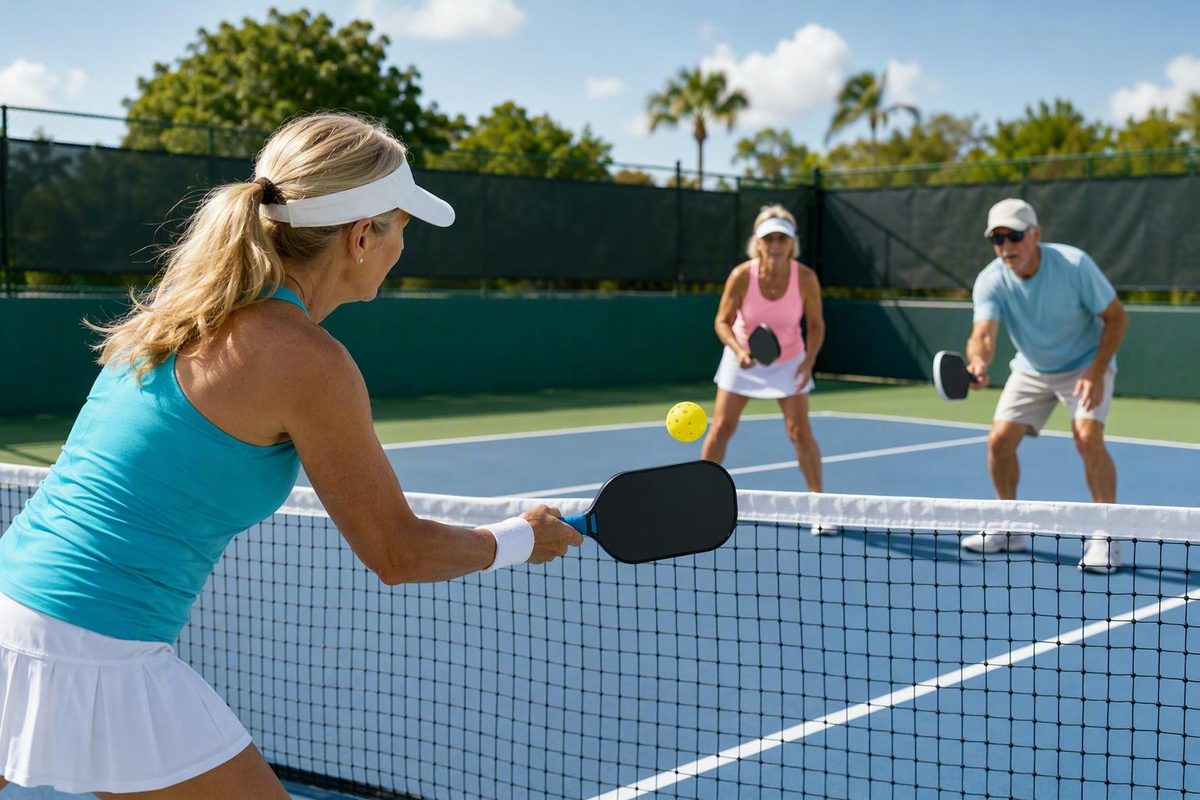
- Call the score.
- Serve diagonally.
- Let the serve bounce.
- Let the return bounce.
- Rally until a fault.
- Award a point or change the server.
This guide focuses on recreational doubles using traditional side-out scoring. It also explains the essential changes for singles. Mandatory rules are kept separate from optional strategy so you know what you must do and what you may simply choose to do.
Related: The Kitchen Rule, Finally Clear.
Pickleball at a Glance: Players, Equipment, Court, and Objective
Pickleball is a rally-based paddle sport played as doubles, with two players on each side, or singles, with one player on each side. Your immediate objective is to return the ball legally until the other side commits a fault.
A basic beginner setup includes:
- One paddle per player
- Pickleballs
- A net
- Access to a marked court
You do not need premium equipment or pickleball-specific clothing to understand the game or join a recreational match.
A standard court is 20 feet wide and 44 feet long for both singles and doubles. The net is 36 inches high at the sidelines and 34 inches at the center, while the non-volley zone extends 7 feet from the net on each side. These measurements are summarized in this beginner court and rules guide.
The main markings and areas are:
- Baseline: The back line at each end. The server begins behind it.
- Sidelines: The long outer boundaries.
- Centerline: The line dividing the area behind each Kitchen into right and left service courts.
- Right service court: The right half of the court from the viewpoint of the player standing at that end.
- Left service court: The left half from that player’s viewpoint.
- Net: The barrier dividing the court.
- Non-volley zone, or Kitchen: The area between the net and Kitchen line on each side.
A simplified overhead view looks like this:
                         ←──── 20 feet ────→

                    ┌─────────────────────────┐
                    │ Right service │ Left service │
                    │     court     │     court    │
                    ├───────────────┼──────────────┤
                    │       KITCHEN — 7 feet       │
                    ├═══════════════ NET ══════════┤
       44 feet      │       KITCHEN — 7 feet       │
          ↕         ├───────────────┼──────────────┤
                    │ Left service  │ Right service│
                    │     court     │     court    │
                    └─────────────────────────┘
The top and bottom labels differ because “right” and “left” are determined from each player’s own end while facing the net. For the player at the bottom, the right service court appears on the diagram’s right. For the player at the top, that player’s right appears on the diagram’s left.
The basic rhythm of play is: call the score, serve diagonally, observe the two required bounces, rally until a fault, and then apply the appropriate scoring or service consequence.
How to Start a Rally and Serve to the Correct Box
Any fair method can determine which player or team serves first. In doubles, the player positioned on the right side of the serving team begins.
The four-part serve-location checklist
Before serving, check four things:
- Begin behind the baseline.
- Serve from the area between the centerline and sideline.
- Send the ball crosscourt.
- Land it in the diagonally opposite service court beyond the Kitchen line.
The serve must clear both the Kitchen and its boundary line. A serve that lands in the Kitchen or touches the Kitchen line is a fault.
Volley serve and drop serve
Beginners should recognize two serve methods:
- Volley serve: Strike the ball before it bounces.
- Drop serve: Drop the ball, let it bounce, and then strike it.
USA Pickleball’s beginner guidance describes the volley serve at a high level as an underhand serve with contact below the waist and the paddle positioned below the wrist at contact. It also recognizes the drop serve as a separate method. The same guidance says the serve begins behind the baseline, travels crosscourt, and must clear the Kitchen and its line (USA Pickleball).
That is enough detail for a recreational introduction, but serve regulations are revision-sensitive. Do not treat this summary as a complete interpretation of current tournament requirements. If you are preparing for officiated play, consult the official rulebook in force for that event and follow the event official’s instructions.
A serve that clips the net is not automatically dead. It remains in play if it crosses the net and otherwise lands legally in the correct diagonal service court (Pickleheads).
Serve troubleshooting
| Outcome | Legal? | What happens? |
|---|---|---|
| Ball crosses the net and lands in the proper diagonal service court beyond the Kitchen line | Yes | The receiving side lets it bounce and returns it |
| Ball lands in the Kitchen or touches the Kitchen line | No | Service fault |
| Ball lands in the wrong service court | No | Service fault |
| Server begins from an invalid serving position or uses an invalid serve under the rules being applied | No | Service fault |
A deep serve toward the back of the service court is a common tactic because it may keep the receiver farther from the net. It is not a legal requirement. A shorter serve is legal if it lands in the proper service court beyond the Kitchen line.
Follow One Rally: Serve, Bounce, Return, Bounce, Then Open Play
The two-bounce rule is easiest to understand as a sequence:
- The server sends the ball diagonally across the net.
- The receiving side lets the serve bounce.
- The receiver returns the ball.
- The serving side lets that return bounce.
- Open play begins.
It requires one bounce on each side, not two bounces on the same side. After those two required bounces, either side may volley the ball or play it after another bounce (The FORT).
A volley is a shot struck out of the air before the ball bounces.
A sample rally from the score call to the first volley
Suppose Team A is beginning the game:
- Team A calls “0-0-2.”
- Team A serves diagonally from the right.
- Team B must wait: The serve lands and bounces in Team B’s correct service court.
- Team B returns the ball.
- Team A must wait: The return lands and bounces on Team A’s side.
- Team A plays the ball after that bounce.
- The two-bounce requirement is complete.
- If Team B’s next shot reaches Team A before bouncing, Team A may volley it, provided the player does not commit a Kitchen fault.
The serving player should not automatically sprint toward the net immediately after serving. Because the return must bounce on the serving side, the server should remain prepared to play that bounce. Moving forward later may be useful, but the incoming shot should influence when and how the player advances.
What ends the rally?
A fault is an action or event that ends the rally. Common beginner faults include:
- Hitting the ball out of bounds
- Allowing the ball to bounce twice before returning it
- Hitting the ball into the net without clearing it
- Making an invalid serve
- Volleying illegally from the Kitchen
Under traditional side-out scoring, the result depends on which side committed the fault:
- Receiving side faults: The serving side scores a point.
- Serving side faults: The serving side does not score, and its service turn ends or passes to the serving player’s partner.
- Receiving side wins the rally: The receiving side does not score under this format; it gains or moves toward gaining the serve.
The Kitchen Rule: What Is Legal, What Is a Fault, and Why Players Get Confused
The Kitchen is the non-volley zone extending 7 feet from the net on each side. Its boundary line is part of the zone.
That is incorrect. You may:
- Stand in the Kitchen
- Walk through the Kitchen
- Enter it to play a ball after the ball bounces there
- Remain there as long as you do not volley
The restriction concerns volleys, not general entry.
You may not volley while touching the Kitchen or its line. You also commit a fault if you volley from outside the Kitchen and your momentum from that shot subsequently carries you into the zone or onto its boundary line (Texas Pickleball’s rules comparison).
Legal and illegal Kitchen situations
| Situation | Legal? | Why? |
|---|---|---|
| A dink bounces in the Kitchen, and you step in to return it | Yes | You are playing the ball after a bounce |
| You stand in the Kitchen without volleying | Yes | The zone is not a general no-entry area |
| You volley while one foot touches the Kitchen line | No | The line is part of the non-volley zone |
| You volley outside the Kitchen, then momentum carries a foot onto the line | No | The momentum from the volley creates a fault |
Line treatment can seem inconsistent at first. For an ordinary rally shot, a ball landing on a boundary line generally counts as in. The important serve exception is that a serve touching the Kitchen line is invalid.
For an additional visual explanation, Pickleball Learn lists a dedicated article titled “The Kitchen Rule, Finally Clear”. Treat it as a follow-up explanation rather than a substitute for the governing rules used in formal or disputed play.
Doubles Scoring and Serving Order, Step by Step
This section explains traditional side-out scoring. Only the serving team can score a point under this format.
Games commonly go to 11 points and require a two-point winning margin, although other formats may be used. Agree on the format before the game begins.
How to call a doubles score
Call three numbers before every serve:
- Serving team’s score
- Receiving team’s score
- Server number: one or two
For example, 4-2-1 means:
- The serving team has 4 points.
- The receiving team has 2 points.
- The team’s first server during this service possession is serving.
“Server one” and “server two” are not permanent identities assigned to the partners for the entire game. They indicate whether the team is using its first or second service turn during its current possession.
Why the game starts at 0-0-2
Traditional doubles begins at 0-0-2 because the opening serving team receives only one service turn before the first side-out. Calling the opening player “server two” makes the normal sequence work: when that player loses a rally, service passes directly to the opponents.
After that opening exception, each team normally receives a first-server turn and then a second-server turn before a side-out. The three-number call, opening exception, switch after a point, and common game-to-11 format are demonstrated in this rules and scoring walkthrough.
Complete opening example
Assume Alex and Blair serve first against Casey and Drew:
- Alex stands on the right and calls 0-0-2.
- Alex serves diagonally.
- Alex and Blair win the rally, so their team scores.
- The score becomes 1-0-2.
- Alex and Blair switch left-right positions.
- Alex—the same player—serves again, now from the left.
- Alex and Blair lose the next rally.
- Because their opening possession began with server two, service passes directly to Casey and Drew.
That transfer of service to the opposing team is called a side-out.
A later service-possession example
Now suppose Casey and Drew gain service later in the game:
- Casey is the first server for this possession.
- Casey’s team loses a rally.
- No point goes to Alex and Blair because they were receiving.
- Service passes to Drew, Casey’s partner, as the second server.
- Drew’s team loses another rally.
- A side-out occurs, and service transfers to Alex and Blair.
If Casey or Drew had won a rally while serving, their team would have scored a point. The partners would then switch left-right positions, and the same individual would continue serving from the other side.
Compact doubles scoring flowchart
SERVING TEAM WINS RALLY
        ↓
Score one point
        ↓
Partners switch left/right
        ↓
Same player serves again


SERVING TEAM LOSES RALLY
        ↓
Was this the team's first server?
   ├─ Yes → Partner becomes second server
   └─ No  → Side-out to opposing team

Opening exception:
The game starts at 0-0-2, so the opening server's first loss
causes an immediate side-out.
If players disagree about the score or server, resolve the issue before putting the ball in play.
How Singles Changes the Serve, Score Call, and Court Coverage
Singles has one player on each side. It uses the same 20-by-44-foot court as doubles, together with the same Kitchen restrictions and two-bounce rule (Wintrust Sports Complex).
The main changes involve score calling and service rotation.
Singles scoring and serving
A singles score contains two numbers:
- Server’s score
- Receiver’s score
There is no server number because there is no partner waiting for a second service turn.
The server’s own score determines the serving side:
- Even score: Serve from the right.
- Odd score: Serve from the left.
The serve still travels diagonally into the opposite service court. When the server wins a rally, the server scores, changes sides, and serves again. When the server loses a rally, service immediately passes to the opponent.
Two score examples
- At 4-3, the server’s score is 4, an even number. The server serves from the right.
- At 5-3, the server’s score is 5, an odd number. The server serves from the left.
Only the server’s score determines the serving side. The receiver’s score does not.
Singles versus doubles coverage
In singles, one player covers an entire side of the court. In doubles, partners coordinate movement and divide coverage dynamically. That difference affects positioning and shot selection, but it does not make either format universally better or easier.
Choose according to preference:
- Singles emphasizes individual movement, placement, and recovery.
- Doubles adds partner communication, shared coverage, and coordinated positioning.
The Basic Shots and Positioning That Make a First Game Work
Everything in this section is strategy and instruction, not a list of mandatory rules. You do not have to master every shot before joining a beginner game.
Eight basic shots and their purposes
- Serve: Starts the rally and sends the ball into the diagonal service court.
-
Return: Sends the serve back after its required bounce.
-
Volley: A shot struck out of the air before it bounces.
-
Dink: A soft shot used near the Kitchen and intended to land short.
-
Lob: A high shot sent over an opponent.
- Overhead: A forceful shot played above the head, often against a high ball.
For a first game, prioritize control and keeping the ball in play before trying to add heavy power or spin. That is beginner guidance, not a guaranteed formula for winning.
Positioning after the serve and return
A deep return can give the receiving side more time to move toward the Kitchen line. The serving side has a different immediate obligation: it must let the return bounce. That is why the server and partner should not rush forward without regard to the incoming ball.
After the two required bounces, moving toward the Kitchen line is common doubles positioning. Advance under control and in response to the shot. If the opponents are hitting an aggressive ball, charging forward automatically may leave you off balance.
Useful beginner habits include:
- Hold a balanced ready position.
- Keep volley motions compact rather than taking a large backswing.
- Recover your balance after each shot.
- Let the height and quality of the incoming ball influence whether you advance.
- In doubles, move in coordination with your partner.
- Communicate about balls traveling through the middle.
- Avoid leaving a large gap between partners.
These positioning ideas—including staying prepared behind the baseline after serving, advancing under control, using compact volleys, and coordinating with a partner—are instructional recommendations rather than rules (PlayPickleball).
Dinks and drops belong to the soft game: controlled shots intended to land short rather than overpower an opponent. That progression also reflects Pickleball Learn’s stated teaching order: confusing rules first, the soft game next, and recreational strategy after that.
Rules versus strategy
| Situation | Rule or strategy? | Meaning |
|---|---|---|
| Let the serve bounce and then let the return bounce | Rule | Required before either side volleys |
| Do not volley while touching the Kitchen | Rule | Violating it ends the rally |
| Serve deep | Strategy | A common choice, but not required |
| Hit a deep return | Strategy | May create more time to advance |
| Move toward the Kitchen line after the required bounces | Strategy | Common positioning, not mandatory |
| Advance together with your partner | Strategy | Supports coordinated coverage |
| Prioritize control over maximum power | Strategy | Beginner guidance, not a rule |
Your First-Game Checklist and Five-Minute Practice Plan
Pregame checklist
Before starting:
- Confirm whether you are playing singles or doubles.
- Confirm traditional side-out scoring or another agreed format.
- Identify the court boundaries and Kitchen lines.
- Choose the first server through a fair method.
- Make sure everyone understands the two-bounce rule.
- Make sure everyone understands that entering the Kitchen is legal but volleying while touching it is not.
- Agree on the target score and winning margin.
One-minute court orientation
Walk the court before serving:
- Find the baseline: The serve begins from behind this line.
- Point to the diagonal service target: The serve must travel crosscourt.
- Identify the Kitchen line: The serve must clear it; touching it is a fault.
- Trace the ordinary boundaries: Baselines and sidelines generally count as in when a rally shot lands on them.
Five-minute cooperative practice
This is a simple preparation sequence, not a claim about the optimal way to train.
Minute 1: Cooperative diagonal serves Serve gently from behind the baseline and aim for the correct diagonal service court. Focus on direction and legality rather than power.
Minute 2: Serve and return The receiver lets every serve bounce and returns it. The serving side catches the return after it bounces, reinforcing the correct sequence.
Minute 3: Four-shot two-bounce rehearsal Play four controlled shots:
- Serve
- Return after the serve bounces
- Third shot after the return bounces
- Fourth shot, which may be a volley or groundstroke
Minute 4: Gentle volleys Stand outside the Kitchen and exchange controlled volleys. Keep your feet clear of the Kitchen line and use compact motions.
Minute 5: Cooperative dinks Allow the ball to bounce in or near the Kitchen and exchange soft shots. Practice stepping in for a bounced ball and then recovering your position.
First-point script
For the opening point of a doubles game:
- Call 0-0-2.
- Serve diagonally from the right.
- The receiving side lets the serve bounce.
- The serving side lets the return bounce.
- Continue the rally with volleys or groundstrokes.
- Identify the fault that ends the rally.
- If the receiving side faulted, award the serving side a point.
- If the serving side faulted, apply the opening exception and give service to the opponents.
Five reminders during play
- Call the score before serving.
- Serve from behind the baseline.
- Wait for both required bounces—one on each side.
- Do not volley while touching the Kitchen or its line.
- Only the serving side scores under traditional side-out scoring.
Quick-reference card
Doubles score call: Serving score — receiving score — server number Opening call: 0-0-2; the opening team gets one service turn before side-out Two-bounce sequence: Serve bounces — return bounces — open play Kitchen rule: You may enter, but you may not volley while touching the zone or its line; volley momentum cannot carry you in Common faults: Out ball, second bounce, failure to clear the net, invalid serve, illegal Kitchen volley After a serving point: Switch left-right; the same player continues serving After a service loss: First server passes service to the partner; second server causes a side-out, except during the opening 0-0-2 possession
This is a practical beginner overview of traditional recreational play, not a complete tournament rulebook. Serve mechanics and other technical interpretations can change or require more detail than a beginner guide provides. For officiated competition, unusual faults, or disputed situations, consult the current rules adopted for the event.
Frequently Asked Questions
Can you stand in the Kitchen in pickleball?
Yes. You may stand in, enter, or walk through the Kitchen. You may also step into it to play a ball after that ball bounces.
A fault occurs when you volley while touching the Kitchen or its boundary line, or when momentum from your volley carries you into the zone afterward (Texas Pickleball).
Why does a doubles pickleball game start at 0-0-2?
The opening serving team receives only one service turn before the first side-out. Calling the opening player “server two” means that when the team loses its first serving rally, service passes directly to the opponents.
After that opening exception, each doubles team normally has a first-server turn and then a second-server turn before side-out (rules and scoring guide).
Does a pickleball serve count if it touches the net?
It can. If the serve clips the net, crosses successfully, and lands legally in the correct diagonal service court beyond the Kitchen line, play continues. If it falls short, lands in the Kitchen, touches the Kitchen line, or lands outside the proper service court, it is a fault (Pickleheads).
Are lines in or out in pickleball?
Ordinary boundary lines generally count as in. The notable beginner exception is the Kitchen line on a serve: the serve must clear the Kitchen and its line, so a serve touching that line is a fault.
The Kitchen line is also part of the Kitchen when judging a player’s position during a volley (USA Pickleball).
What is the main difference between singles and doubles pickleball scoring?
Singles uses a two-number call: the server’s score followed by the receiver’s score. The server serves from the right when the server’s score is even and from the left when it is odd.
Doubles uses three numbers: the serving team’s score, the receiving team’s score, and the server number. Doubles normally gives both partners a service turn before side-out, while a singles player who loses a serving rally gives service directly to the opponent.
The complete playing-order framework is straightforward: call the score, serve diagonally, wait for one bounce on each side, rally without an out ball, second bounce, or illegal Kitchen volley, and then apply the point or service change.
Keep the quick-reference card nearby during a low-pressure first game. Favor control over power, and add soft-game skills and coordinated doubles positioning after the foundational rules and scoring sequence feel familiar.