
What Beginner Pickleball Lessons Should Teach—and in What Order
Choose beginner pickleball lessons that teach the Kitchen rule, serve and return, soft shots, doubles positioning, and a simple practice plan.
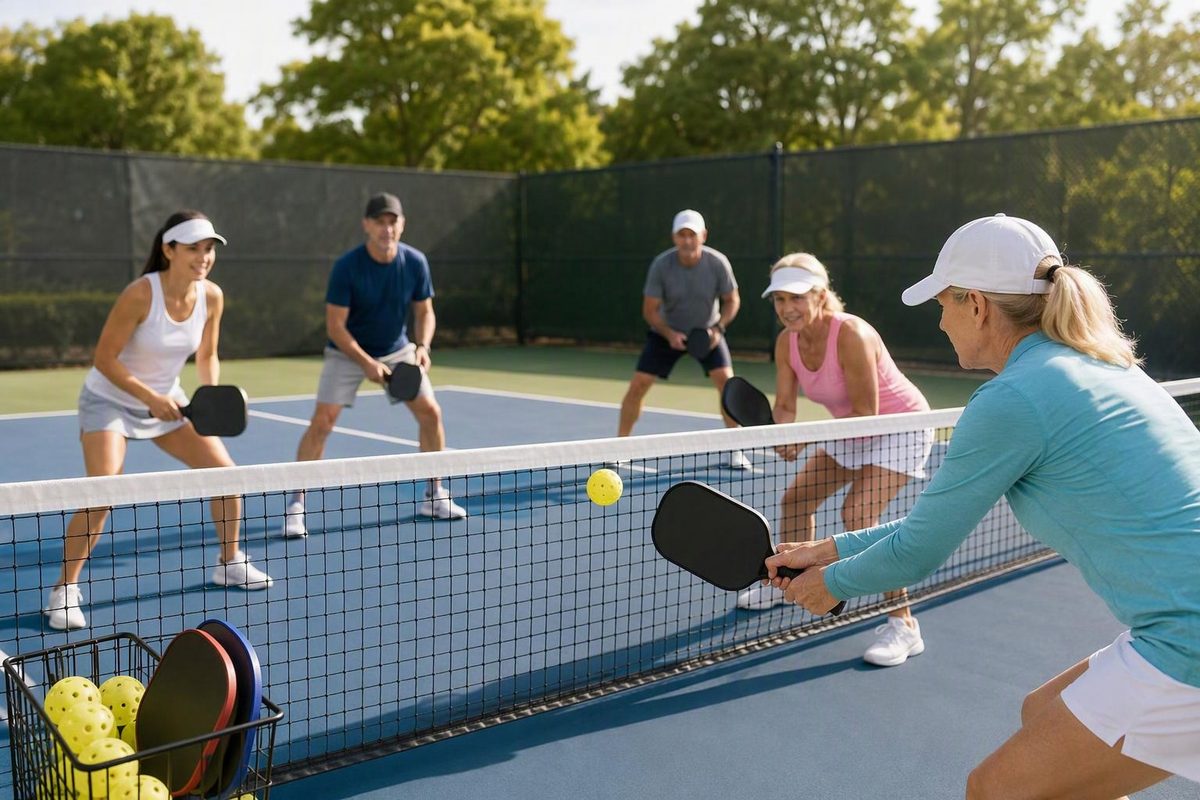
Beginner pickleball lessons should get you ready to play a real doubles point—not bury you in every rule or advanced shot at once. A useful learning order is:
- The Kitchen and two-bounce rules
- Serve, return and basic scoring
- Dinks and controlled volleys
- Movement to the non-volley-zone line
- Simple doubles positioning
Whether you book a clinic, a group series or a private session, use that order to judge what the lesson offers.
Clear up the Kitchen rule first
The Kitchen is pickleball’s non-volley zone: the 7-foot area on each side of the net. The common misunderstanding is that you cannot enter it. You can. You may stand there and hit a ball after it bounces.
What you cannot do is volley—hit the ball before it bounces—while touching the Kitchen or its line. It is also a fault if your momentum from a volley carries you into the zone. Those details are part of the 2026 USA Pickleball rules summary and are explained through common court situations in The Kitchen Rule, Finally Clear.
A beginner lesson should let you test the rule rather than merely hear it. Try three feeds:
- Volley while standing behind the line: legal.
- Step into the Kitchen and hit after a bounce: legal.
- Volley from behind the line, then fall or step into the Kitchen because of your momentum: fault.
Checkpoint: Before swinging, you can say whether the incoming ball will bounce or be volleyed and place your feet accordingly.
What the first lesson should cover
A good first session can stay narrow. You need enough instruction to start a legal rally and keep the ball in play.
Grip, ready position and compact contact
Start with a comfortable neutral grip, the paddle in front of your body and enough knee bend to move in either direction. Practice short swings and contact in front rather than taking a large tennis-style backswing. USA Pickleball’s beginner positioning guidance likewise emphasizes a paddle-up ready position, short backswings and contact in front of the body (USA Pickleball).
The instructor does not need to rebuild every movement immediately. One observable cue—such as “finish balanced” or “meet the ball in front”—is more useful than several mechanical changes at once.
Serve and return
Learn one repeatable serve before trying to add speed or spin. The serve travels diagonally into the opposite service court. Under the standard rules, a volley serve has specific upward-motion, contact-height and paddle-position requirements; a drop serve follows a different test. Only one serve attempt is allowed. The official summary provides the current serve checklist.
Then learn the rule that controls the opening of every rally: the receiver must let the serve bounce, and the serving team must let the return bounce. After those two required bounces—one on each side—either team may volley. See the two-bounce rule step by step.
A simple positioning cue follows from that rule:
- Serving team: Remain near the baseline so the return can bounce in front of you.
- Receiving team: The receiver begins behind the baseline, while the receiver’s partner can start at the Kitchen line.
Checkpoint: Play five rally starts without either team volleying too early.
Score and rotation
Your lesson should teach enough scoring to prevent confusion, but scoring should not consume the whole session. In traditional side-out scoring, only the serving team scores. A doubles score call gives the serving team’s score, the receiving team’s score and the server number. Games are normally played to 11, win by two. USA Pickleball’s 2026 rules summary also describes rally scoring, in which a point is awarded after every rally, so ask which scoring system your venue, league or event uses (USA Pickleball rules summary).
Practice by playing a short game to five while pausing before each serve to identify the server, the correct side and the score call. If you want the whole sequence before class, use How to Play Pickleball.
What lessons two through four should add
Once you can start a point correctly, build toward the part of the court where doubles rallies are commonly played.
Lesson two: dinks and controlled volleys
A dink is a soft shot, usually hit after a bounce near the Kitchen, intended to land in the opponents’ non-volley zone. Learn to lift it over the net with a compact motion rather than flicking or chopping at it.
Pair that with controlled volleys from behind the Kitchen line. The goal is not a winner. Keep the paddle in front, block the ball and recover to a ready position.
Checkpoint: With a partner, complete five cooperative dinks in a row, then five controlled volleys without stepping on the Kitchen line.
Lesson three: moving forward without rushing
The returning team can often establish its position near the Kitchen line early. The serving team must first allow the return to bounce, then earn its way forward. A third-shot drop—a softer shot intended to descend into the opponents’ Kitchen—can create time to advance, but it is not automatically successful simply because it lands there.
Move with your partner and stop in a balanced position before the opponent strikes. Do not run through the shot. If your ball sits high, pause rather than charging into an attack.
Checkpoint: Both partners arrive at roughly the same depth and are balanced when the opponents make contact.
Lesson four: doubles decisions
Your first strategy does not need complicated patterns. Use three priorities:
- Return the ball in court with margin.
- Move with your partner instead of leaving a large middle gap.
- Choose a soft shot when attacking would require hitting upward from below net height.
Play conditioned points in which the feed, serve or return is predetermined. That gives you repeated practice with one decision while preserving the shape of a real rally.
Group clinic or private lesson?
Choose a group beginner clinic if you want an introduction, partners to practice with and repeated exposure to scoring and rotation. Ask about the player-to-instructor ratio and how much of the session involves hitting rather than waiting.
Choose a private lesson if mobility, prior racket-sport habits or one persistent technical problem calls for individual attention. A semiprivate lesson with one partner can be especially useful for doubles movement and communication.
Before paying, ask:
- Is this for true beginners or players who already sustain rallies?
- Are paddles and balls supplied?
- Will we learn standard scoring and play supervised points?
- How much court time does each player receive?
- What should I practice before the next session?
Certification is one useful signal, not a substitute for clear teaching. USA Pickleball identifies PCI, PPR and RSPA as its official coach education and certification partners (USA Pickleball). Also look for an instructor who states the goal, demonstrates it, watches each player and gives a specific correction.
What to bring
Bring water, comfortable athletic clothing and court shoes designed to support side-to-side movement. USA Pickleball also highly recommends eye protection and advises warming up before play (Health & Safety Hub). Ask whether loaner paddles are available before buying equipment solely for the first lesson.
Tell the instructor about relevant physical limitations before the session. During drills, retrieve stray balls before restarting and avoid backing into another court while watching the ball.
A 20-minute practice between lessons
Use a partner and eight balls:
- 5 minutes: Cooperative serves and returns. Count only rally starts that satisfy both required bounces.
- 5 minutes: Crosscourt dinks. Aim well inside the sidelines rather than at the corners.
- 5 minutes: One player feeds controlled volleys while the other blocks from behind the Kitchen line; switch halfway.
- 5 minutes: Play points to five. Call the score before every serve and freeze briefly after each shot to check both partners’ positions.
Track one result, such as legal rally starts out of ten or the longest dink sequence. Your next beginner pickleball lesson can then address an observed problem instead of beginning with “I just need to get better.”