
What Is Pickleball? Learn the Game’s Basic Rules
Learn what pickleball is, what equipment you need, how the Kitchen and two-bounce rules work, and a simple way to try your first rallies.
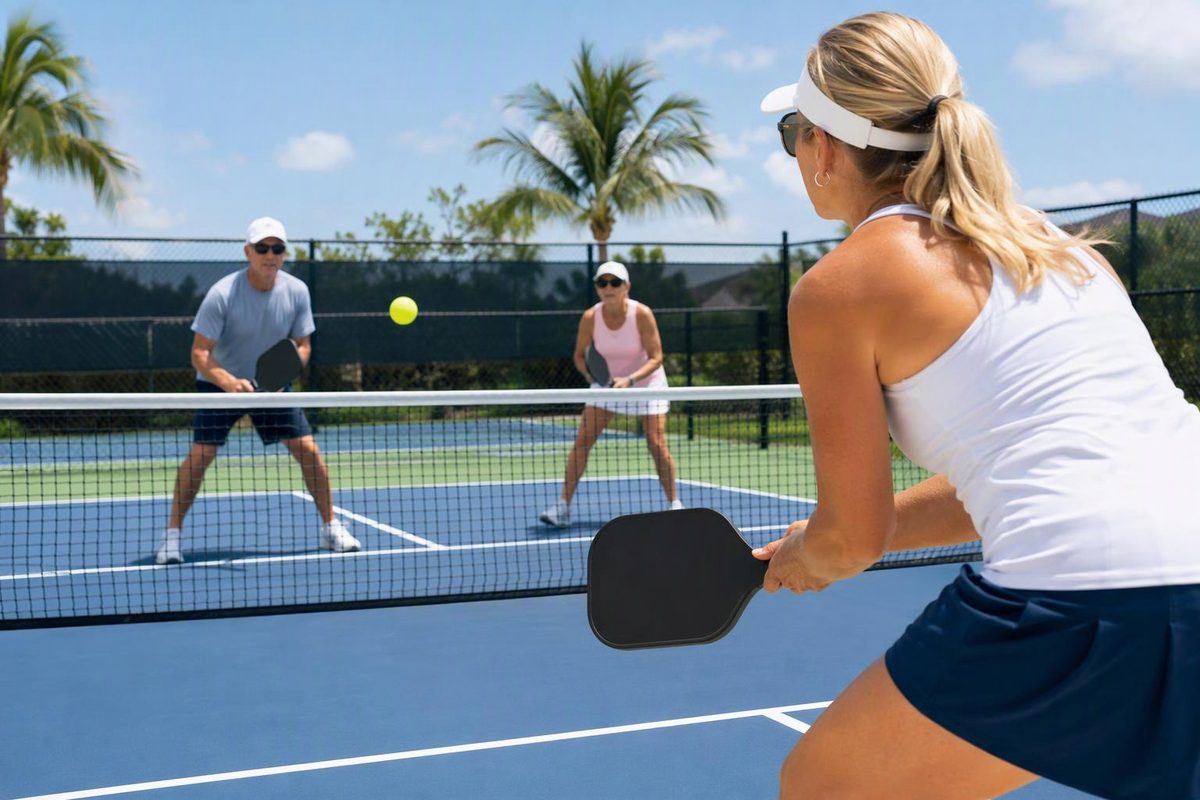
Pickleball is a paddle sport in which two or four players hit a perforated plastic ball back and forth across a net. You can play singles—one player on each side—or doubles, with two players per team. It combines elements of tennis, badminton and table tennis, but two rules give it a distinct feel: the Kitchen rule and the two-bounce rule. USA Pickleball’s overview explains the basic format.
The aim is to return the ball into your opponents’ court until they cannot make a legal return. That might mean they hit out, fail to get the ball across the net or let it bounce twice.
The Kitchen is not a “keep out” zone
The Kitchen, officially called the non-volley zone, extends 7 feet from the net on each side. A volley means hitting the ball before it bounces.
You may stand in the Kitchen and hit a ball that has bounced. What you cannot do is volley while you—or anything in contact with you—touch the Kitchen, including its boundary lines. You also cannot let your volley’s momentum carry you into it or into contact with someone or something touching it. After touching the Kitchen, both feet must contact the playing surface completely outside it before you volley again. These are the limits in Sections 3 and 11 of the 2026 USA Pickleball Official Rulebook.
For example: a short ball bounces near the net. You can step into the Kitchen, return it and step back out. You do not have to stay outside and stretch awkwardly to reach it.
The first two returns must follow a bounce
Every rally starts with a serve. The two-bounce rule then requires:
- The receiver to let the serve bounce before returning it.
- The serving side to let that return bounce before hitting it.
After those two required bounces, either side may volley from a legal position or play the ball after one bounce. It does not mean letting the ball bounce twice on your side. Section 10 of the 2026 rulebook sets out both requirements.
In doubles, this explains why the serving team should stay back for the return rather than immediately run toward the net. The receiver starts behind the baseline, while their partner can begin just outside the Kitchen line. These are USA Pickleball’s recommended starting positions, not mandatory positions for everyone.
What you need to play
Start with a pickleball paddle for each player, a pickleball, court shoes suited to sideways movement and access to a marked court with a net. Ask whether a beginner session provides loan equipment before buying your own.
The court is 20 feet wide by 44 feet long, with the same dimensions for singles and doubles. The net is 36 inches high at the sidelines and 34 inches at the center. You can play indoors or outdoors. USA Pickleball’s court and equipment overview describes the setup.
Serving and scoring, briefly
Serve from the correct serving area behind the baseline into the diagonally opposite service court. The ball must land beyond the Kitchen and its line. One beginner-friendly option is a drop serve: release the ball from one hand at a natural, unaided height, without tossing, pushing or adding spin. Keep the release visible to the receiver, let the ball bounce, then hit it. Section 7 of the 2026 rulebook covers serve placement and both legal serve types.
In standard scoring, only the serving side earns points. Games are typically played to 11, win by 2. The 2026 rules also include a provisional rally-scoring option, where the winner of each rally earns a point, so ask which format your group uses. See USA Pickleball’s scoring overview and Sections 4 and 14 of the rulebook. For score calls and doubles serving turns, follow our first-game walkthrough.
Try the soft game first
Pickleball is not only about hitting hard. A dink is a soft shot that lands in your opponent’s Kitchen. Keeping it low makes it harder for an opponent to attack aggressively, as explained in USA Pickleball’s dink guide.
Try this five-minute partner practice:
- Setup: Face each other just outside the Kitchen lines.
- Action: Gently feed the ball into the opposite Kitchen. Let each shot bounce and use a short swing to send it back. Step in when needed, then recover outside the line.
- Checkpoint: Aim for five consecutive shots that land in the Kitchen. Count controlled placements, not hard hits.
Once that feels comfortable, use beginner pickleball lessons to connect the rules, serve and return, soft shots and doubles positioning.