
How High Is a Pickleball Net? Measure These Three Spots
A pickleball net is 34 inches at the center and 36 at the sidelines. Learn the 2026 tolerance, where to measure and how to check your setup.
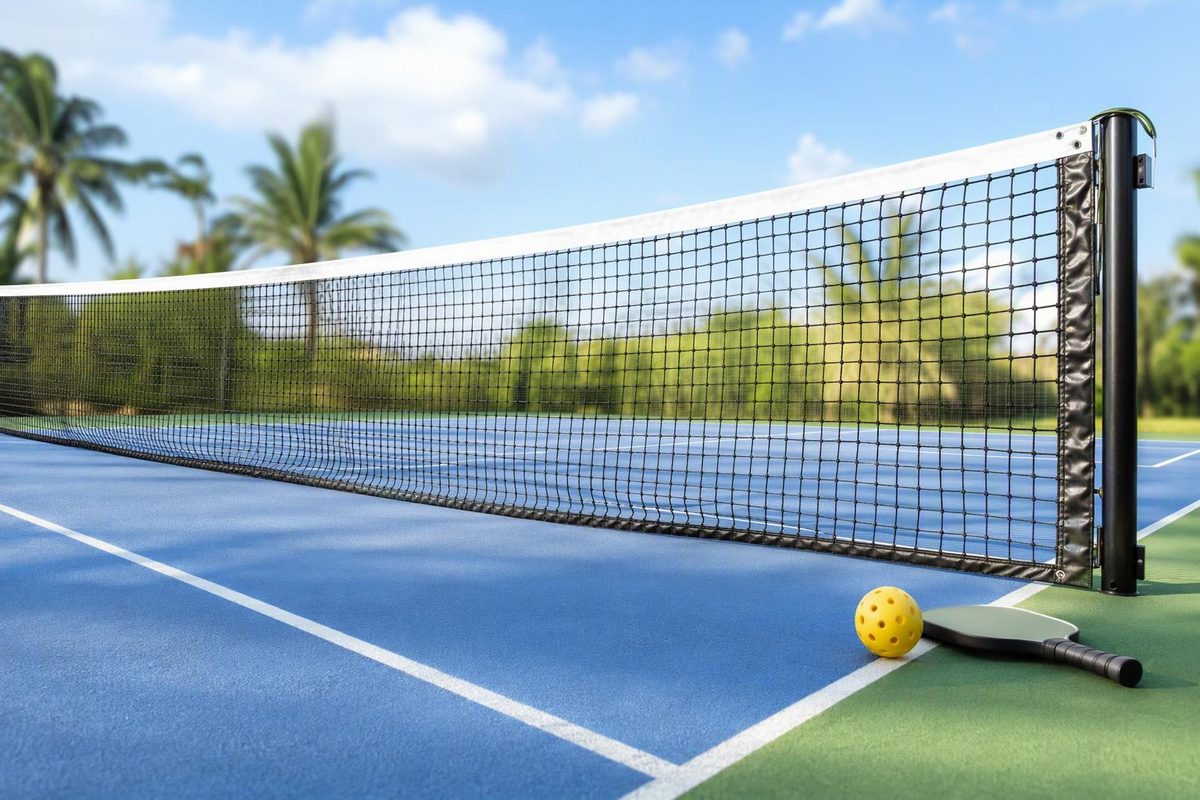
Under USA Pickleball rules, a net is 34 inches high at the center and 36 inches high at both sidelines, measured from the playing surface to the top of the net. It should not be level all the way across.
The 2026 USA Pickleball Official Rulebook, Rules 3.B.6–3.B.7, allows a tolerance of ¼ inch above or below each specified height:
| Measurement point | Target height | Allowed range |
|---|---|---|
| Center of the court | 34 inches (86.36 cm) | 33¾–34¼ inches |
| Outer edge of either sideline | 36 inches (91.44 cm) | 35¾–36¼ inches |
Aim for the target measurements when setting up; the tolerance is not a reason to deliberately lower the net.
Measure at the sidelines—not the posts
The important distinction is where the net crosses the outer edge of each sideline. Measuring only beside the posts does not check the required sideline height: the posts sit outside the court.
At the center, measure to the top of the net, including the center strap if one is fitted. The rulebook permits a center strap to help adjust the middle to the required height. These details are specified in Rules 3.B.2 and 3.B.5–3.B.7.
For the surrounding layout, see pickleball court dimensions.
A quick net-height check
Use a tape measure before your warm-up:
- Check both sidelines. Hold the tape vertically from the court surface to the top of the net at each sideline’s outer edge. Aim for 36 inches at both locations.
- Check the center. Measure halfway between the sidelines. Aim for 34 inches, including any center strap.
- Adjust the setup. Follow the net system’s instructions for tension, height or center-support adjustment. Do not assume a portable net is correct simply because its frame is fully assembled.
- Recheck all three spots. An adjustment in one place can affect another.
Keep the tape upright rather than angled, and avoid lifting or pressing down on the net while measuring. If a shared court’s net cannot be adjusted correctly, tell the facility operator instead of modifying its hardware.
What the lower center means for your soft game
A shot crossing near the center has a lower net to clear than one crossing near a sideline. That is useful when practicing dinks—soft shots that bounce in the opponent’s Kitchen—but it is not an invitation to skim the tape.
Try this checkpoint: after checking the net height, stand diagonally opposite a partner near your Kitchen lines. Let every shot bounce and exchange ten cooperative dinks that cross near the center. Use a gentle arc and enough clearance to keep the exchange going.
Count shots that both clear the net and bounce in the Kitchen. If several hit the tape, add a little height to the trajectory rather than simply hitting harder.