
How to Play a Standard Singles Pickleball Game
Covers full-court play, diagonal serves, both required bounces, volley timing, who can score, and exactly when service changes hands.
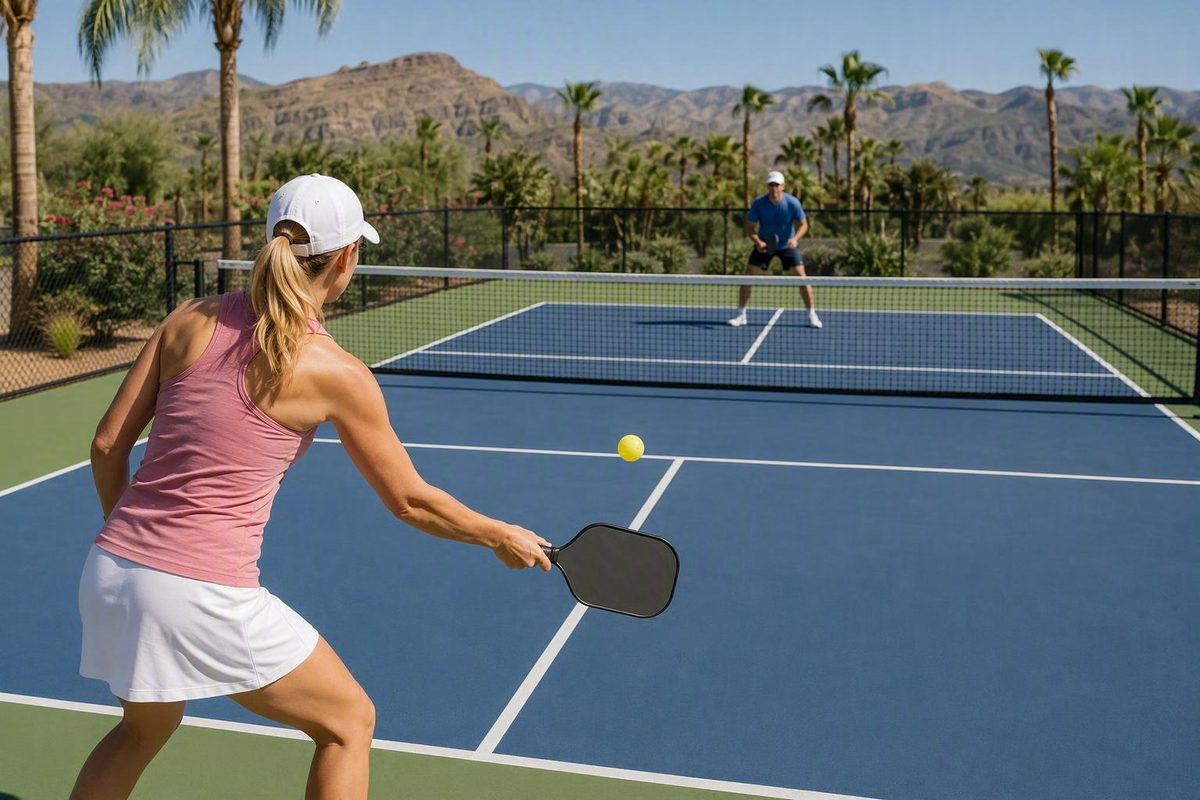
Standard singles pickleball uses the full court. Serve diagonally into the opponent’s opposite service court, allow both the serve and the return to bounce, and then continue with volleys or shots after a bounce. Under standard side-out scoring, only the server can score. A server who wins the rally earns a point, changes service courts, and serves again; a receiver who wins takes over the serve without receiving a point.
Singles rules at a glance
The quick-reference table below summarizes standard singles under the 2026 USA Pickleball Official Rulebook.
| Rule | Standard singles requirement |
|---|---|
| Court | The full 20-by-44-foot court is in play |
| Serve direction | Diagonally into the opponent’s opposite service court |
| Who can score? | Only the server |
| Service run | Continues until the server loses a rally |
| First two shots | The serve and the receiver’s return must each bounce |
| Non-volley zone | Each zone is 7 by 20 feet; do not volley while touching it or its lines |
| Typical winning score | 11 points, with a lead of at least two |
The easiest sequence to remember is serve, bounce, return, bounce, then play out the rally. If the server wins, award a point and have the server continue from the other service court. If the receiver wins, award no point and transfer the serve.
The usual target is 11 points with a two-point winning margin, but an event may announce a different target or an optional format. Confirm the scoring method before starting.
The singles court and diagonal serve
Singles does not use narrowed sidelines. The regulation playing area is 20 feet wide and 44 feet long, and one player is responsible for the entire court on each side of the net (2026 USA Pickleball Official Rulebook).
Each end has a right service court and a left service court. A service court lies on one side of the centerline and extends from the non-volley-zone line to the baseline. The baseline, sideline, and centerline that bound the receiving court are included in that service court.
The server directs the ball diagonally across the net into the opponent’s opposite service court. A player serving from one side therefore targets the service court across the centerline on the receiver’s end.
To visualize the layout, picture a full-width court divided lengthwise by the net. At each end, the centerline separates the right and left service courts. Between the net and the service courts is the non-volley zone, which spans the full width of the court. A legal target area for the serve is the service court diagonally opposite the server.
Two categories of lines are important:
- The baseline, sideline, and centerline bounding the target service court belong to that service court.
- The non-volley-zone line belongs to the non-volley zone.
That distinction affects whether a ball lands in the target service court and whether a player is touching the non-volley zone while volleying.
How scoring and service changes work
Standard singles uses side-out scoring. Only the player serving can add a point to the score.
When the server wins a rally:
- The server receives one point.
- The server changes to the other service court.
- The server serves again.
The same player continues serving and alternating service courts after each successful serving rally. The service run ends when that player loses a rally.
When the receiver wins, the receiver does not earn a point. Instead, service passes to that player, who becomes the new server. This transfer of service after a singles player loses the serve is called a side out.
| Situation | Point awarded? | What happens next? |
|---|---|---|
| Server wins the rally | One point to the server | Server changes service courts and serves again |
| Receiver wins the rally | No point | Side out; receiver becomes the server |
| Score reaches 11–10 | Not yet a win | Continue until someone leads by two |
At 11–10, the leader has reached the usual target but does not have the required two-point margin. The game therefore continues and could end at 12–10. If the margin remains one point, play continues beyond that score (2026 USA Pickleball Official Rulebook).
Because a receiver cannot score under side-out scoring, winning two consecutive rallies does not necessarily produce two points. A player might win the first rally as receiver to gain the serve, then win the next rally as server to score one point.
A singles rally, step by step
A standard rally unfolds as follows:
- The server serves diagonally. The ball travels over the net toward the opponent’s opposite service court.
- The receiver allows the serve to bounce. After that bounce, the receiver returns the ball.
- The server allows the return to bounce. The server then plays the third shot.
- Open rally play begins. Once both required bounces have occurred, either player may hit subsequent balls after a bounce or volley them, subject to the non-volley-zone restriction.
- The rally ends. One player wins when the opponent commits a fault or otherwise loses the rally.
The first two required landings satisfy the two-bounce rule. The rule does not require every shot to bounce twice. It requires the served ball to bounce before the receiver strikes it and the receiver’s return to bounce before the server strikes the next shot.
After those two bounces, players generally have two choices: play the ball after it bounces or strike it out of the air. A shot struck out of the air is a volley, so the player’s position relative to the non-volley zone matters.
The result of the rally depends on who served:
- If the server wins, the server scores one point, changes service courts, and serves again.
- If the receiver wins, no point is awarded and service changes hands.
A fault is a rule violation that makes the ball dead and causes the offending player to lose the rally. For basic scoring purposes, the key result is straightforward: a server’s fault causes a side out, while a receiver’s fault gives the server a point and another serve.
The non-volley zone in singles
A volley is a shot struck before the ball bounces. A singles player may not volley while touching the non-volley zone, commonly called the kitchen.
Each non-volley zone is 7 feet deep and spans the court’s 20-foot width. Its boundary lines are part of the zone under the official rulebook. A player standing on the non-volley-zone line is therefore touching the zone and commits a fault by volleying from that position.
The restriction applies specifically to volleys. It does not prohibit every shot played from inside the zone. If the ball has bounced, a player may enter the zone and strike it after the bounce.
Use this basic distinction during play:
- The ball has bounced: It may be played while the player is standing in the non-volley zone.
- The ball has not bounced: The player may not strike it while touching the zone or any of its boundary lines.
Before attempting a volley near the kitchen, check where your feet are. Contact with the line counts as contact with the zone.
Standard singles, rally scoring, and mini-singles are not the same format
The word “singles” does not always identify the complete format. Standard singles is the full-court, side-out-scoring game described in this guide. The 2026 USA Pickleball framework also recognizes optional or modified forms of play.
| Format | Court use | Scoring or rule status | What to confirm |
|---|---|---|---|
| Standard singles | Full court | Standard side-out scoring | Winning target and event procedures |
| Optional rally scoring | Confirm announced format | Provisionally approved option | Scoring procedure in use |
| Mini-singles | Half-court variation | Separate from standard singles | Announced mini-singles rules |
| Event-modified play | May vary | Organizer or tournament modifications | Court, scoring and special provisions |
Rally scoring should not be assumed merely because a game is singles. Under the 2026 framework, it is a provisionally approved optional variation rather than the standard scoring method covered here.
Mini-singles is also distinct from ordinary singles. It is a half-court variation, not another name for the full-court game.
Tournament provisions and inclusive-play rules may modify standard play. Directors of some non-sanctioned events may also adapt rules to suit their participants. Before beginning, confirm whether the organizer is using standard singles, optional rally scoring, mini-singles or another announced modification, along with the winning score and required margin.
For an ordinary standard game, the practical pre-play check is short: agree on side-out scoring, the full court and the winning target. Then serve diagonally, observe the two-bounce rule, change service courts after a won serving rally, and transfer service after the server loses. These rules reflect the supplied 2026 USA Pickleball framework; an announced event format may differ.