
Pickleball Topspin: How to Hit It With Control
Learn how to create pickleball topspin with a low-to-high swing, choose when to use it in doubles, and practice with a simple partner drill.
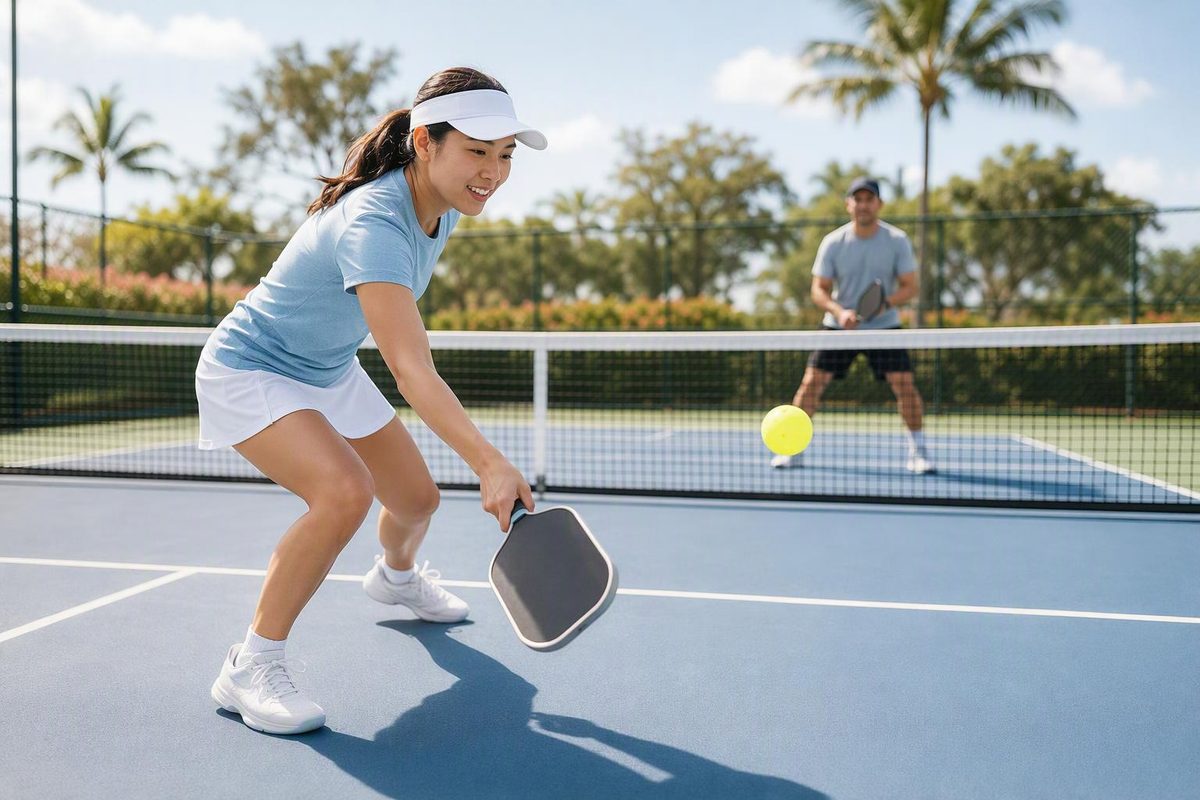
Topspin is forward rotation on the ball. It helps the ball dip during flight, giving you a way to clear the net and still bring the shot down into the court. The basic action is to swing forward and upward through contact, rather than simply hitting harder. Dynamite Pickleball’s forehand-drive guidance teaches this low-to-high brushing motion.
Topspin is legal under 2026 USA Pickleball rules—including on serves. Rule 7.B.2 allows you to add spin when your paddle strikes the serve, but you may not manipulate the release to add spin beforehand; natural rotation and a gravity-driven roll off the paddle are permitted. Your serve must still satisfy the other serving rules. See the official rulebook and our serve guide.
Start with a forehand topspin drive
A drive is a firm shot hit after a bounce. Learn the motion on a comfortable ball, with enough space and time to swing. Don’t begin with a stretched reach or a hurried Kitchen exchange.
- Prepare with a small body turn. Turn your shoulders toward your forehand side as the ball approaches. Keep your knees comfortably bent and use adjustment steps to find the ball.
- Leave room beside you. Contact should be in front of you and to your forehand side—not tucked against your hip. If your elbow feels trapped, adjust your feet rather than forcing the swing.
- Set the paddle below the contact point. You need room for the paddle to travel upward through the ball. Lower yourself with your legs instead of reaching down with only your arm.
- Swing forward and up. Brush upward across the back of the ball while also sending it toward your target. Think “through and up,” not “straight up.” Avoid scooping underneath it with a face tilted toward the sky.
- Let the finish happen. Allow the paddle to continue upward and across your body, then return to ready position. Don’t force an exaggerated finish to manufacture spin.
Coach Matt Slowinski emphasizes contact both to the side and in front because that spacing gives the paddle room to travel forward and upward. In the same Pickleball Clinic lesson, James Ignatowich recommends a loose arm rather than trying to muscle the ball.
Checkpoint: You should finish balanced, with room between your arm and torso. Judge the shot by its net clearance and landing—not by how dramatic the swing looks.
Use less swing in the soft game
A topspin drive, dink and drop can share a brushing action, but they should not share the same swing size. A dink is a soft shot played near the Kitchen that lands in the opponent’s Kitchen; a drop aims for that area from farther back.
For a dink or drop, keep the motion compact and prioritize a controlled landing. Ignatowich recommends only a small amount of topspin on these shots and warns against overusing the wrist in the Clinic’s coaching guidance.
In recreational doubles:
- Try a drive when the bounce gives you time and comfortable spacing. Aim with margin rather than chasing a sideline.
- Favor a soft defensive shot when you are stretched or off balance and need to take pace out of the rally. Don’t force a topspin drive from a cramped position.
- Keep dinks soft. If adding spin makes the ball sit up for an opponent to attack, simplify the stroke.
Topspin is an option within your shot selection, not a reason to drive every ball. Our third-shot guide explains when a drop or drive better serves the point.
A simple partner drill
Setup: Both players start near their baselines. Your partner feeds comfortable balls to your forehand, then lets your shots bounce. Choose a broad target well inside the opposite court.
Action: Hit ten forehands at an easy pace. Focus on spacing and a forward-and-up swing. Switch roles, then repeat. Only add pace once you can land seven of ten in the chosen area; that is a practice checkpoint, not a skill rating.
Make one adjustment at a time:
- Balls sailing long: Reduce pace first. Check that you aren’t scooping with the paddle face tilted upward.
- Balls catching the net: Allow more clearance; don’t expect spin to rescue a shot aimed too low.
- Cramped or uneven contact: Improve your spacing before changing your swing.
Finish with a short cooperative dink rally. Keep the smaller stroke and notice whether you can add a gentle roll without losing control of the landing.