
Build a Serve You Can Trust Before You Try to Hit Harder
Use a six-step routine, generous targets and measured drills to add depth, placement and variation without sacrificing reliability.
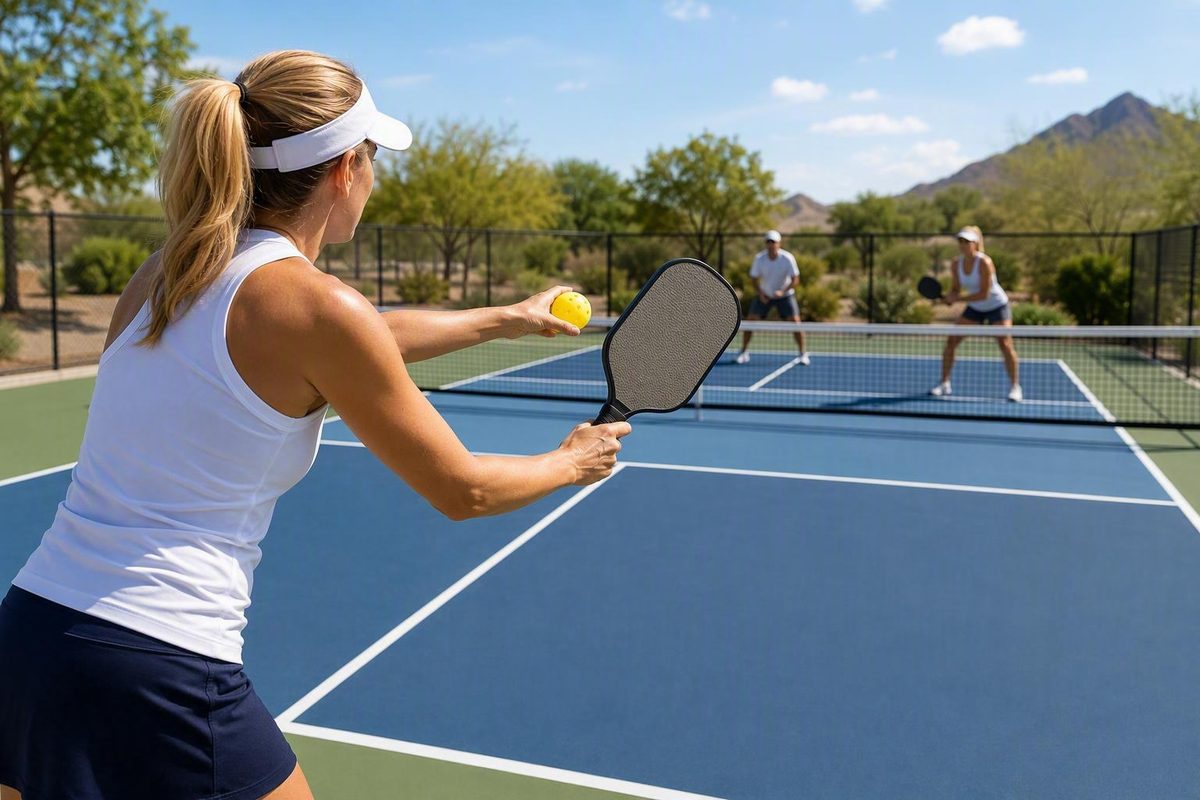
The best pickleball serving tip for most recreational players is simple: build a legal, repeatable serve before adding power, spin, or ambitious placement. Use the same routine, aim at a generous target, swing smoothly, and track your makes. Once the ball reliably lands in the correct court, add depth, then placement, and finally one variation at a time.
The seven tips below follow that progression. The rules section is a separate checkpoint for understanding the broad framework and verifying competition details.
Start here: use the same six-step serving routine
A dependable serve begins before the paddle moves. Use this sequence every time:
- Choose a generous target. Start near the middle of the correct service court rather than close to a line.
- Set a balanced stance. Settle into a comfortable position in the serving area behind the baseline.
- Relax your grip and shoulder. Excess tension makes the release and swing harder to repeat.
- Use a consistent release. Keep the ball comfortably in front of you and toward your paddle side.
- Swing smoothly through contact. Let the paddle continue toward the target instead of stopping at the ball.
- Finish and track the ball. Watch through contact, hold a balanced finish, visually track the serve into the opposite service court, and prepare to play the return after its required bounce.
Think of the swing as a loose pendulum driven mainly from the shoulder. Avoid making your serve depend on a quick wrist flick or sharp elbow bend. Your first goal is controllable contact—not maximum speed.
Give yourself one short cue before each attempt:
Target. Breathe. Release. Swing. Watch.
That cue directs your attention to actions you can control. “Hit it hard” does not tell your body how to make clean contact. “Release, swing, watch” does.
Know the two serve types—and verify detailed rules before competition
Pickleball has two basic ways to start the ball:
- A volley serve strikes the released ball before it bounces.
- A drop serve strikes the ball after it bounces on the playing surface.
Neither is automatically better. Test both and notice which release produces more repeatable contact. One player may prefer meeting a released ball in the air; another may time the swing more comfortably after a bounce.
Broadly, the serving area is behind the baseline, and a standard serve travels diagonally into the opposite service court. The serve is the initial paddle strike that starts the rally. The receiving side must let the serve bounce, and the serving side must let the return bounce before either side volleys, as established in the 2026 USA Pickleball Official Rulebook.
Playing a tournament? Consult the complete current rulebook and any event-specific instructions for exact requirements covering serving motion, release, contact, spin, foot faults, lines, and a serve that touches the net. Do not rely on an old article or courtside summary for those details.
For practice, keep the choice practical: use the serve type that lets you repeat the release, find the ball cleanly, and direct it toward a sensible target.
Build consistency before adding power
A faulted serve prevents that rally from developing, so reliability should come before aggressive pace or spin.
Keep the release comfortably in front and on your paddle side, where the ball can meet the same swing path repeatedly. Stay relaxed and let the paddle travel through the ball. Rushing, squeezing the handle, or manufacturing speed with a wrist snap adds moving parts when you need fewer of them.
Try this drill:
- Choose the broad middle of the correct service court.
- Hit 30 serves.
- Count only legal makes.
- Record the result, serve type, and notable conditions.
- Repeat the drill in later sessions.
This 30-ball make-count appears in manufacturer-published instructional guidance from Engage Pickleball. Treat it as a way to establish your own baseline, not as a validated test or universal pass mark.
If results vary widely between sessions, standardize the routine and release before adding pace. Look for a steady trend rather than judging your serve from one unusually good or bad set.
Add depth without turning the baseline into a gamble
A deep serve may keep the receiver farther from the non-volley zone while returning. It does not guarantee a weak return, and it loses its value when too many attempts land long.
Create a deep target zone while leaving room inside the baseline. Aiming roughly two to three feet inside the baseline is one USA Pickleball instructional suggestion, not a rule or an ideal margin for every player (see the serving guidance). Your safe margin will depend on your control and the conditions.
Use this drill:
- Mark a conservative deep zone with cones, chalk, or visual landmarks.
- Hit 20 serves toward it.
- Record total legal serves.
- Separately record deep-zone hits.
- Move the target farther inside the baseline if long faults increase.
A manufacturer-published drill also uses 20 deep-serve attempts, although its suggested target margin differs; the important practice principle here is to track both depth and successful serves (review the drill).
If deep-zone hits rise while your legal-make rate collapses, you have exchanged reliability for risk. To create more depth, accelerate smoothly through the ball and complete the follow-through rather than tightening your grip or flicking your wrist at the last moment.
Choose a target with a simple decision table
Serving strategy should begin with the receiver in front of you. Watch where that player stands, how they prepare, and which returns appear uncomfortable. Do not assume every opponent has a weaker backhand.
These are situational coaching options, not proven or universally superior tactics:
| Receiver position or tendency | Possible target | Intended purpose | Risk |
|---|---|---|---|
| No clear tendency | Middle of the service court | Preserve a generous margin | Low |
| Crowding forward | Deep with a safe baseline margin | Make contact occur farther back | Medium |
| Observably less comfortable on backhand | Backhand side | Test that specific return | Medium |
| Takes a large swing | Body | Reduce comfortable swinging room | Medium |
| Stands unusually deep | Occasional short serve | Change contact point and movement | High |
The middle target is your reset button. If narrower attempts at the backhand, body, or a corner produce too many faults, return to the broad middle and rebuild control.
Judge the result, not just the intention. A body serve may restrict one receiver’s swing but sit comfortably for another. A deep serve may hold one player back while another handles it easily. Observe the actual return and adjust.
Use the miss to choose your next adjustment
A miss provides information, but it does not prove what went wrong. Treat each fix as a practical experiment and change one element at a time.
| Miss | Practical experiment |
|---|---|
| Into the net | Choose more net clearance; check that the paddle continues smoothly upward and through contact |
| Long | Reduce pace or move the target farther inside the baseline |
| Wide | Simplify alignment, swing toward the target, and return temporarily to the center |
| Legal but short | Accelerate smoothly and finish the swing instead of tightening the grip or flicking the wrist |
| Inconsistent contact | Slow the routine, standardize the release, and watch the ball through paddle contact |
Test an adjustment over a small group of serves instead of rebuilding your motion after every fault. If picturing a higher window above the net reduces net misses, keep that cue. If it does not, restore your usual swing and test the release position.
For wide misses, check your target, setup, and finish before making a larger mechanical change. For inconsistent contact, slow the routine down. The ball should arrive at a predictable meeting point.
Add variety only after you own a base serve
Use this learning order:
- Repeatability
- Depth
- Placement
- Controlled variation in pace, paddle-generated spin, or serve type
Variation can make your intentions less predictable, but no particular spin or named serve is automatically superior. A variation earns a place in your game only when you can land it often enough to justify its additional risk.
Change one variable at a time. If you simultaneously swing harder, aim closer to the sideline, and add spin, you will not know which change caused the misses.
As a suggested self-test:
- Hit 10 normal serves and record the makes.
- Hit 10 serves with one change in pace or placement.
- Compare the make counts and where the successful serves landed.
- Keep testing the variation only if the potential benefit appears worth the additional faults.
Those counts are practice-sized comparison sets, not performance standards. If extra pace makes little difference to the return but causes several more faults, it is a poor trade for now. If a slightly deeper target stays reliable and changes the receiver’s contact point, it may be worth keeping.
Do not rely on dated guidance about manipulating the ball before release. Check the complete current rulebook for exact spin and release restrictions before taking a new technique into competition.
Make outdoor conditions part of the target
Outdoors, your normal target may not be the sensible target that day. Wind can alter ball flight, while sun and shadows can make the release or contact harder to see.
Use warm-up serves to answer three questions:
- Is the wind moving the ball left, right, long, or short?
- Can you see the ball clearly through release and contact?
- How much margin do you need from the lines?
When conditions are uncertain, choose a more central target and leave extra room for error. Adjust your aiming point for the wind rather than trying to overpower it. If sun or shadows interfere with visibility, simplify the target and make watching the ball through contact your main cue.
Your highest-percentage target may change from one end of the court to the other. Use warm-up serves to observe those differences.
A focused session can combine the full progression:
- Hit 30 controlled serves toward the broad middle and record legal makes.
- Hit 20 serves toward a conservative deep zone, recording legal makes and deep-zone hits.
- Finish with paired sets comparing one variable: normal versus harder, middle versus narrower, or volley serve versus drop serve.
Keep the order clear: reliable first, deep second, varied last. Before competitive play, confirm detailed serve legality in the complete current rulebook.
Can I step into the court after contacting the serve?
Yes. USA Pickleball’s instructional guidance says a player may step into the court after making contact with the serve (see its explanation). The timing matters: establish a legal serving position for contact, then move as needed to prepare for the return. Consult the current official rulebook for the exact foot-fault requirements that apply at contact.
What happens immediately after the serve under the two-bounce rule?
The receiving side must let the serve bounce before returning it. The serving side must then let that return bounce before playing it. After those two required bounces—one on each side—either team may volley a ball that is otherwise playable under the 2026 USA Pickleball Official Rulebook.
Should I try to ace my opponent with the serve?
Not as your default goal. The serve’s basic job is to land legally, begin the rally, and apply manageable pressure. Chase an outright winner only when the extra pace or narrower placement does not create more risk than the possible reward justifies. For most new and improving players, a dependable deep or well-placed serve is the better foundation.