
How to Return a Low Drop to Your Left-Side Backhand
Handle low drops to your left-side backhand: choose a volley or bounce, move without overreaching, return softly, and recover with your partner.
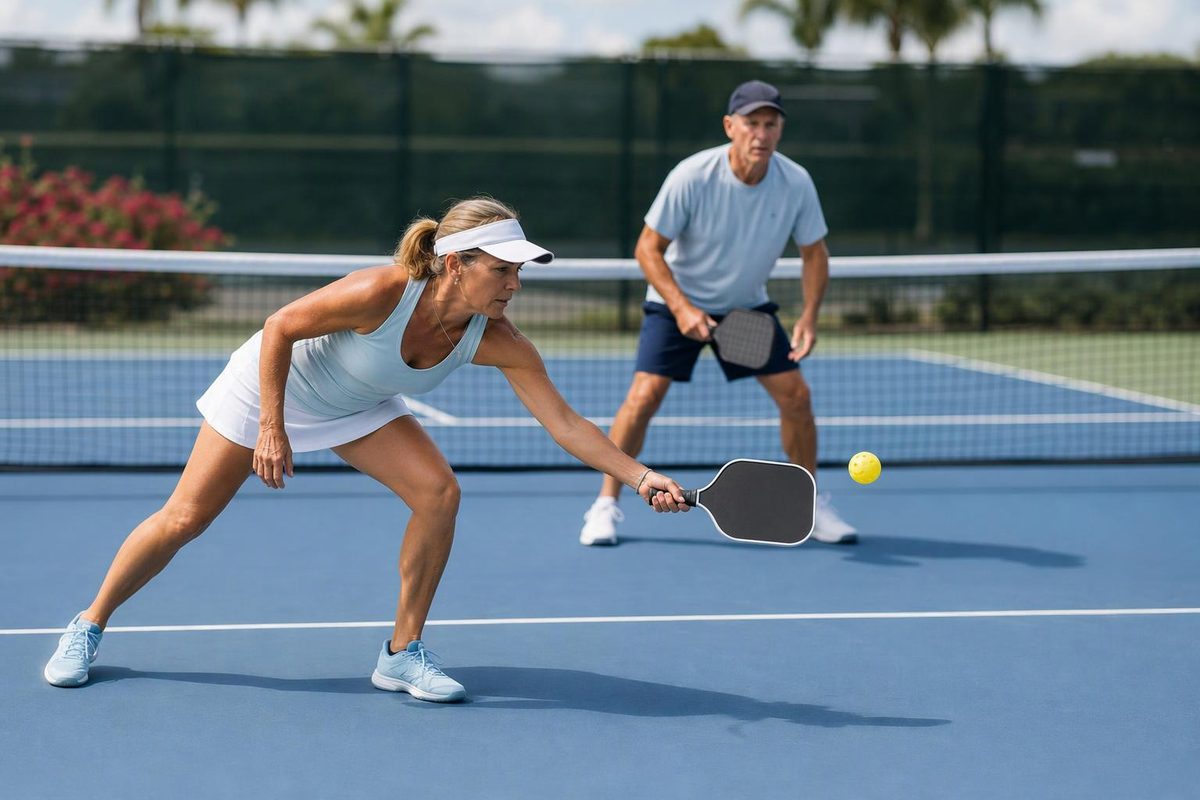
When an opponent’s drop arrives low to your backhand on the left side, do not force a hard reply just to keep them back. Take a soft volley if you can reach it while balanced; otherwise, move to the bounce and dink it back into their Kitchen.
Here, “return” means replying to an opponent’s drop—not returning serve. The setup is a right-handed doubles player near the left Kitchen line, with the backhand toward the outside sideline. For a left-hander in that position, the backhand is toward the middle instead.
You may let it bounce—and enter the Kitchen
A drop creates no special bounce requirement. Once the serve and return have each bounced, you may volley legally from outside the Kitchen. You may also step into the Kitchen to play a bounced ball. A volley becomes a fault if you or anything you wear or carry touches the Kitchen or its line during the volley, including through your volley momentum. USA Pickleball’s rules summary explains both rules.
That means you do not have to lean precariously over the line to save your position.
Read the drop before choosing the reply
Use the contact you can actually make, not the shot you hoped to hit:
| What you see | Useful reply |
|---|---|
| The ball is reachable in front, but below net height | A soft backhand volley into the Kitchen |
| The ball drops short or wide beyond a balanced volley reach | Move to it, let it bounce, then dink |
| The drop sits up for comfortable contact above net height | A firmer volley toward an opponent’s feet or an opening |
PrimeTime Pickleball’s starting guideline is to volley softly from low contact and more firmly from high contact. Hitting hard from below the net requires an upward trajectory and can offer opponents a high ball to attack. See its volley strategy and technique guidance.
Move left before reaching left
For the low, wide ball, organize your feet before adding paddle motion:
- Get balanced before the opponent hits. If you are still advancing after your return of serve, split-step—a small hop that resets your balance—just before their contact rather than running through the reply. USA Pickleball’s positioning guidance uses this timing cue.
- Move toward the ball’s path. For a nearby wide drop, use a small lateral shuffle left instead of leaving both feet planted and stretching your arm sideways. If the ball will bounce short, move forward as needed, including into the Kitchen.
- Lower with your knees and hips. Do not simply fold at the waist and leave the paddle dangling below you. Coach CJ Johnson emphasizes using the lower body to maintain a more controlled wrist and paddle position on backhand dinks. See her backhand-dink guidance.
- Keep contact in front. Present the backhand face early, use a short motion, and keep the wrist steady rather than flicking it to rescue a late ball. Give the low reply enough lift to clear the net.
Johnson’s shuffling-dink drill reinforces the useful combination: bent knees, good balance, paddle and ball in front, then recovery toward the Kitchen line.
Choose a forgiving target, then recover
When stretched toward the left sideline, start with a broad target near the middle of the opponent’s Kitchen rather than a sharp sideline angle. Your immediate task is a controlled soft reply, not a winner.
A good drop may allow the serving team to reach the line. Accept the dink exchange rather than forcing a deep attack from poor contact. Fourth-shot guidance from Andrew Gilman makes that distinction.
Stay linked with your partner rather than moving independently—a principle in USA Pickleball’s positioning guidance. For this wide-left retrieval, agree that your partner shifts with you to help cover the middle without crowding you at the sideline. After contact, bring your paddle back to ready and recover toward your left-side position. If you entered the Kitchen, return to a legal position outside it before volleying again.
Practice the left-side decision
Start outside your left Kitchen line. Have a partner feed soft drops from midcourt to your backhand, alternating:
- a reachable low volley;
- a short ball requiring a bounce;
- a wider ball requiring lateral movement.
Play ten feeds into a broad Kitchen target. Then switch roles. This is a suggested practice setup, not a performance standard.
Checkpoint: Can you choose volley or bounce without overreaching, return the ball softly, and finish ready for the next shot? If wide feeds break that sequence, reduce the width before increasing pace. For the underlying stroke, see backhand-volley setup and contact.