
Four Pickleball Footwork Drills for Balanced Court Movement
Practice split-step timing, lateral dink movement, legal Kitchen recovery and controlled approaches with four footwork drills and clear checkpoints.
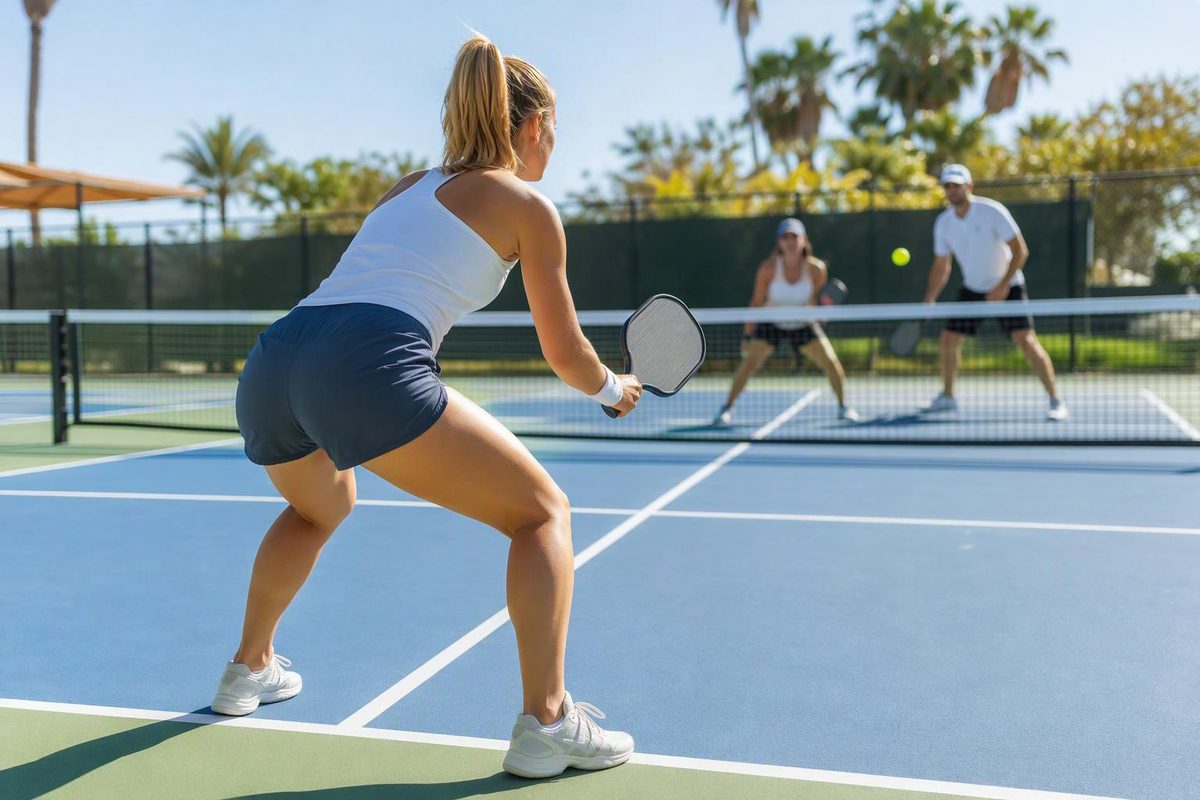
You may step into the Kitchen to play a ball that has bounced. The footwork rule to remember is what happens next: after touching the Kitchen, both feet must have contacted the playing surface completely outside it, including its boundary lines, before you volley. A volley means hitting the ball before it bounces. Your volley’s momentum must not carry you back into the Kitchen. These are standard-play requirements under the 2026 USA Pickleball rulebook, Sections 3 and 11.
Practice four movement patterns: prepare to react, move sideways to a dink, recover after stepping into the Kitchen, and advance without getting caught mid-stride. The aim is not to take the most steps. It is to arrive where you can play the next ball under control.
Before you start
Use a dry, clear court, a paddle and a few balls. Warm up with easy movement before adding quicker changes of direction. Stop to collect any loose balls before continuing.
Start without a ball, then add cooperative feeds. Keep your knees comfortably bent and your paddle in front. The repetitions below are suggested practice doses, not a fitness test; shorten them if your movement becomes rushed.
1. Split-step and react
A split-step is a small hop that resets your balance before you move toward the next shot. USA Pickleball’s positioning guidance recommends it just before the opponent hits.
Setup: Stand outside the Kitchen line, roughly midway across your half of the court. A practice partner stands across the net with a paddle but no ball.
Action:
- Have the partner make a slow shadow swing.
- Make a small split-step as the swing approaches imaginary contact. Keep it low, not a high jump.
- At imaginary contact, the partner points left or right.
- Move one or two steps that way, then recover to your starting position.
Do 10 cues. Then have the partner feed gentle balls to either side, using the same preparation before each feed.
Checkpoint: Aim to land balanced around your partner’s contact, not still be rising when you need to move. You can start in either direction without first rocking back or untangling your feet.
Fix: If you guess the direction before the cue, slow down. Separate preparation from reaction: get ready first, then respond to the ball.
2. Short lateral shuffle into a dink
This is a slower, smaller-range adaptation of coach Marko Grgic’s Kitchen Shuffle drill, which combines lateral movement with side-to-side dink feeds.
Setup: You and your partner face each other across the net at the Kitchen line. Ask for alternating feeds a step or two to your left and right—not sideline-to-sideline chases.
Action:
- Move the foot nearest the ball toward it, then let the other foot follow without bringing your feet together.
- Adjust your position so you can contact the bounced ball in front rather than reaching sideways from your starting spot.
- Return a soft dink—a shot that lands in your partner’s Kitchen—and recover toward your starting position.
- Repeat for 10 feeds, then switch roles.
Keep the movement compact. This drill practices nearby lateral adjustments; it is not a rule that every wide ball must be reached by shuffling.
Checkpoint: Your body moves with your paddle, and you finish ready for the next feed rather than tipping toward the sideline.
Progression: Once alternating feeds feel controlled, let the feeder choose the side unpredictably.
3. Step into the Kitchen, then recover
Setup: Start just outside the Kitchen line. Your partner has several balls and feeds a short ball that requires you to step inside to reach it after the bounce.
Action:
- Let the ball bounce, step in and dink it back.
- Recover outside the Kitchen with short, controlled steps.
- Check that both feet have contacted the court beyond the line.
- Only then, have your partner send a gentle ball for you to volley.
Do eight short-ball-and-volley sequences, then switch. The feeder should wait for a completed recovery, not try to catch you out.
Checkpoint: You do not volley while a trailing foot is still inside or on the line. You also finish the volley without drifting into the Kitchen.
Fix: If the sequence feels hurried, remove the second ball. Rehearse the step-in, hit and legal recovery before adding it again.
4. Drop, advance, split-step
Coach Gina Cilento’s drop–advance–stop drill emphasizes controlled steps forward and a pause before the opponent’s contact—not a reckless sprint after a poor drop.
Setup: Start near the baseline with your partner across the net at the Kitchen line. Have them feed a comfortable bounced ball for you to drop softly into their Kitchen.
Action:
- Hit the drop and move forward while your partner waits for the ball.
- Split-step as they prepare to hit, even if you are still between the baseline and Kitchen.
- Play their gentle return from that position.
- Advance again when your shot gives you time, repeating until you reach the Kitchen line.
Complete five approaches, then switch. Do not require yourself to reach the line in a fixed number of shots.
Checkpoint: Your partner’s contact determines when you prepare—not a marker on the court. If their reply reaches you quickly, handle it from where you are instead of taking another forward stride.
Make movement the score
Choose the two drills that match your recurring problem. Count a repetition only when you meet its footwork checkpoint; a ball landing in does not excuse an uncontrolled finish.
Finish with a short cooperative rally using less predictable placement. Keep the same movement focus, then use the 30-minute partner practice when you want to work on the shots themselves.