
Four-Player Pickleball Drills for Dinks, Teamwork and Court Position
Use this 30-minute four-player pickleball practice to work on dink placement, middle-ball calls, moving forward together and smarter attacks.
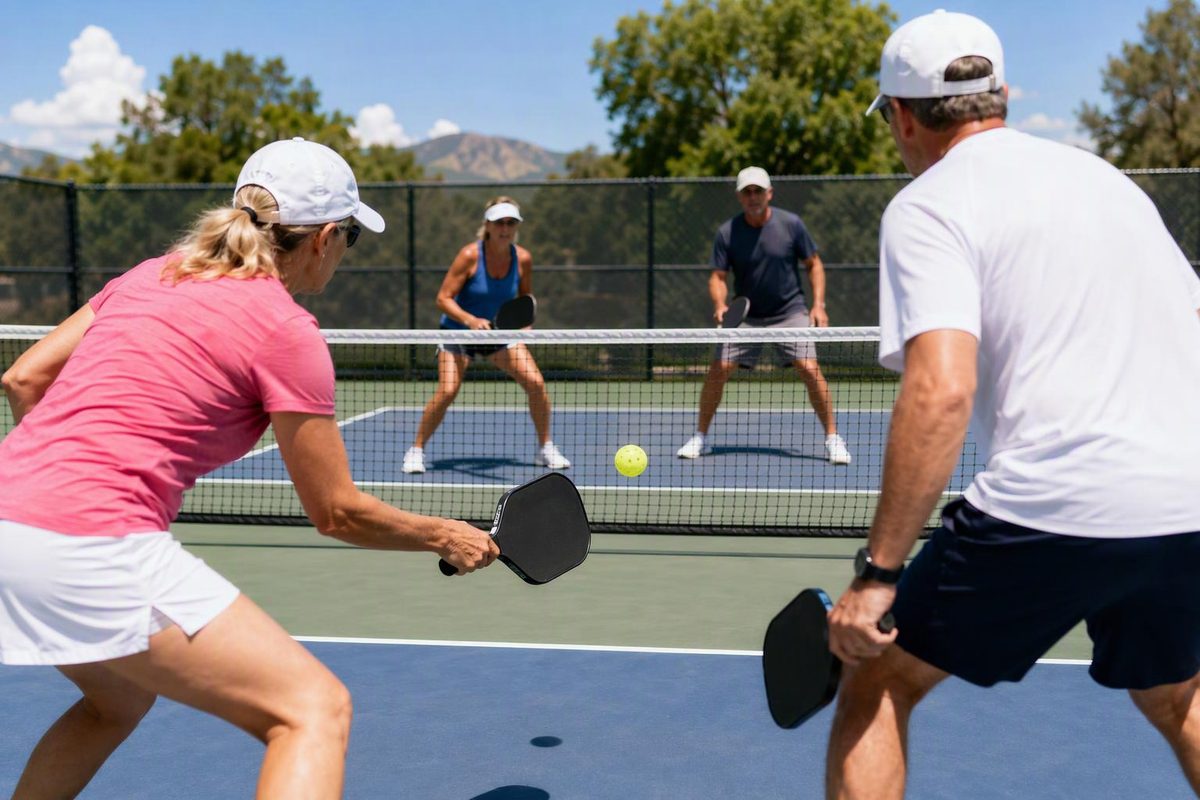
You can step into the Kitchen to hit a ball that has bounced. The restriction is on a volley—hitting before the bounce. You must initiate a volley outside the Kitchen, including its lines, and neither you nor anything touching you may contact it during the volley. Your volley momentum cannot carry you into it. After touching the Kitchen, both feet must contact the playing surface completely outside it before you volley again. See Section 11 of the 2026 USA Pickleball rulebook.
That matters when practicing short dinks: move in when needed rather than stretching from behind the line, then recover outside it.
These four-player drills use two teams and one live ball, not two separate partner rallies. You’ll practice directing dinks, sharing middle balls, advancing together and choosing when to attack.
You need a court, four paddles, a few balls and a timer. Keep spare balls outside the playing area.
| Time | Drill | Team task |
|---|---|---|
| 3 minutes | Easy movement and gentle hitting | Warm up cooperatively |
| 5 minutes | Figure-eight dinks | Control direction and stay ready |
| 6 minutes | Middle-ball calls | Decide who takes the shared ball |
| 8 minutes | Two up, two back | Move forward without leaving a partner behind |
| 8 minutes | Dink, then play | Keep the soft game until an attack is available |
The counts and restrictions below are suggested practice targets, not skill-rating standards or tournament rules. Start cooperatively; add pressure only while the exercise stays manageable.
1. Figure-eight dinks: involve all four players
Setup: Everyone stands just behind the Kitchen line. Label your team A and B, and the opponents directly across from them C and D. A dink is a soft shot intended to bounce in the opponent’s Kitchen.
Action: Follow this sequence with soft shots that bounce in the Kitchen:
- A hits straight ahead to C.
- C hits crosscourt to B.
- B hits straight ahead to D.
- D hits crosscourt to A.
Repeat, then reverse the pattern halfway through: A to D, D to B, B to C, C to A. This uses the four-player figure-eight pattern described in the 3.5 Skills and Drills guide.
Keep every ball on the bounce for this exercise. Aim well inside the Kitchen rather than near a sideline. Even when the next shot is going to your partner, keep your paddle ready and adjust your position with them.
Checkpoint: Complete three full circuits—12 shots—without a miss or a player losing balance. If the pattern breaks down, slow the feed and use larger targets.
2. Middle-ball calls: remove the guesswork
Setup: Stay two per side at the Kitchen line. Designate one caller on each team; switch callers after three minutes.
Action: Start a cooperative dink rally. Mix comfortable shots toward individual players with shots toward the middle. For a shared middle ball, the designated caller says “mine” or “yours” early enough for both players to respond.
The player taking the ball hits a controlled dink. Their partner leaves room for the swing, stays ready and recovers alongside them. Nobody crosses in front of a partner to chase a ball that has already been claimed.
This is a communication exercise, not a permanent rule about who owns the middle. Give both teammates turns making the decision.
Checkpoint: Over five middle balls, count how many produce one early call and one clear hitter. Two paddles reaching for the same ball—or neither player moving—is the error to fix, even if the ball happens to go over.
If calls keep arriving late, pause the rally and practice one gentle middle feed at a time.
3. Two up, two back: advance as a team
Setup: One team starts at the Kitchen line. The other starts about halfway between its Kitchen line and baseline. Use one ball across the full court.
Action: A Kitchen player feeds a gentle ball that bounces in front of either opponent. The team farther back sends a soft drop toward the opposing Kitchen, then advances as the reply allows. A drop is a soft shot from farther back intended to land in the Kitchen.
The Kitchen team returns at a controlled pace, mixing shots between the two opponents. The advancing team tries to soften each reply and work forward. Before the Kitchen team hits, stop advancing and get balanced. Don’t race ahead while your partner is still dealing with a difficult ball.
Staying linked with a partner and resetting balance before the opponent strikes are central cues in USA Pickleball’s positioning guidance.
End the attempt after both players reach the line and the group completes four controlled dinks, or after an error. Alternate the initial feed between players. Swap front and back teams after four minutes; each team swaps left and right positions halfway through its turn.
Checkpoint: Count team arrivals, not individual arrivals. A successful attempt leaves both partners balanced at the line, ready for the next shot.
Make it easier: Start closer and let the first drop bounce. Later, the Kitchen team can volley reachable drops and add moderate pressure.
4. Dink, then play: add decisions and competition
Setup: All four players start just behind their Kitchen lines. Begin each rally with a friendly dink feed, alternating the feeding team.
Action: Require the first four shots, including the feed, to bounce in the Kitchen. Once the fourth shot has bounced, play the rally out across the full court. Volleys and attacks are now allowed, subject to the Kitchen rule.
Stay soft when the ball is low or awkward. Look for an attack you can contact comfortably in front, rather than speeding up simply because the restriction has ended. This adapts the four-player dink/volley exercise in the skills-and-drills guide, using a four-dink opening and practice scoring.
Award one point to the rally winner. An error during the opening dinks—including volleying or hitting outside the Kitchen—also loses the rally. Swap left and right positions after four minutes.
Checkpoint: Between rallies, identify one decision: was the attack available, or did the hitter force it from a difficult ball? Track that separately from the score.
If rallies rarely reach the live phase, keep the whole game dinks-only. If your group needs more help with shared coverage, review the simple doubles point plan before repeating the middle-ball drill.