
Pickleball Wall Drills for Dinks, Volleys and Soft Resets
Practice dinks, compact volleys and soft resets with three pickleball wall drills, simple targets and checkpoints in a 15-minute solo session.
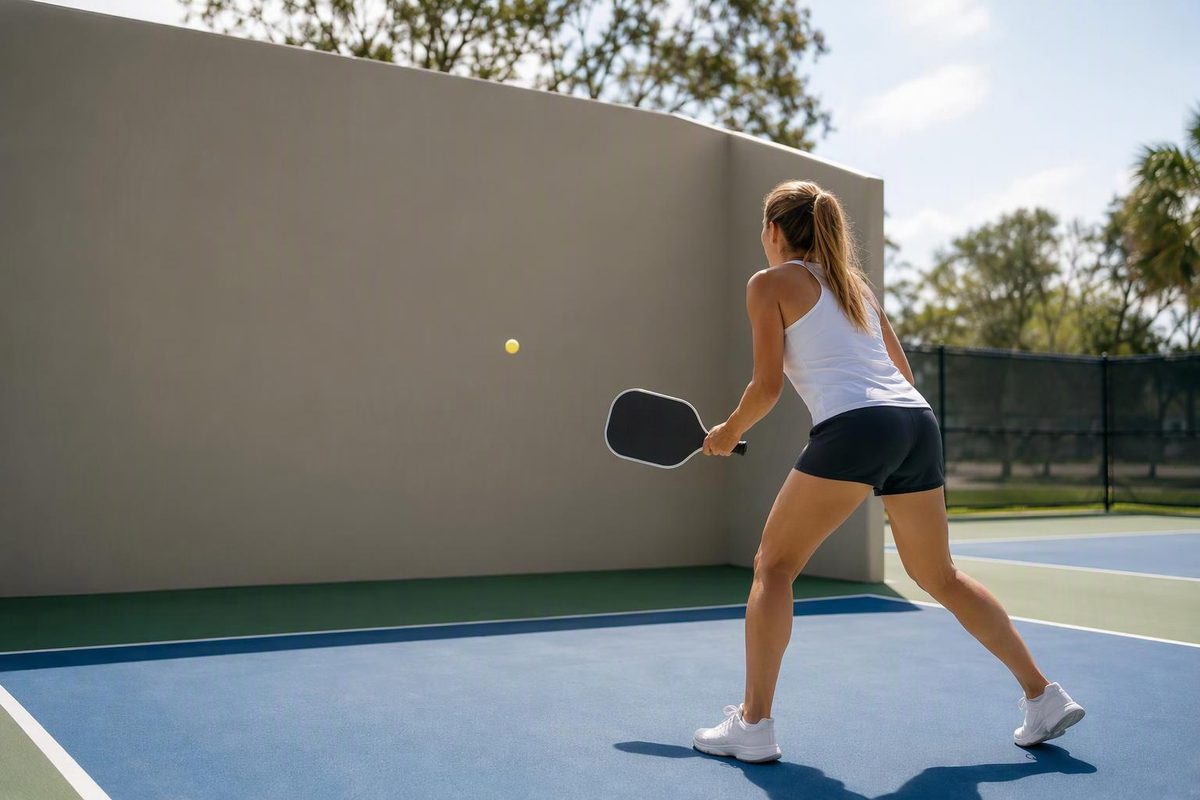
Use pickleball wall drills to practice three things: contacting the ball in front, recovering your paddle between shots, and taking pace off an incoming ball. Start with soft shots—not the fastest rally you can keep alive.
One rule matters when you mark a practice Kitchen line: you may step inside it to hit a ball that has bounced, but not to volley. A volley means hitting before the bounce. Under USA Pickleball rules, the Kitchen line itself counts as part of the non-volley zone, and momentum from your volley cannot carry you into it. After stepping inside, reestablish both feet completely outside before volleying. See the 2026 official rules, Rules 3.A.4.c and 11.A, or the Kitchen rule explained for common edge cases.
Set up the wall
You need a paddle, a pickleball, a tape measure and removable tape or chalk, if the property owner permits marking.
- Choose a solid, window-free wall with permission to practice. Leave clear space behind and beside you, away from traffic and pedestrians.
- Use a dry, even surface. Stop rather than chase a ball that takes an awkward bounce off a crack.
- Mark a horizontal reference 34 inches above the ground, the regulation net height at center; the net is 36 inches at the sidelines. These measurements come from the official rulebook, Rules 3.B.6–7.
- Mark a floor line 7 feet from the wall as a positioning reference.
- Add a broad wall target roughly 2 feet wide and 1 foot tall, with its bottom just above your net-height mark.
These are practice references, not a replica court. Hitting above the wall line does not prove that the same shot would clear a real net or land in the opponent’s Kitchen.
Once the wall is marked, try this 15-minute session: two minutes of easy movement and gentle self-feeds, five on dinks, four on volleys, three on resets and one recording your results. The targets and counts below are suggested practice goals, not skill-rating standards.
1. Soft dink rhythm: five minutes
Setup: Begin near the 7-foot floor line. Drop the ball, let it bounce and gently send it toward the wall target.
Action: Let each rebound bounce once before hitting again. Keep your knees bent, make contact in front and use a small, smooth stroke. Adjust with your feet rather than reaching from a fixed position.
Work in this order:
- Forehand only.
- Backhand only.
- Alternating forehand and backhand, if you can control the direction.
This progression and the emphasis on a consistent contact point follow PrimeTime Pickleball’s wall-training guidance.
Checkpoint: Aim for 10 consecutive contacts that reach the broad target and return at a manageable pace. Count only repetitions where you stay balanced and contact the ball in front. Restart when you have to lunge or swing hard simply to keep the rally going.
If a rebound lands short, step forward to play it after the bounce. You do not need to stay behind the floor line for this drill. If the ball keeps racing past you, soften the stroke before trying for a longer streak.
A real dink is a soft shot that lands in the opponent’s Kitchen. Here, you are rehearsing touch and contact—not verifying that landing spot.
2. Compact volleys: four minutes
Setup: Start about 6–8 feet from the wall. Feed gently and return the rebound without letting it bounce. Initially, aim higher on the wall than the low target so you have more time.
Action: Keep the paddle in front of your body, use a short motion and return it to a ready position after each contact. Practice forehands, then backhands, then alternate.
PrimeTime’s volley wall drill uses this distance and a higher-to-lower target progression. Lower your aim only when you can maintain clean contact; do not add power at the same time.
Checkpoint: Try for 10 controlled volleys without a large backswing or contact beside or behind your body.
If you move closer than 7 feet, treat that as a reaction exercise—not legal Kitchen positioning. For a game-like footwork check, keep both feet completely behind your marked line and finish balanced there.
If the exchange gets frantic, stop and re-feed more softly. The goal is a repeatable paddle motion, not surviving increasingly hard rebounds.
3. Feed and soften: three minutes
A reset takes pace off an incoming ball, aiming for a soft return that your opponents cannot easily attack.
Setup: Stand behind the floor line with your paddle ready. Send a moderately firm feed into the wall, then prepare to block its rebound before it bounces. Begin gently enough to control the return.
Action: Meet the rebound in front with a relaxed grip and little forward swing. Guide it toward the low wall target. Let the next rebound fall and collect it; this is one feed and one reset, not a continuous rally.
The feed-then-soften sequence, loose grip and forward contact point follow PrimeTime’s reset drills.
Checkpoint: Try five forehand resets and five backhand resets. Count a success when you hit the target, the next rebound lands between you and the wall, and you remain balanced behind the floor line. That is a wall-control measure—not proof of a successful on-court reset.
If you keep punching the ball back hard, reduce the feed speed and shorten your stroke.
Check the skill on court
Record your best controlled dink streak, volley streak and resets out of 10. Next session, repeat the same setup before making one variable harder.
Then test the skill with a partner: rally dinks across a real net and ask for comfortable volley feeds that you can soften into the Kitchen. The wall lets you repeat contacts; a partner adds real depth, angles and shot-selection decisions. For a longer session combining wall work and court targets, use the 25-minute solo practice plan.