
Pickleball Terms: Rules, Shots and Doubles Language Explained
Learn essential pickleball terms, from Kitchen and two-bounce rule to dinks, drops, side outs and stacking—with examples for recreational doubles.
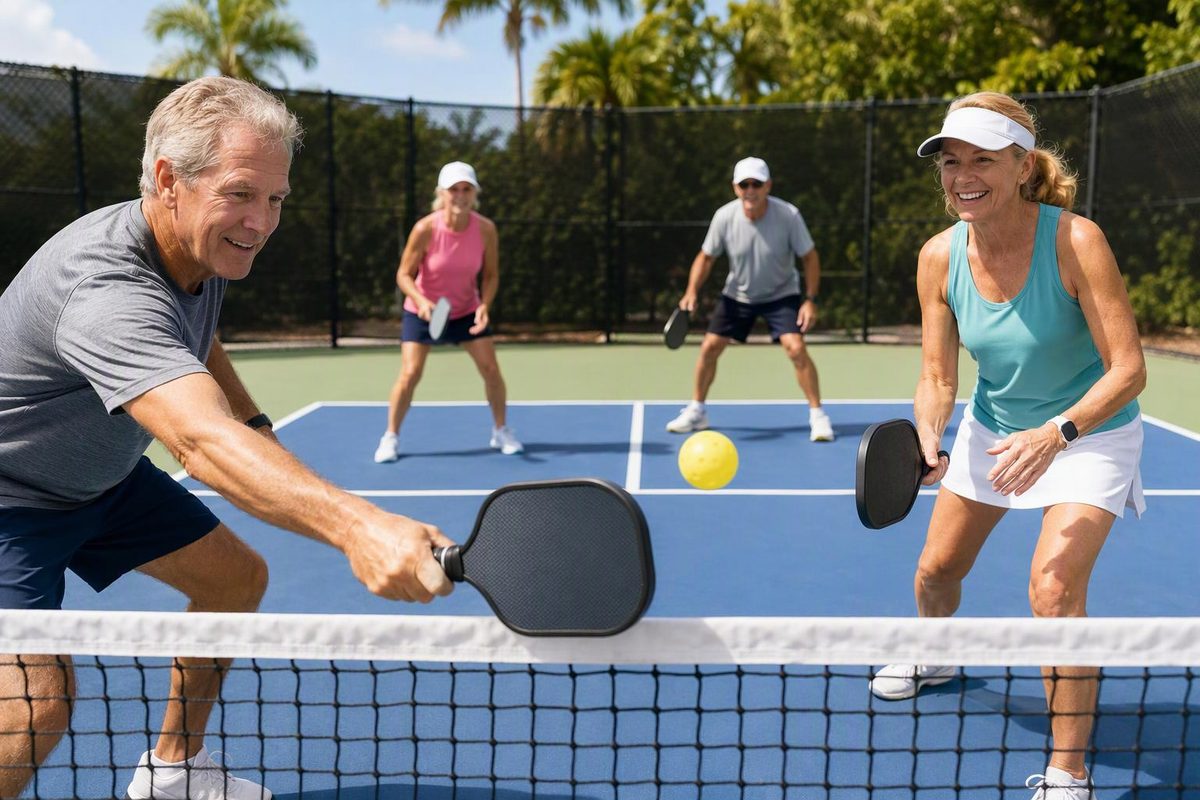
The Kitchen is a no-volley zone, not a no-entry zone. You may step into it to hit a ball that has bounced. A volley—hitting the ball before it bounces—has different restrictions. Start with that distinction, then learn the scoring calls, soft shots and positioning language you’ll hear in doubles.
The rule explanations below follow the 2026 USA Pickleball Official Rulebook. Shot names and strategy terms describe what players do; they do not create extra rules.
Rule terms that prevent arguments
Volley: A shot hit before the ball bounces. It describes how you contact the ball, not how hard you hit it.
Groundstroke: A shot hit after the ball bounces. A soft shot and a hard shot can both be groundstrokes. See USA Pickleball’s basic shot definitions.
Kitchen / non-volley zone / NVZ: Three names for the same area: the 7-foot-deep zone on each side of the net. Its boundary lines are part of the zone. You cannot touch it—or have anything touching you contact it—during the act of volleying. Your volley’s momentum cannot carry you into it, even after the rally ends. That momentum restriction ends when you regain balance and control of your movement. After contacting the Kitchen, both feet must contact the playing surface completely outside it before you volley again. See Section 2 and Rules 3.A.4.c and 11.A.
Two-bounce rule: The receiver must let the serve bounce; the serving team must let the return bounce. After those two required bounces, either team may volley, subject to the Kitchen rules.
Double bounce: Two bounces on the same side before the ball is returned. That is normally a fault, unlike the two-bounce rule, which requires one bounce per side at the start. Players sometimes call the two-bounce rule the “double-bounce rule,” so listen for the context. Wheelchair and adaptive-play provisions allow a second bounce for eligible players. See Sections 10 and 25, or our two-bounce rule guide.
Fault: A rules violation that ends the rally and loses it for the player or team committing the violation. Hitting out, failing to return before the second bounce and illegal Kitchen contact are examples in standard play.
Dead ball: A ball that is no longer in play.
Hinder: A temporary outside occurrence that adversely affects play, such as a stray ball entering your court and interfering with a shot. Permanent objects, such as fences, are not hinders. A called hinder stops play and leads to a replay.
Replay: Restarting the rally without awarding a point or changing the server. These definitions and procedures appear in Sections 2 and 9.
Court and positioning terms
| Term | Plain-English meaning |
|---|---|
| Baseline | The back boundary line, parallel to the net. |
| Sideline | A side boundary line, perpendicular to the net. |
| Centerline | The line separating the right and left service courts, from the Kitchen line to the baseline. |
| Service court | Either box between the Kitchen and baseline. The Kitchen is not part of it. |
| Kitchen line / NVZ line | The line parallel to the net, 7 feet away. Keep your feet completely outside it when volleying. |
These court features are defined in Rule 3.A.4.
Transition zone / midcourt: The area you pass through between the baseline and Kitchen line. “No man’s land” is a nickname, not a prohibited area. If you cannot reach the Kitchen line before the opponent hits, get balanced to play the next ball rather than charging forward.
Split step: A small hop or settling movement timed just before the opponent’s hit so you are ready to move either way. USA Pickleball’s positioning guide explains the split step and transition zone.
Serving and scoring language
Serve: The shot that starts a rally. In standard play, it goes diagonally into the opposite service court.
Return of serve: The receiving player’s reply to the serve, played after its required bounce.
Drop serve: A serve struck after the dropped ball bounces on the playing surface.
Volley serve: A serve struck before the released ball bounces. The two serve types have different motion requirements; use our serve guide for the checklists. Their definitions and placement rules appear in Sections 2 and 7.
Rally: The continuous play from the serve until the ball becomes dead. A rally is not necessarily a scored point.
Side-out scoring: The standard format in which only the serving team scores points.
Side out: Service passes to the other team. In standard doubles, losing a rally as the first server hands service to your partner, not your opponents. Both partners normally serve before a side out; the team serving first in a game gets only one server in its opening rotation.
Server number: The third number in a standard doubles score call. If you are serving, “4–2–1” means your team has 4 points, the opponents have 2, and you are the first server of this service rotation. Standard doubles games begin at “0–0–2.”
Rally scoring: A format in which the team winning each rally scores a point. Confirm the format before playing rather than assuming every group uses standard side-out scoring. These distinctions are covered in Sections 2, 4, 5, 6 and 14 of the rulebook.
Shot terms: learn the soft game first
| Term | What the shot does |
|---|---|
| Dink | A soft shot played after a bounce near the Kitchen, intended to land in the opponent’s Kitchen. |
| Drop shot | A soft shot played after a bounce from farther back, intended to land in the opponent’s Kitchen and help your team approach. |
| Third shot | The serving team’s next shot after the serve and return. It names the shot’s place in the rally, not a required technique. |
| Third-shot drop | A drop played on that third shot. It is an option, not a rule. |
| Drive | A fast, relatively low shot hit with pace. |
| Reset | A soft, controlled reply intended to slow an attack and restore a more neutral exchange. |
| Lob | A high, lofted shot intended to go over opponents and land deep. |
| Overhead smash | A forceful overhead shot directed downward into the opponent’s court. |
USA Pickleball explains dinks, drops, lobs and overheads; Ace Pickleball Club’s glossary also defines drives and resets.
Dink versus drop: Both aim for the Kitchen. The useful distinction is where you hit from: close to the Kitchen for a dink, farther back for a drop. Neither name forces your opponent to let the shot bounce. Learn the dink technique, then practice choosing a third-shot drop or drive.
Doubles terms and common slang
- Crosscourt: Diagonally across the court, rather than straight ahead.
- Poach: Intercepting a ball in your partner’s usual coverage area.
- Stacking: Arranging and adjusting partner positions to keep preferred sides during rallies. It does not remove the requirement for the correct server and receiver to use their correct positions.
- Banger: Informal shorthand for a player who favors hard shots over the soft game.
- ATP / around-the-post: A return sent around the outside of a net post rather than over the net.
- Erne: A volley struck near the net while positioned outside the sideline beside the Kitchen. It is not permission to volley while touching the Kitchen.
Ace Pickleball Club covers these strategy terms and nicknames. For legality, use the rulebook: Rules 5.B, 11.A and 13.C govern positions, Kitchen contact and around-the-post returns.
Put the words into a five-minute practice
With a partner, begin just outside opposite Kitchen lines. Exchange gentle dinks for two minutes, calling “groundstroke” after a bounce or “volley” if you take one out of the air. Check that every volley finishes with your balance outside the Kitchen.
For the remaining three minutes, have one player move back near the baseline. The Kitchen-line player feeds a gentle ball deep; the baseline player lets it bounce and sends a soft drop toward the other player’s Kitchen. Switch roles halfway through.
Checkpoint: Can you distinguish contact type from shot purpose? A dink and a drop are both groundstrokes in these definitions, but they come from different court positions. Taking a soft ball out of the air makes it a volley—and brings the volley rules into play.