
Make Your Two-Handed Backhand Show Up in Matches
Train your two-handed backhand with progressive feeds, decision cues and scored doubles scenarios—without forcing two hands onto every ball.
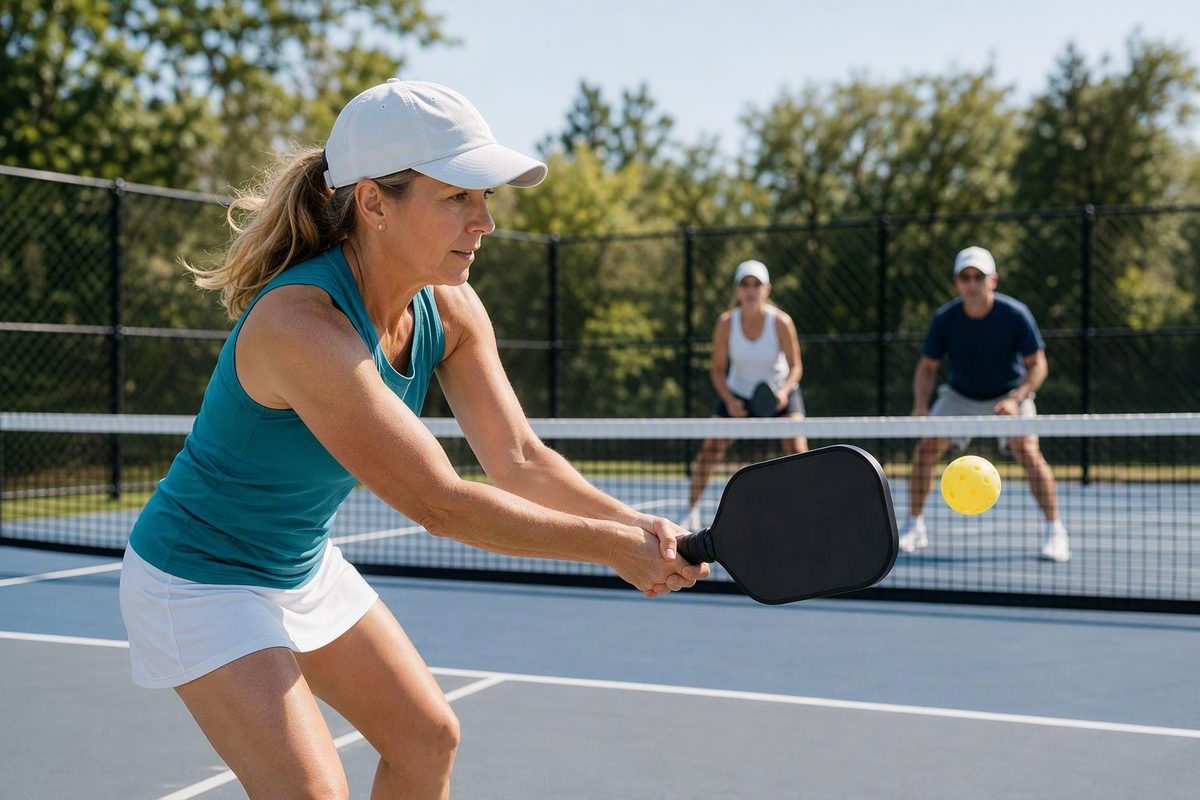
First, the rule: a two-handed backhand is legal. Rule 12.B, “Paddle Possession,” in the 2026 USA Pickleball Official Rulebook allows a player to hold the paddle with one or both hands and switch it from hand to hand at any time.
The practical question is not whether you can use two hands. It is whether you recognize the right ball early enough to use them.
A two-handed backhand can add stability against pace and help produce power or topspin. But two hands can restrict your reach and leave you cramped on a ball hit into your body. The goal is a decision habit: use two hands when the ball fits your hitting window; release one hand when space or reach matters more.
Choose by the ball, not a fixed court rule
Use these as starting cues rather than absolute rules.
Favor two hands when:
- You are balanced and the ball is comfortably on your backhand side.
- You are driving a return or groundstroke from the baseline.
- You are countering pace near your backhand shoulder.
- You want stability while blocking or resetting a reachable ball in transition.
- You are using a backhand roll, aggressive dink or speed-up that you have already practiced.
Release the second hand when:
- The ball is stretching you wide.
- A fast volley jams your body and there is no time to move.
- You need the extra reach of one arm to take a dink or volley out of the air.
- Your simplest available play is a short, one-handed block.
This distinction follows Catherine Parenteau’s guidance published by Selkirk. She identifies power, stability and pace absorption as advantages of two hands at the baseline, in transition and during suitable kitchen exchanges. She recommends releasing the non-dominant hand when a body shot jams the player or a reaching volley leaves too little room to follow through (Selkirk’s two-handed backhand guidance).
Use one repeatable match cue
Trying to remember several technical instructions during a rally rarely helps. Use this sequence instead:
See backhand → set the second hand → judge space.
Begin in a neutral ready position with the non-dominant hand touching the paddle or handle. As soon as you read backhand, establish two hands. If the ball then jams or stretches you, release the second hand. This makes two hands the prepared option without making them compulsory.
The observable checkpoint is early preparation. On a groundstroke, look for the second hand to be in place before the forward swing begins. On a volley, look for a stable paddle in front rather than a late grab during contact.
The following progression is a coaching suggestion, not a fixed timetable. Adjust the feed speed, target size and scoring to your present control.
Drill 1: Predictable backhand feeds
Setup: Start at the baseline. Put a broad target in the deep middle or crosscourt half of the opposite court. A partner feeds comfortable bouncing balls to your backhand side.
Action: Hit eight balls with two hands at about 60% pace. Recover to a neutral ready position after every shot. Complete three rounds, changing the feed slightly within your comfortable backhand window.
Checkpoint: Count a quality repetition only when you prepare before the forward swing, contact in front and finish balanced. Record target hits separately; do not swing harder merely to raise the target score.
If broad targets and outcome tracking are new to you, the same principles appear in this solo target-drill plan.
Drill 2: Two hands or release
Setup: Stay at the baseline. Ask the feeder to mix two recognizable balls:
- A comfortable backhand feed within your normal stance.
- A wider feed that requires a step and extra reach.
Action: Use two hands on the comfortable ball. Release to one hand for the stretched ball. The feeder should begin with a clear difference between the two feeds, then make the locations less predictable.
Scoring: Play 12 feeds.
- Earn 1 point for the intended hand choice.
- Earn 1 additional point for an in-bounds ball that lands beyond the kitchen.
Compare rounds by decision points first and placement points second. A useful habit is choosing the appropriate response, not forcing two hands while off balance.
Checkpoint: The choice should happen before the forward swing. If you repeatedly change during the swing, slow the feeds or make the two locations easier to distinguish.
Drill 3: Add body balls and transition resets
Setup: Begin halfway between the baseline and kitchen line in a low, balanced stance. The feeder stands at the opposite kitchen line. They mix a reachable backhand, a ball into your body and a wider ball.
Action: Keep two hands for the reachable backhand when that makes the paddle stable. Use one hand to block a jammed ball or reach a wide one. Aim every response softly into the kitchen; this is not a speed-up drill.
Scoring: Earn 1 point for the intended hand decision and 1 for a ball that lands in the kitchen. Play 12 feeds, then switch roles.
Checkpoint: Keep the paddle in front and the motion short. USA Pickleball’s beginner guidance recommends a ready paddle, bent knees, short backswings and contact in front. When moving through transition, it also recommends resetting your balance before the opponent hits (USA Pickleball positioning guidance). Those cues matter more here than generating pace.
Finish with a scored doubles scenario
Feeds build the response; a live scenario tests whether you select it while also reading opponents and covering the court.
Setup: Use four players. One team begins at the baseline and the other at the kitchen line. Start each rally with a cooperative feed to one baseline player’s backhand, then play the full court live. Alternate which baseline player receives the opening feed.
The receiver’s options:
- A two-handed drive when balanced with room to contact in front.
- A two-handed controlled reset when the ball is reachable but pressured.
- A one-handed block or reach when jammed or stretched.
Training score: The baseline team earns 1 decision point when the receiver makes the intended hand choice on the opening ball, regardless of the rally result. The team that wins the rally also earns 1 rally point. Track the two totals separately, and rotate starting positions after six feeds.
Before each round, name one intention: “I will set two hands early, then release if I lose space.” Afterward, count the appropriate decisions—not just the successful shots. That is the match habit you are training: recognize the backhand early, then use the simplest option the ball allows.