
6 Pickleball Tips to Use in Your Next Doubles Game
Learn the bounce and Kitchen rules, control soft shots, choose safer targets and move with your partner—plus a short practice to connect the habits.
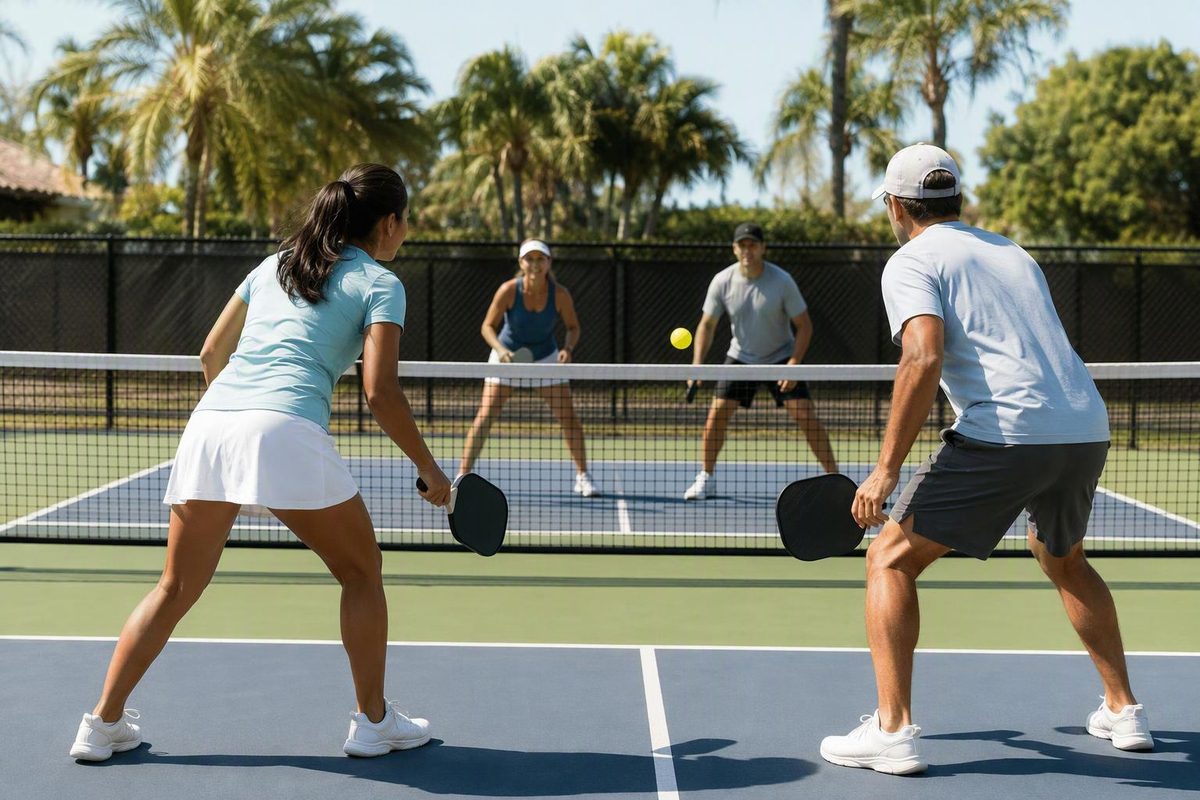
Start with the rules that determine when you can hit, then work on touch and positioning. These pickleball tips give you a specific cue to use during a rally—not six different swings to remember at once.
1. Know when a volley is legal
A volley means hitting the ball before it bounces. At the beginning of a rally, the receiver must let the serve bounce, and the serving team must let the return bounce. After those two required bounces, either team may volley or play the ball after a bounce, subject to the Kitchen rule below. That is the two-bounce rule, not permission to let a ball bounce twice on your side. See Section 10 of the 2026 USA Pickleball rulebook.
The Kitchen—the non-volley zone—is not a stay-out zone. You may enter it to play a bounced ball; you do not have to wait for the bounce before entering. You cannot contact it, including its boundary lines, while volleying, or let your volley’s momentum carry you into it. After contacting the Kitchen, both feet must contact the playing surface completely outside it before you volley again. These requirements appear in rules 3.A.4.c and 11.A of the 2026 rulebook.
Court cue: After serving, stay back with room to play the return after its bounce. At the Kitchen line, leave enough space to volley without stepping on the line. For the tricky situations, read the Kitchen rule explained.
2. Learn to keep a soft shot low
A dink is a soft shot played after a bounce near the Kitchen, intended to land in the opponent’s Kitchen. When everyone is near the net, use it to keep the ball low rather than trying to finish every rally. USA Pickleball’s dink guidance recommends patience until an opponent leaves a ball high enough to attack.
Start with a generous landing area, not the sideline. Give the ball enough arc to clear the net without turning it into an easy high ball.
Checkpoint: Can you and your partner sustain a cooperative dink rally without repeated net hits or high pop-ups? Build that control before adding sharp angles. The dink guide explains the shot in more detail.
3. Make your swing fit the time available
When the ball arrives quickly, a large backswing gives you more movement to complete before contact. Keep the paddle in front, bend your knees and use a compact motion, especially near the Kitchen line. These are among USA Pickleball’s basic technique recommendations.
Court cue: Move your feet to create room for contact in front of your body. If the paddle is still winding up when the ball reaches you, shorten the preparation before trying to hit harder.
4. Give your return a safe, deep target
For recreational doubles, make a deep return through the middle your starting option. Aim roughly 2–3 feet inside the baseline, not directly at it. USA Pickleball’s return guidance recommends this margin and explains that middle returns reduce the serving team’s available angles.
Start far enough behind the baseline to handle a deep serve, then adjust to the actual ball. After returning, move toward the Kitchen line; your non-receiving partner can already be there.
Checkpoint: Count returns that land in your chosen deep area. A spectacular return followed by several misses is a reason to enlarge the target, not swing harder.
5. Move forward, then get balanced before contact
The receiving and serving teams should not advance on the same timetable. The returner can move up after the return. The serving team first has to play that return after its bounce, then judge whether the next shot gives them time to advance.
As you move, use a split step: a small, balanced settling movement just before the opponent hits. USA Pickleball’s positioning guidance recommends this to prepare for the next ball.
Court cue: Do not keep charging forward while your opponent strikes. Get balanced, react, and advance again when the ball allows it. For the serving team’s next decision, see choosing a third-shot drop or drive.
6. Cover the court with your partner
Move laterally with the ball rather than treating each half of the court as a separate job. Staying connected helps avoid large gaps between partners; it is another principle in USA Pickleball’s positioning guidance.
Agree before play on simple middle-ball calls: “mine” or “yours.” Call early enough for your partner to respond.
Checkpoint: Between rallies, review your spacing after a wide shot. Did you both shift to cover the likely reply, or did one player stay planted?
Put two habits into an eight-minute practice
With one partner and a court:
- Three minutes—soft control: Start just outside opposite Kitchen lines. Rally cooperative dinks and count your longest run of playable shots. You may step into the Kitchen to retrieve short balls, but re-establish both feet outside before volleying.
- Three minutes—return depth: Switch roles after every five serves. The receiver aims into the deep middle with baseline margin. Record target hits separately from merely in-bounds returns.
- Two minutes—movement timing: Play opening rallies without keeping score. The returner moves forward; the server waits for the return bounce. Both practice getting balanced before the opponent’s next contact.
In your next doubles game, choose just two cues: one shot cue and one movement cue. For example, “deep middle return” and “balanced before contact.”