
Pickleball Court Dimensions: What to Measure and Where
A pickleball court is 20 by 44 feet. Check Kitchen and service-box dimensions, net height, line measurements and the extra space needed around the court.
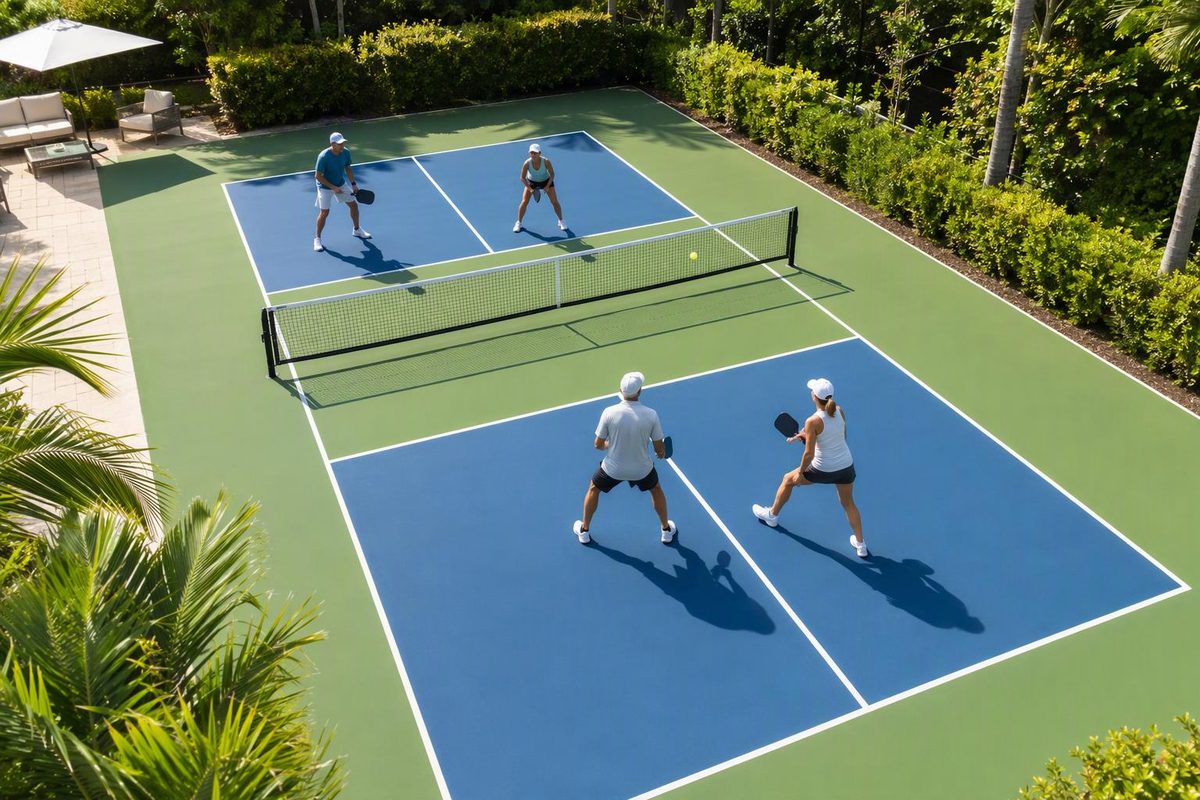
A standard pickleball court is 20 feet wide by 44 feet long, including the boundary lines. Singles and doubles use the same court size—there are no doubles alleys. That is the lined court, not the full space needed to play: USA Pickleball specifies a minimum playing surface of 30 by 60 feet. (2026 USA Pickleball Rulebook, Section 3.A)
Court measurements at a glance
| Feature | Measurement |
|---|---|
| Full lined court | 20 ft wide × 44 ft long (6.10 × 13.41 m) |
| Each half, from net to baseline | 20 ft wide × 22 ft long |
| Kitchen on each side of the net | 20 ft wide × 7 ft deep |
| Each service box | 10 ft wide × 15 ft long |
| Court lines | 2 in wide (5.08 cm) |
| Net height at the sidelines | 36 in (91.44 cm) |
| Net height at the center | 34 in (86.36 cm) |
The half-court and service-box measurements follow from the official layout: each 22-foot half contains a 7-foot Kitchen and a 15-foot service area, divided down the middle. Net-height tolerance is ±¼ inch under the 2026 rules. (Rulebook, Sections 3.A–3.B)
What the lines mean during play
The baseline is the back boundary. The sidelines mark the court’s width. The centerline divides each end’s right and left service boxes; it runs only from the Kitchen line to the baseline on a standard court.
The Kitchen, formally the non-volley zone, extends 7 feet from the net on each side. Its boundary lines belong to the Kitchen. That means standing on the Kitchen line while hitting a volley—a shot struck before the ball bounces—is a fault. You may enter the Kitchen at any time except during the act of volleying; you do not have to wait for a ball to bounce. After touching the Kitchen, both feet must contact the surface completely outside it before your next volley. Your volley’s momentum cannot carry you into the Kitchen, either. (Rulebook, Sections 3.A.4 and 11.A)
For ball placement, remember the important exception: a serve landing on the Kitchen line is out. A serve touching the correct service box’s baseline, sideline or centerline is in. During the rest of the rally, a ball landing on any court line—including the Kitchen line—is in. (Rulebook, Sections 3.A.4, 7.E and 8.B–8.C)
How much space do you need around the court?
Do not fit the 20-by-44-foot rectangle tightly between walls or fences. Players need room beyond the lines to serve and chase shots.
USA Pickleball’s 2026 specifications distinguish these playing-surface sizes:
| Use | Overall playing surface | Space outside a centered court |
|---|---|---|
| Minimum | 30 × 60 ft | 5 ft beside each sideline; 8 ft behind each baseline |
| Recommended for new construction and tournament play | 34 × 64 ft | 7 ft beside each sideline; 10 ft behind each baseline |
The outside-space figures are calculated from the official dimensions, assuming the court is centered. They describe the playing surface, not a complete facility footprint with spectator areas or other amenities. (Rulebook, Section 3.A.3)
Measuring a temporary layout
On a suitable surface where marking is permitted:
- Check the overall space first. Allow for the playing surface, not just the boundary rectangle.
- Mark a square-cornered 20-by-44-foot rectangle. Measure to the outside edges of the perimeter lines.
- Place the net halfway along the length. Each baseline is 22 feet from the net.
- Mark both Kitchen lines 7 feet from the net. Measure to each line’s outside edge—the edge farther from the net. Add a centerline from each Kitchen line to its baseline.
- Check line width and net height. Use 2-inch lines, all the same color and clearly contrasting with the surface. Measure to the top of the net where it crosses each sideline’s outer edge and at the center; include the center strap if fitted. (Rulebook, Sections 3.A–3.B)
Once set up, try a short partner practice: stand just outside opposite Kitchen lines and exchange soft shots that bounce in the other Kitchen. Step in when needed, then reset outside the line. The checkpoint is visible: both feet have contacted the surface outside the Kitchen before any volley, and your finish stays balanced outside the zone. For the shot itself, see how to hit a dink.