
6 Pickleball Exercises for Controlled Court Movement
Try six beginner-friendly pickleball exercises, plus a short warm-up, with clear cues for strength, balance and Kitchen-line movement.
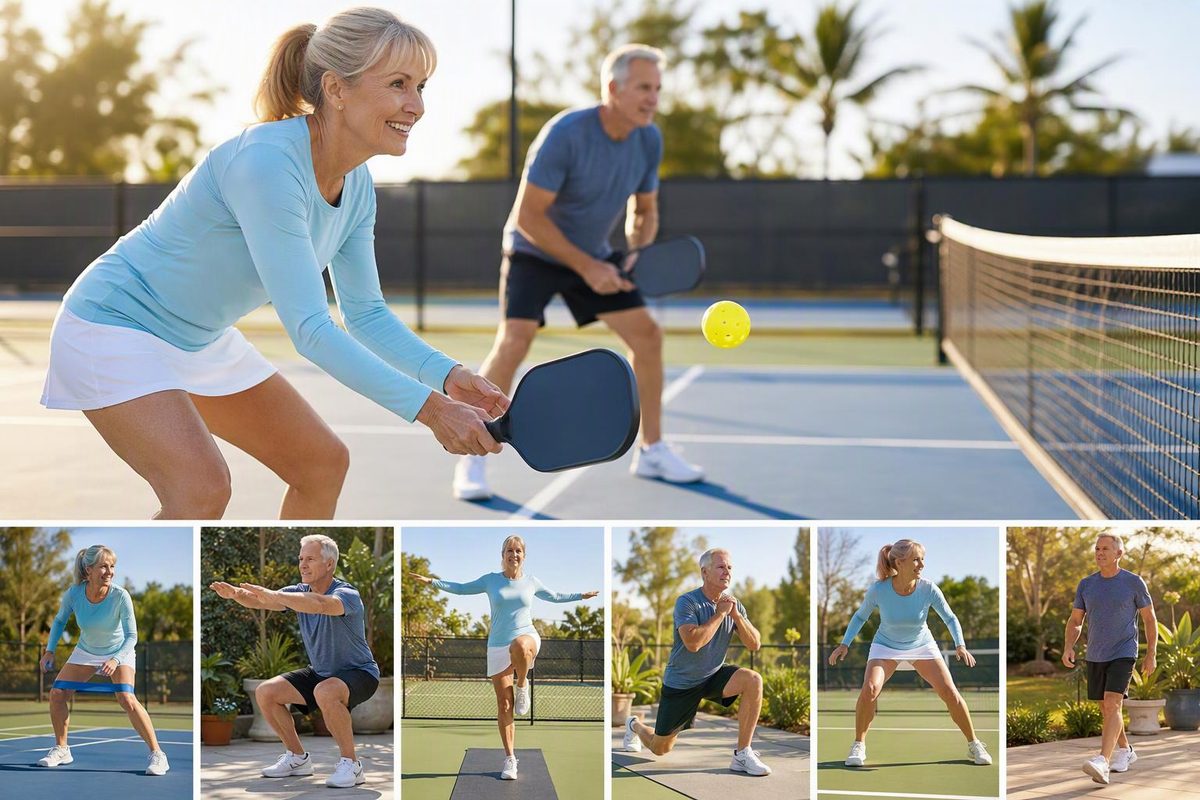
Useful pickleball exercises include controlled chair rises, calf raises, wall push-ups, supported balance work and short court-movement patterns. The aim is to practice getting into position and stopping under control—not simply moving faster.
One rule matters before you practice near the net: you may enter the Kitchen without waiting for a bounce, including to play a ball that bounces. You may not volley while touching the Kitchen or its line, and your volley momentum cannot carry you into it. A volley is a shot hit before the bounce. These restrictions come from USA Pickleball’s rules summary.
The routine below separates physical preparation from paddle skills. If you want repeated hitting practice instead, use our 30-minute partner drills.
Start with a short moving warm-up
Before playing or exercising, spend about five minutes moving gently:
- Walk or march for a minute.
- Alternate comfortable knee lifts and heel-to-backside movements.
- Make small shoulder circles, then slightly larger circles.
- Take slow sideways steps in both directions.
- Finish with easy shadow swings and a few gentle dinks if you have a partner.
Start slowly and increase the pace gradually. Stamford Health physical therapist Matt Fedro recommends low-intensity leg movements, calf raises, shoulder circles and simulated paddle swings as part of a pickleball warm-up.
Use a clear, dry surface and keep a stable support nearby for the home exercises. Stop if you feel pain, dizziness or instability. If an injury or health condition limits your exercise, ask your clinician which movements are appropriate.
Four simple exercises away from the court
These are a gentle starting point, not a complete strength program. Begin with one round, resting between exercises as needed. The NHS strength routine recommends building repetitions slowly and exercising at least twice a week.
1. Sit-to-stand: practice lowering and rising
Setup: Use a solid chair without wheels that will not slide. Choose a height that lets you sit with your feet flat and knees bent at right angles. Sit near its edge with your feet hip-width apart.
Action: Lean slightly forward, stand slowly using your legs, then sit back down under control. Aim for five repetitions; use your hands to guide your descent if needed.
Checkpoint: You can lower yourself without dropping into the seat.
Treat this as general leg-strength work. On court, you still want a comfortable bend in your knees rather than a deep squat before every shot.
2. Calf raises: work through a controlled heel lift
Setup: Stand behind a stable chair with your hands on its back for support.
Action: Slowly lift both heels as far as comfortable, then lower them to the floor. Start with five repetitions.
Checkpoint: Your body rises vertically without rocking forward or bouncing.
The NHS includes supported calf raises in its strength routine. Feldman Physical Therapy also recommends calf raises for pickleball players, with two-leg raises as an easier alternative to single-leg work. You do not need to start with hopping exercises.
3. Wall push-ups: add simple upper-body work
Setup: Stand at arm’s length from a wall. Place your palms against it at chest height, fingers pointing upward.
Action: Keep your back straight as you slowly bend your elbows close to your sides, move toward the wall, then press back. Begin with five comfortable repetitions.
Checkpoint: Your body moves as one unit; your lower back does not sag.
The NHS wall press-up instructions offer a progression toward three sets of five to ten repetitions.
4. Supported one-leg stand: practice steady balance
Setup: Face a wall with your fingertips touching it.
Action: Lift one foot slightly, keeping your hips level and a small bend in the standing knee. Hold for five to ten seconds, then put the foot down gently. Repeat three times per side.
Checkpoint: You can return the foot quietly without tipping sideways.
These timings follow the NHS balance routine. Keep the support available; balancing with your eyes closed or while hitting a ball is not necessary for this starting routine.
Two movement exercises without a live ball
5. Side-step and stop
Setup: Stand just behind the Kitchen line with your paddle in front and knees comfortably bent.
Action: Take two small sideways steps, bringing the trailing foot toward—but not across—the leading foot. Stop, then repeat in the other direction. Try five trips each way at walking speed.
Checkpoint: Your feet do not collide, your head stays fairly level and you can stop without an extra recovery step.
This short pattern lets you rehearse lateral adjustments beside your doubles partner. Baptist Health’s warm-up guidance includes lateral shuffles without crossing the feet. Keep this version short and controlled rather than racing across the full court.
6. Advance, settle and shadow-hit
Setup: Begin a few steps behind the Kitchen line. Ask a partner to stand opposite you and make occasional slow shadow swings, without a ball.
Action: Move forward at walking pace. As your partner prepares to swing, stop advancing and settle into a balanced ready position. Make a compact shadow shot. Finish each approach behind the Kitchen line, then turn and walk back to your starting position. Try six approaches.
Checkpoint: You are balanced when the imaginary ball arrives—not still charging forward.
USA Pickleball teaches a split step before an opponent hits: a small hop to reset balance. This walking version lets you rehearse the timing without adding a jump.
In a real point, the serving side must let the return bounce before hitting its third shot, as explained in the two-bounce rule. Advance when your shot gives you time, settle before the opponent’s contact and move with your partner. Our doubles positioning guide connects those movements to the point.