
Pickleball Doubles Strategy: Move Together, Choose Better Shots
Build a doubles point plan: start in the right positions, earn your way to the Kitchen, cover the middle and practice decisions with your partner.
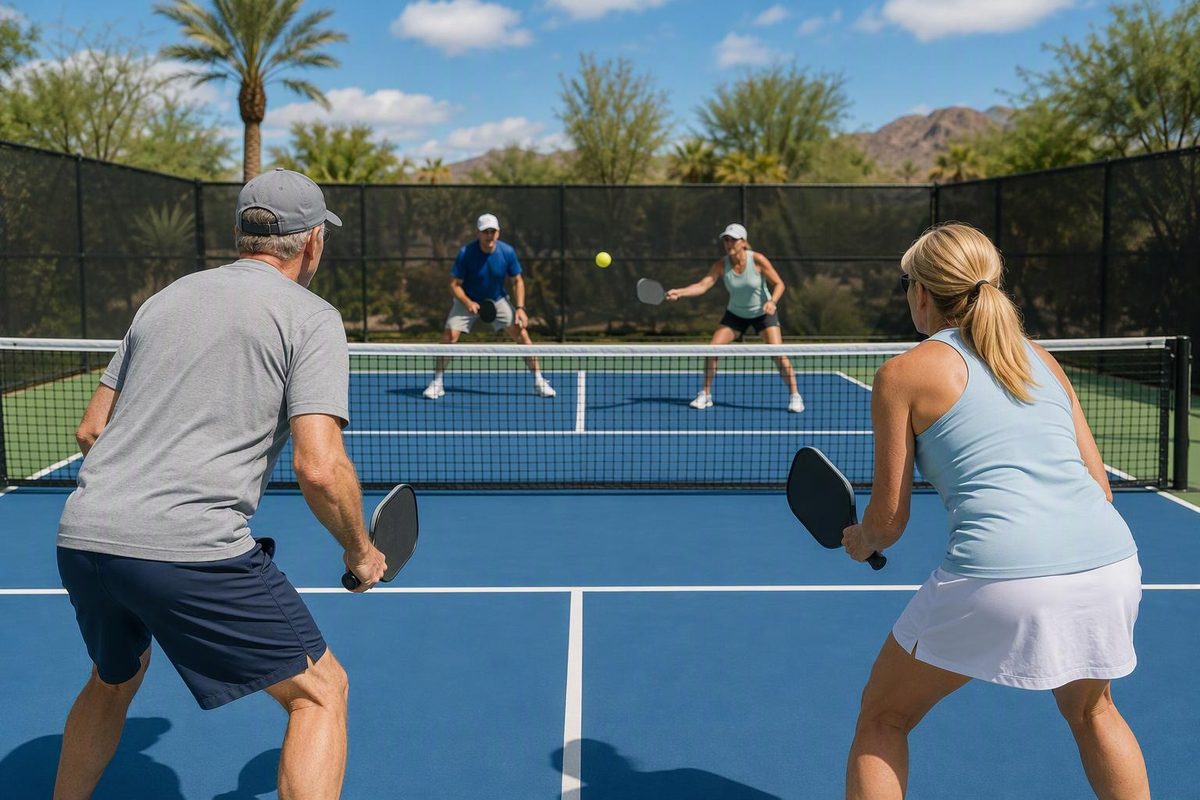
Good pickleball doubles strategy connects your shot to your partner’s next position. Use this basic plan: return deep, earn your way to the Kitchen line, move as a pair, and attack when the ball gives you an opportunity.
This guide focuses on team decisions during a point. For foundational shot and movement habits, start with these recreational pickleball tips.
First, know when a volley is legal
Under the 2026 USA Pickleball rules, the receiver must let the serve bounce, and the serving team must let the return bounce. After those two required bounces, either team may volley—hit the ball before it bounces—subject to the Kitchen rules. Your third-shot drop does not have to bounce before an opponent hits it. See rule 10.A in USA Pickleball’s official rulebook.
The Kitchen, or non-volley zone, is not a no-entry area. You may step into it to play a bounced ball. After contacting it, both feet must contact the playing surface completely outside it before you volley again. Neither your volley nor its momentum may cause you to contact the Kitchen, including its boundary lines. That is why the useful attacking position is just behind the Kitchen line, not inside it. These restrictions appear in rules 3.A.4.c and 11.A of the 2026 rulebook.
1. Give each partner the right starting job
When serving: both players should stay back near the baseline, leaving room for the return to bounce. The server’s partner should not rush to the Kitchen before the return arrives.
When receiving: the returner starts behind the baseline; the other partner starts just behind the Kitchen line. After returning, the receiver moves forward to join that partner. These starting positions follow USA Pickleball’s positioning guidance.
Make a deep, controlled return through the middle your default, with margin inside the baseline. A return with more arc can give you time to advance. USA Pickleball recommends these return targets and movement cues.
Checkpoint: when the serving team hits its third shot, are you balanced and ready, or still running through your return? If you have not reached the line, get balanced where you are rather than continuing to charge through contact.
2. Use the third shot to earn forward movement
The third shot is the serving team’s reply to the return. Choose it for the situation, not because you decided before the rally to hit only drops or only drives.
- Deep or low return: try a drop—a soft shot intended to land in the opponents’ Kitchen—to reduce their attacking opportunity and buy time.
- Short return with a high bounce: consider a controlled drive to apply pressure. A weaker reply may give you an easier drop on the fifth shot.
- Your shot sits high: hold your position and prepare to defend rather than automatically charging forward.
These choices match USA Pickleball’s drop-versus-drive guidance.
The non-hitting partner should watch the shot, too. If it leaves an easy attack, sprinting ahead alone creates a team with one player up and one back. Advance when the ball gives you time; settle into a balanced ready stance before the opponent strikes.
Checkpoint: judge your drop by the reply and the time it gives your team—not simply whether it gets volleyed. For more shot-selection detail, see choose a third-shot drop or drive.
3. Cover the court as a pair
Once both players reach the Kitchen line, avoid treating your halves as separate courts. Shift with the ball: if one partner moves toward the sideline, the other shifts toward the middle rather than staying planted. USA Pickleball recommends following the ball and staying linked with your partner.
Before playing, agree on a simple middle-ball default. For example, give a comfortable, balanced forehand priority when both players can reach the ball. But do not make “forehand takes everything” an absolute: a stretched forehand may be a worse choice than your partner’s ready backhand.
Call “mine” or “yours” early. After a confusing ball, use the pause between rallies to agree who should take that situation next time.
Checkpoint: when one player moves wide, does the partner protect the gap between you?
4. Create an attack rather than forcing one
At the Kitchen line, use soft shots to make opponents move and produce a less comfortable reply. Start with generous targets; as control improves, vary placement between the middle and an opponent’s forehand or backhand. USA Pickleball’s dinking guidance recommends varying targets to create attackable high balls.
Use this simple decision cue:
- Contact below net height or off balance: favor a soft shot and recover your position.
- Contact above net height while balanced: consider a controlled attack toward an open gap or the opponents’ feet.
Treat this as a starting guideline, not a rule. A high ball is an opportunity, not an instruction to swing as hard as possible.
Practice: 10 rallies with one team checkpoint
Setup: use four players on a doubles court. One team serves for 10 practice rallies, then switch roles. Play each rally out without keeping game score.
Action: the receiving team practices a deep return and joining its partner. The serving team chooses a drop or drive, then advances only as the ball allows. Both teams call shared balls early.
Checkpoint: choose one team decision to track for the set: movement after the third shot, lateral coverage after a wide ball, or ownership of middle balls. After each rally, briefly review that moment. Count successful decisions separately from rally wins; if the situation did not occur, do not count it.
Repeat the set with one adjustment—earlier middle calls, a safer return target, or less rushing after a high third shot. Keep the task small enough that both partners can notice it during play.