
Build Smarter Singles Points Without Chasing Every Ball
Follow a five-step plan: choose purposeful targets, recover immediately, establish depth, approach with an advantage, and reset under pressure.
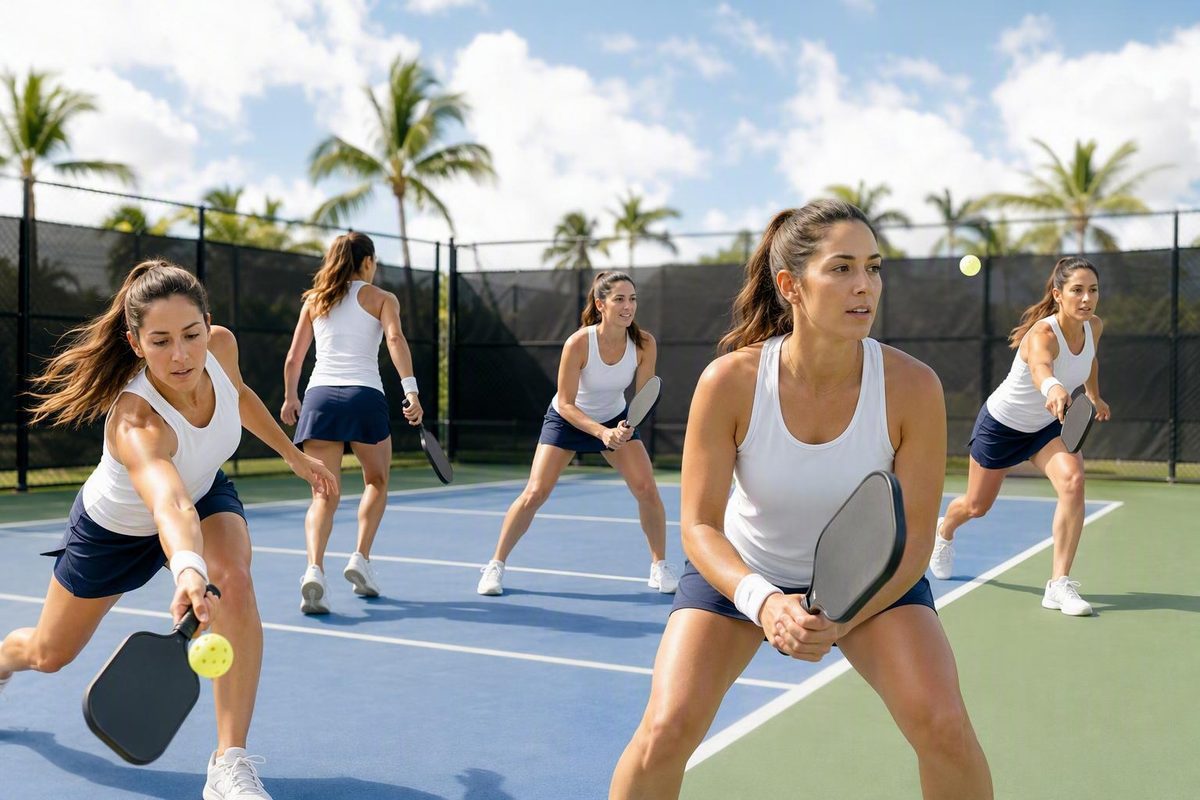
The simplest pickleball singles strategy is this: choose a purposeful target, recover as soon as the ball leaves your paddle, establish depth before seeking a winner, and approach the non-volley-zone line only when your shot has created an advantage. If you are stretched or off balance, reset the rally instead of forcing the attack. This point-by-point plan helps you cover the full court with better positioning rather than trying to outrun every ball.
Start with this five-step singles match plan
Singles uses the same court and basic rules as doubles, but one player covers the entire side. That extra space makes balance, movement, recovery and shot discipline especially important. USA Pickleball’s beginner rules summary confirms that singles and doubles share the same court size and basic rules.
Use this five-step plan:
- Serve or return with purpose. Pick a target based on the position you want to create.
- Recover immediately. Start moving as soon as your shot leaves the paddle.
- Establish depth. Keep the opponent back or make them hit while moving.
- Approach only after creating an advantage. Move forward behind a ball that leaves you balanced and pressures the opponent.
- Reset safely under pressure. When stretched, use height, depth or controlled pace to regain position.
A good shot is not merely one that lands in. It should also help you prepare for the next ball.
For most recreational players, consistency and depth are safer starting priorities than attempting a winner from a neutral or defensive position. Pace can help, but not when it removes your margin over the net or inside the lines. The objective is to earn an attackable ball rather than manufacture one from a poor position.
The rules shape this plan. The serve travels diagonally, and the serve and return must each bounce before either player may volley. The non-volley zone restricts volleys; it does not prohibit entering the zone to play a ball that has bounced. These serve, bounce and non-volley-zone requirements are covered in USA Pickleball’s official rules summary.
That means the returner can use the required bounce on the serving side to gain court position—but advancing is still a tactical decision, not an obligation. A weak return may leave the returner running forward while the server has time and open space for a pass.
The recommendations below are adaptable coaching guidance, not statistically proven formulas. Your movement, preferred shots and opponent’s tendencies may justify changing the default plan.
Use the serve and return to establish court position
The serve and return begin your positioning work. On both shots, prioritize depth and accuracy, then add pace only when you can do so without creating excessive fault risk.
Choose among three serve targets
A practical serving pattern rotates among:
- Deep middle: A high-margin starting target that can limit sharp return angles.
- At the body: Aims to complicate the returner’s spacing and footwork.
- Wide: Moves the returner away from a central position and may open the opposite side.
Do not assume the backhand is weaker. Test the forehand, backhand, body and movement in both directions. One player may have a compact, reliable backhand but struggle when jammed on the forehand side. Another may handle pace well but become less comfortable when pulled wide.
Once an opponent anticipates a target, change it. Variation does not require aiming close to the sidelines; a modest change in direction can be enough to disturb an early move.
Make the return deep enough to support your next move
Your default return goal is to keep the server back while giving yourself time to recover or advance under control. Depth matters more than maximum speed. A controlled return landing toward the back of the court can be more useful than a harder ball that frequently lands short or goes long.
The quality of the return should determine what happens next:
- Deep or wide return that pressures the server: Consider moving forward under control.
- Short, central return: Stay back or pause because the server may have comfortable passing angles.
- Return hit while off balance: Recover first instead of continuing an automatic charge.
- High return that gives the server time: Expect an aggressive reply and establish your balance before committing.
Chris Mitchell’s practitioner guidance, published by Pickleball England, similarly recommends using deep or angled returns to support an advance while staying back after a short, relatively central return.
Before each point, ask:
- Where is my serve or return target?
- What reply is that target most likely to produce?
- Which lane should I recover through?
- How good must the next ball be before I approach?
Under traditional side-out singles scoring, an even server score means serving from the right and an odd score means serving from the left. Only the server can score in that format. USA Pickleball’s singles scoring and positioning guide explains how the server’s score determines the serving side. Confirm which scoring format your game uses before play begins.
Recover to cover angles—not automatically to dead center
Use one repeatable movement cue throughout the rally:
Hit, move, split-step, read.
Hit the ball, begin recovery immediately, split-step near the opponent’s contact and then read the reply. Do not remain still to admire your shot. Its quality matters because it changes where you should move, but watching it does not help you defend the next ball.
The geometric center of your court is a useful reference—not a compulsory destination. Your best recovery position depends on where you sent the ball, where the opponent will contact it and which replies are easiest from that position.
Consider three common scenarios:
- You play through the middle: Recover near a central position because you have not created an extreme outside angle.
- You pull the opponent wide: Shade toward the most dangerous available reply. Depending on the opponent’s contact point, that may mean protecting the easier down-the-line ball or the open court rather than standing on the center mark.
- You are pulled outside the sideline: Recover diagonally toward the likely reply lane. Running straight toward dead center can expose the angle behind your movement.
This angle-dependent approach reflects instructional guidance that recommends recovering toward the opponent’s most useful options rather than automatically returning to geometric center. UTR Sports’ singles strategy guide also connects recovery position to the direction of the previous shot.
Think of recovery as closing the most useful door available to the opponent. You cannot cover every possible shot. Your job is to make the easiest reply less damaging while remaining balanced enough to react to another option.
When stretched, buy time before trying to retake ideal position. Useful choices include:
- A controlled deep ball with safe net clearance
- A neutral block that removes some pace
- A carefully selected defensive lob
- A soft reset that forces the opponent to hit another ball
A defensive lob can provide recovery time, but a short lob may give the opponent an overhead. Use it when the extra flight genuinely helps you recover, not as a routine escape from every difficult position.
Avoid memorizing exact recovery coordinates. The appropriate location changes with shot direction, contact quality, mobility and the opponent’s preferred patterns. Learn the relationship between the ball and the available angles instead.
Know when to approach—and when to stay back
Reaching the non-volley-zone line can create attacking opportunities, but singles does not require an automatic rush after every return. The approach shot and the movement behind it must work together.
Before advancing, look for four cues:
- Your ball landed deep or moved the opponent.
- You finished the shot balanced.
- The opponent is under pressure, moving or reaching.
- Your placement has reduced the available passing angles.
Approaching through the middle can be useful because it gives the opponent fewer extreme angles than a poorly placed wide ball. But middle placement does not rescue a short, high or slow approach. If the opponent is balanced and has time, you can still be passed or lobbed. Practitioner instruction on selective approaches likewise recommends moving forward behind a quality ball rather than charging on a neutral shot.
Advance under control. As the opponent prepares to contact the ball, stop your forward run with a split-step. This puts you in a position to move laterally, defend your feet or handle a lob. Running through contact makes even a reachable ball difficult to control.
Stay back or pause when:
- Your return is short and central.
- You are leaning, reaching or recovering from a difficult shot.
- Your ball is neutral and the opponent can attack comfortably.
- The opponent is already set to pass or lob.
- Moving forward would leave you between positions at contact.
Use the following decisions as practical defaults:
| Rally situation | Decision | Reason |
|---|---|---|
| Deep ball pressures the opponent | Approach | Depth creates time and may produce a weaker reply |
| Short, central ball | Pause or stay back | The opponent has comfortable passing angles |
| Wide ball moves the opponent | Approach selectively | Advance if balanced and able to cover the likely reply |
| Defensive ball hit while stretched | Defend | Recover before trying to take the line |
| Opponent already established at the line | Pause or defend | Choose a pass, drop or reset before moving forward |
The line is a destination you earn, not a place you must reach immediately.
Choose the shot that fits the ball and court position
There is no universal third shot—or universal rally shot—for singles. Choose among a drive, pass, drop, dink, lob or overhead by assessing four things:
- Ball height
- Your balance
- Your court position
- The opponent’s position and movement
| Ball and balance | Court situation | Practical choice | Purpose |
|---|---|---|---|
| High or comfortably attackable | Opponent moving or leaving space | Drive or pass | Attack the opening |
| Low ball, balanced contact | Opponent established at the line | Drop or soft shot | Keep the ball low and improve position |
| Low ball near the line | Both players forward | Dink | Deny an easy attack and create a lift |
| High ball overhead | You are set beneath it | Controlled overhead | Attack while retaining balance |
| Difficult ball while stretched | Opponent pressing forward | Defensive lob or reset | Buy recovery time |
| Neutral ball from the backcourt | Neither player has a clear advantage | Deep, controlled shot | Maintain margin and build pressure |
Drive or pass
Drive or pass when the ball is high enough to attack, you are balanced and the opponent has left usable space. Passing becomes especially attractive when the opponent is moving forward or has committed toward one side.
Do not confuse “space exists” with “the sideline must be hit.” A pass with margin can still beat a moving player. Forcing every drive close to a line turns an attacking opportunity into an avoidable error.
Drop or soft shot
Use a drop or softer ball when contact is low, the opponent is established at the non-volley-zone line or a change of pace would give you time to improve your position. The shot does not have to win the rally immediately. Its job may be to make the opponent contact the ball below net height.
Dink
A dink becomes useful when both players are near the line and the ball must stay low. Prolonged dink exchanges are generally less central in singles than in doubles because more open court is available, but soft play still matters. A patient dink may produce the first ball high enough to attack.
Players may enter the non-volley zone to play a bounced ball. The restriction applies to volleying while touching the zone or its line.
Overhead
Use an overhead when the ball is sufficiently high and you can establish yourself beneath it. For recreational play, prioritize a balanced contact and a controlled target rather than treating every overhead as a maximum-power finish. If you are moving backward or contacting behind your body, choose a conservative target and prepare for another shot.
Defensive lob
Reserve the defensive lob for a situation in which its flight provides valuable recovery time or moves an opponent away from the line. A short lob can invite an overhead, so do not use it simply because you have run out of other ideas.
Two patterns are easy to repeat:
- Move wide, then hit behind: Pull the opponent toward a sideline. If they recover early and quickly, consider sending the next suitable ball behind their movement.
- Jam, then use the opening: Play toward the body or middle to limit a clean swing, then direct the next attackable ball into open court.
Change direction selectively. A neutral ball does not demand a sideline winner. Continue building with depth until the ball, your balance and the opponent’s position support the change.
Fix the mistakes that make singles feel exhausting
Singles often becomes tiring because one poor decision creates the next emergency. Diagnose the pattern rather than blaming every lost point on speed.
-
Shallow serves and returns: The opponent steps forward and attacks without first being moved. Correction: Choose a deep target and reduce pace until you can reach it consistently.
-
Ball-watching: You remain near the contact point while the opponent prepares the reply. Correction: Begin recovery as soon as the ball leaves your paddle.
-
Automatic net rushing: You advance behind a weak ball and offer an easy pass or lob. Correction: Reassess the shot’s depth, your balance and the opponent’s position before crossing forward.
-
Fixed center recovery: You return to the same spot regardless of the angle created. Correction: Shade toward the opponent’s most dangerous available reply.
-
Overhitting: Your attempt to end the rally sacrifices depth, balance and margin. Correction: Use controlled pace to create the attackable ball before trying to finish.
-
Predictable targeting: Repeatedly attacking one side allows the opponent to move early. Correction: Test the forehand, backhand, body and both movement directions before committing to a pattern.
All six corrections return to the same cue: hit with purpose, recover immediately, then reassess.
Practice three patterns that transfer directly to matches
You do not need complicated equipment. A few cones, chalk marks or visual court references are enough.
1. Depth drill
Mark a generous target area toward the back of the service court. Practice serves first, then returns.
Begin by tracking whether the ball reaches the deep area while staying in. Once placement becomes repeatable, vary among middle, body and wide targets. Add pace last.
- Beginner: Track depth and balanced contact.
- Intermediate: Alternate targets without losing margin.
- Advanced recreational: Add disguise and pace changes while maintaining depth.
2. Approach-decision drill
Have a partner alternate deep, short and central feeds. Do not decide in advance to approach every ball.
Advance only when your shot creates pressure and leaves you balanced. Stay back after a weak or neutral shot. Split-step as your partner makes contact, then play out the point.
- Beginner: Identify “go” and “stay” balls.
- Intermediate: Add passing shots when the approach is weak.
- Advanced recreational: Disguise the approach target and vary the follow-up.
This drill teaches the decision, not merely the forward run.
3. Angle-recovery drill
Rally from alternating locations. After every shot, recover diagonally toward the likely reply lane and split-step at your partner’s contact.
Have the partner sometimes return down the line and sometimes into open court. Your goal is not to guess perfectly; it is to arrive balanced in a position that covers the most likely threat.
- Beginner: Focus on moving immediately and stopping at contact.
- Intermediate: Adjust recovery according to shot direction.
- Advanced recreational: Add shots behind a moving player, changes of pace and more deceptive preparation.
Finish every practice with a match-use test: can you repeat the pattern while balanced? If not, reduce the pace, simplify the target or shorten the movement. A drill that becomes a winner-hitting contest will not teach dependable point construction.
Take one simple plan into your next game: choose a purposeful target, recover the moment the ball leaves your paddle, and approach only when depth, balance and the opponent’s position create a real advantage. Start with one reliable deep serve pattern, one dependable return and disciplined recovery. Add sharper angles, deception and aggression only after those foundations hold up under pressure.