
Advanced Pickleball Techniques: Control, Pressure and Disguise
Practice transition resets, purposeful dinks, volley dinks and disguised speedups—with clear shot-selection cues and a 15-minute partner progression.
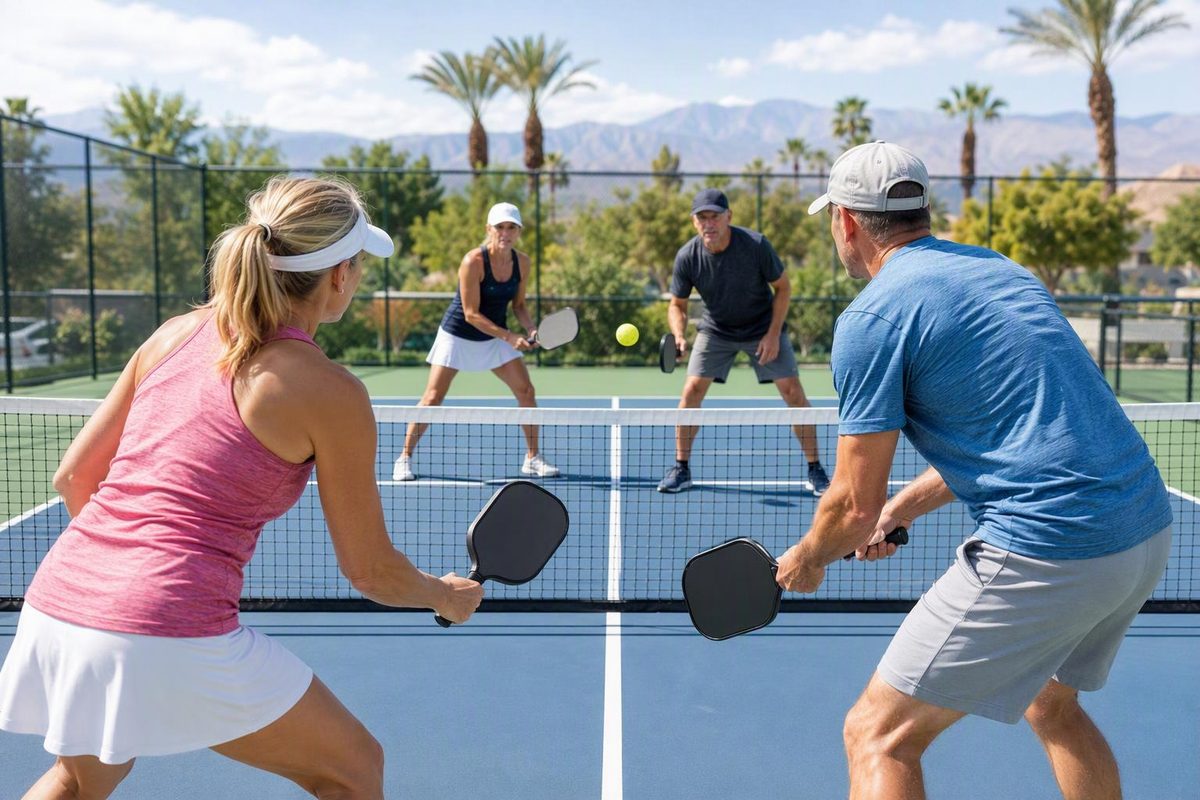
You may reach over the Kitchen—the non-volley zone—to volley; you may not touch its surface or boundary lines during the volley or its resulting momentum. This restriction includes anything you wear or carry; momentum that takes you into a partner touching the Kitchen is also a fault. You may enter it to play a bounced ball, but both feet must contact the surface completely outside it before your next volley. See Rules 3.A.4.c and 11.A in the 2026 USA Pickleball rulebook.
For improving doubles players, useful advanced pickleball techniques connect control to pressure: reset when stretched, move opponents with soft shots, take time away without overreaching, and disguise an attack without losing readiness for the reply. Practice them in that order.
1. Reset in transition—then earn your next step
A reset is a soft defensive shot intended to land in the opponent’s Kitchen. Use it to slow an attack when you are caught between the baseline and Kitchen line—the transition zone. Your immediate job is to remove the opponent’s easy downward attack, not win the rally.
Before contact:
- Stop your forward movement and settle into a balanced, bent-knee stance.
- Keep the paddle in front with little or no backswing.
- Relax your grip enough to absorb pace while retaining control of the paddle.
- Guide the ball over the net rather than punching it back.
These are the central mechanics in USA Pickleball’s reset guidance.
Decision cue: When contact is below net height and you are under pressure, make the reset your default. A high ball you can comfortably hit downward presents a different opportunity.
Move forward when your reset buys time, then settle again before the opponent strikes. Do not run through contact just because you are trying to reach the line. USA Pickleball recommends a split step before the opponent hits—a small hop or settling step that prepares you to move in either direction.
Checkpoint: Did the reply give you time to advance and become balanced, or were you still running when the next ball arrived? A reset need not end the defensive sequence; you may need another.
2. Make your dinks move the opponent
A reliable dink is the foundation. The next layer is placement that changes the opponent’s contact point without making your own ball easy to attack.
At the Kitchen line, use the same compact swing to alternate between broad targets: middle and wider, or forehand and backhand. USA Pickleball’s dinking guidance recommends varying placement to disrupt rhythm and create uncomfortable replies.
Start with generous margins. You are trying to make the opponent adjust their feet or paddle, not paint a sideline. If you are stretched or contacting late, choose a simpler target and regain balance before adding more angle.
Checkpoint: Watch the opponent, not just the landing spot. Did they move, reach or change their contact point? If your wider dink sits up for an easy attack, reduce the angle or pace.
For the basic stroke, revisit what a dink is and how to practice it.
3. Take a dink out of the air without attacking it
A volley dink is a soft volley sent into the opponent’s Kitchen. Taking the ball before its bounce can reduce the opponent’s preparation time while preserving the soft exchange.
In Dominic Catalano’s volley-dink lesson, the useful reach cue is a “bubble” around your body: take the ball in the air when it falls within comfortable reach, rather than stretching to your limit.
Keep your feet outside the Kitchen, paddle forward and chest steady. Use a small guiding motion. An airborne ball is not automatically an attacking ball; low contact may still call for soft control.
Decision cue: If reaching would pull you into the Kitchen or leave you unable to recover, let the ball bounce and reposition.
Checkpoint: Can you finish balanced and ready for the next shot? If you repeatedly stumble forward, choose fewer volleys rather than reaching harder.
4. Disguise the speedup—and prepare for the counter
A speedup changes a soft exchange into a faster attack. Disguise helps, but it does not rescue poor shot selection.
Start with a ball you can contact comfortably in front, preferably above net height with room to hit downward. Avoid forcing the attack while off-balance.
Prepare as though you could still dink: paddle forward, short preparation, no large backswing. Then choose the soft shot or accelerate through the ball. USA Pickleball calls this “holding your dinks”: preparing early and delaying the forward swing so you do not reveal the final shot too soon. Keep contact in front rather than waiting so long that you become cramped. “Holding” refers to swing preparation and timing—not catching or carrying the ball.
Return the paddle to a ready position immediately. The opponent may counter your attack, and your second shot matters as much as your first.
Checkpoint: Judge the whole exchange. Did the speedup create an advantage, and were you ready for the reply? A fast ball followed by a helpless reach is not a successful pattern.
A 15-minute partner progression
Work opposite your partner on the same half of the court. Use cooperative feeds first. These are practice constraints, not game rules.
| Time | Setup and action | What to count |
|---|---|---|
| 5 minutes | One player at the Kitchen line, one in transition. Feed moderate-paced balls; the defender resets, advances when there is time, and settles before the next feed. Restart from transition after reaching the line. Switch roles halfway. | Resets that allow a balanced next contact—not merely balls that clear the net. |
| 5 minutes | Both at the Kitchen line. Dink to broad middle and wide targets within your half. Take comfortable balls out of the air; let stretching balls bounce. | Intended placements completed without losing balance. |
| 5 minutes | Begin with cooperative dinks. Either player may speed up a suitable ball; play out the exchange, then restart softly. | Whether the attacker chose a suitable ball and was ready for the counter. |
Keep feeds slow enough to preserve the intended mechanics. Add pace only when you can still make the decision you are practicing. For a longer session that includes serves, returns and third shots, use the 30-minute partner drill plan.