
Pickleball Faults: What Ends a Rally—and What Doesn’t
Understand common pickleball faults, Kitchen and serve violations, what happens after a fault, and how to handle calls in recreational doubles.
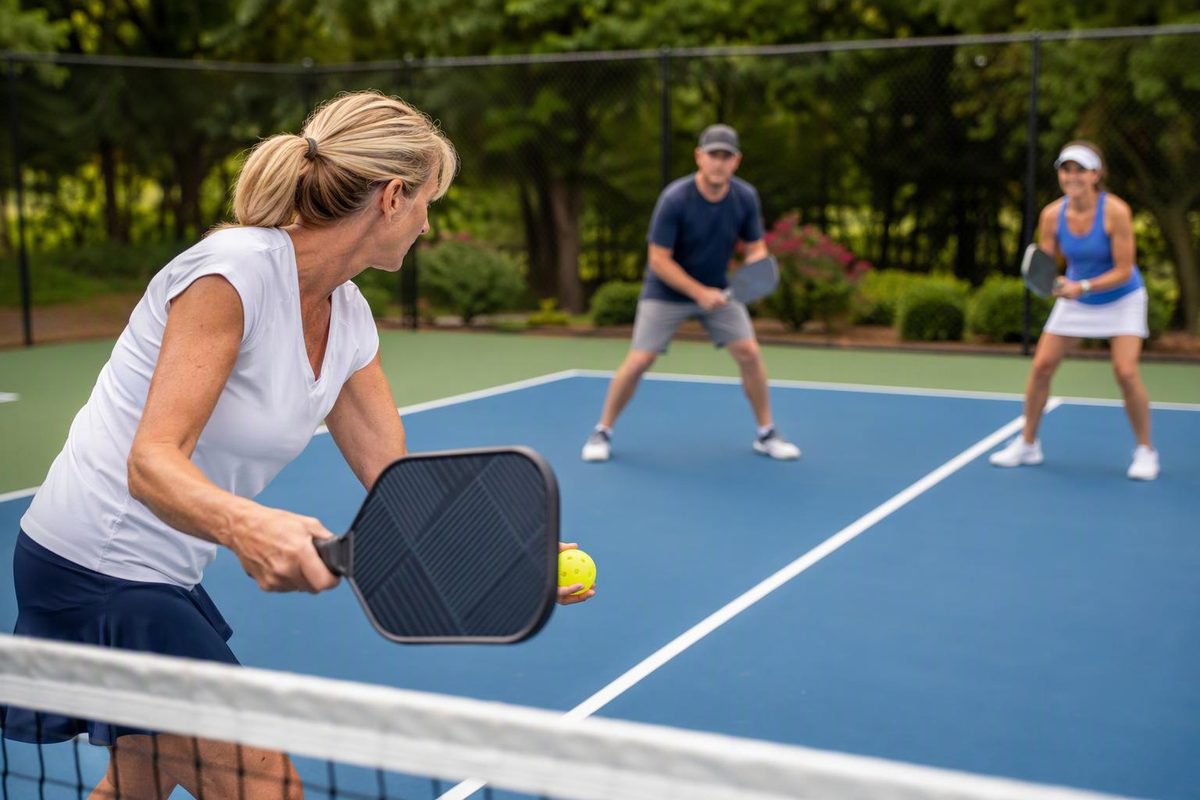
A pickleball fault is a rule violation that makes the ball dead and loses the rally. Hitting out is a fault; simply standing in the Kitchen is not. The important question is what you were doing when the contact happened.
This guide follows the 2026 USA Pickleball Official Rulebook for standard recreational play. An event using another rule set may handle some situations differently.
Kitchen faults: contact and momentum matter
The Kitchen, officially the non-volley zone, includes its boundary lines. A volley means hitting the ball before it bounces.
You commit a Kitchen fault if:
- You volley while touching the Kitchen or its line.
- During the volley, anything you wear or carry touches the Kitchen—for example, your paddle.
- Your volley momentum takes you into the Kitchen, even after the ball is dead.
- While volleying, you touch your partner or anything else that is touching the Kitchen.
- After being in the Kitchen, you volley before both feet have contacted the playing surface completely outside it.
These are the contact and momentum requirements in Rule 11.A. The act of volleying ends when your movement from the follow-through stops—not simply when the ball leaves your paddle.
What is legal: You may enter the Kitchen to hit a ball that has bounced, and you do not have to leave immediately afterward. But before your next volley, establish both feet outside it.
In doubles, your partner being in the Kitchen does not automatically prevent you from volleying. The fault arises if you make the prohibited contact while volleying or through your volley momentum.
Other common rally faults
| Situation | Whose fault is it? |
|---|---|
| The receiver hits the serve before it bounces | The receiving side’s |
| The server or partner hits the return of serve before it bounces | The serving side’s |
| A player fails to return a ball before its second bounce | That player’s |
| A shot first lands outside the opponent’s court | The hitter’s |
| A shot fails to cross the net and lands on the hitter’s side | The hitter’s |
| After the serve, a ball hits a player’s body or clothing | The struck player’s, subject to the paddle-hand exception below |
| Both partners strike the ball while attempting the same return | Their team’s |
| A player, clothing or paddle touches the net or its support system while the ball is live | That player’s |
After the serve, the paddle-hand exception allows contact with a hand below the wrist joint while that hand is touching the paddle. A serve that hits either receiving player before bouncing is the receiving side’s fault, even if it hits their paddle. Catching a live ball that looks headed out is still a fault: let it land instead. These situations are covered in Rules 7.E.5, 10 and 13.G.
Do not confuse the required opening bounces with letting one ball bounce twice. The two-bounce rule requires one bounce on the receiving side, then one on the serving side; after that, either side may volley legally.
Serve faults: check feet, motion and landing
You get one serve attempt, not a tennis-style second serve. A replay allowed by the rules is different from another attempt after a fault.
At contact, keep at least one foot grounded in the correct serving area behind the baseline. Neither foot may touch the baseline or court, or the ground beyond the imaginary extensions of the centerline and sideline.
The motion requirements depend on the serve:
- Volley serve: Hit the released ball before it bounces. The paddle must move in a clear upward arc. The highest point of the paddle head must clearly not be above the highest part of the wrist joint, and the ball must clearly be no higher than the waist at contact.
- Drop serve: Release the ball from a natural, unaided height without propelling it, then hit after it bounces. The volley-serve motion restrictions do not apply.
The serve must land in the correct diagonal service court, beyond the Kitchen. A serve landing on the Kitchen line is a fault; landing on the correct service court’s centerline, sideline or baseline is in. See Rules 7–8, or use the step-by-step serving guide.
Three things that are not automatically faults
- The ball clips the net. A serve that touches the net and lands legally is played, not replayed.
- You swing and miss. The ball remains live; you or your partner may still return it legally.
- One stroke contacts the ball twice. This is legal if one player’s stroke is continuous and in a single direction. A separate second stroke, or contact by both partners, is a fault.
These distinctions appear in Rules 7.E, 10.D–E and 13.A.
What happens after a fault?
With traditional side-out scoring:
- A receiving-team fault gives the serving team a point; the same server continues.
- A serving-team fault ends that server’s turn. In doubles, serve normally passes to the partner, then to the opponents after the second server loses a rally.
- At the start of a doubles game, only one player serves before the first side-out.
A fault does not subtract a point. USA Pickleball’s scoring summary explains this sequence; rally scoring uses a different format.
Making calls without a referee
Call faults on yourself or your partner promptly. Under the standard-play rules, players may call Kitchen faults and service foot faults on opponents. If the teams disagree about one of those calls, replay the rally.
For other suspected opponent faults, mention the specific violation after the rally rather than stopping play to enforce it; the alleged offender makes the final decision. Line calls have separate rules: make out calls on your end, and give opponents the benefit of doubt. See Rules 8–9.
A quick partner checkpoint
Play five cooperative serve–return–third-shot sequences. Say “bounce” on the serve and return, and keep the serving side back until the return bounces.
Then exchange gentle volleys from outside the Kitchen, finishing each one balanced. Mix in short bounced balls: step in to return them, then establish both feet outside before volleying again.
Checkpoint: You can identify the two required bounces and finish each volley without Kitchen contact or a forward stumble.