
Where to Aim Your Serve, Return and Rally Shots
Choose practical doubles targets for serves, returns, drops, dinks and attacking shots, then practice placement through a full point.
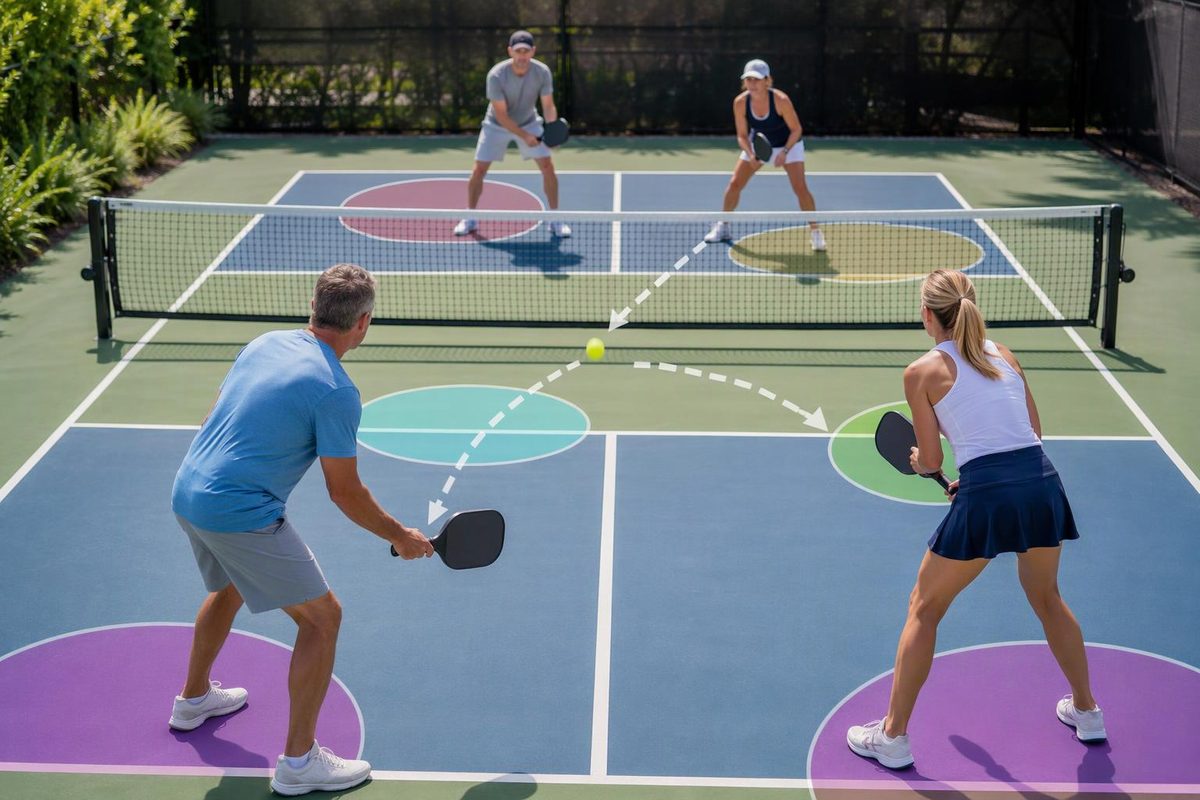
Only the serve has to go diagonally into the opposite service court. It must clear the Kitchen—the non-volley zone—including its line. After the serve, your shots may go straight ahead, crosscourt or through the middle; the centerline does not restrict rally placement. The receiver must let the serve bounce, and the serving team must let the return bounce before either side can volley (hit before the bounce). Volleys remain subject to the Kitchen restrictions. These requirements appear in the 2026 USA Pickleball Official Rulebook, sections 7.E, 8, 10 and 11.
For recreational doubles, choose placement by the shot’s job: depth to hold opponents back, a soft Kitchen target to work forward, and a low contact or open gap to apply pressure. Aim at a useful area, not a perfect spot on a line.
A placement map for the whole point
Serve: deep within the correct service court
Start with a broad target in the deeper part of the diagonal service court. USA Pickleball suggests aiming two to three feet inside the baseline rather than at the line. Move that target farther in if you are missing long.
Once depth is reliable, test the receiver’s less comfortable side. Do not assume it is always the backhand. Watch whether your placement actually changes their contact or return. For the serving routine and mechanics, use the consistency-first serving guide.
Return: deep through the middle
Unlike the serve, your return can use the whole opposing court. A deep middle return is a useful default: it helps keep the serving team back while limiting their third-shot angles. USA Pickleball recommends this placement, again with a safe margin inside the baseline.
Give the return enough arc to help you move forward. If one opponent has an observably weaker third shot, shift the target toward that player—but preserve depth and margin rather than chasing a corner.
Drop: the middle of the Kitchen
A drop is a soft shot from farther back, intended to descend into the opponent’s Kitchen. When both opponents are at the Kitchen line, start with a generous middle target. USA Pickleball’s drop-placement guidance recommends the middle because it limits attacking angles; crosscourt is another option with more Kitchen distance along the ball’s path.
Judge more than the bounce location. Did the opponent meet the ball low, or did it float high enough to attack? A ball can land in your chosen area and still be too high. If you need help choosing the stroke itself, see third-shot drop or drive.
Dink: crosscourt, with the middle as a change
A dink is a soft shot played near the net into the opponent’s Kitchen. At the Kitchen line, use a crosscourt target near the diagonal opponent’s outside foot—the foot nearer the sideline—without aiming on the sideline itself. Mix in a middle dink rather than repeating the same angle. Both placements feature in USA Pickleball’s level-three guidance.
Your goal is an uncomfortable low reply, not a sideline winner. When stretched wide, make the target larger and recover your position before trying to create another angle.
Drives and volleys: feet or a genuine opening
Look at where the opponents are now. A player moving through midcourt presents a useful feet target: USA Pickleball’s positioning guidance identifies that area as vulnerable to downward shots at the feet. Its skill-level descriptions also identify directing volleys toward opponents’ feet as a placement skill.
For a drive—a firm shot after the bounce—or an attacking volley, choose a low target near the feet or an open gap when you can reach it under control. Leave room inside the lines. Do not force a hard upward shot merely because you spotted space. If a fast ball jams you, simplify: use a controlled block or soft reset into the Kitchen instead of demanding a precise winner.
Practice placement through a point
Setup: Four players use the full doubles court. Agree on three broad areas: deep service court, deep middle and middle Kitchen. Use court landmarks rather than objects in players’ running paths.
- Play ten points with one planned sequence: deep serve, deep-middle return, then a middle drop when suitable. Play out each rally normally.
- Switch serving and receiving roles and repeat.
- During Kitchen exchanges, mix crosscourt and middle dinks. Attack only when the incoming ball gives you a manageable opportunity.
Checkpoint: After each point, name one target and its effect: “The return kept them back,” “The drop floated high,” or “The dink made them move.” Record target hits separately from faults. If narrower placement adds misses without changing the reply, enlarge the target before adding pace.